Sponsored
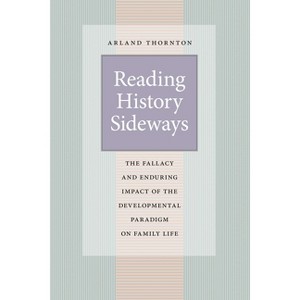
Reading History Sideways - (Population and Development) by Arland Thornton (Paperback)
In Stock
Sponsored
About this item
Highlights
- European and American scholars from the eighteenth through the mid-twentieth centuries thought that all societies passed through the same developmental stages, from primitive to advanced.
- About the Author: Arland Thornton is professor of sociology and a research professor at the Institute for Social Research at the University of Michigan.
- 322 Pages
- Social Science, Sociology
- Series Name: Population and Development
Description
Book Synopsis
European and American scholars from the eighteenth through the mid-twentieth centuries thought that all societies passed through the same developmental stages, from primitive to advanced. Implicit in this developmental paradigm-one that has affected generations of thought on societal development-was the assumption that one could "read history sideways." That is, one could see what the earlier stages of a modern Western society looked like by examining contemporaneous so-called primitive societies in other parts of the world.
In Reading History Sideways, leading family scholar Arland Thornton demonstrates how this approach, though long since discredited, has permeated Western ideas and values about the family. Further, its domination of social science for centuries caused the misinterpretation of Western trends in family structure, marriage, fertility, and parent-child relations. Revisiting the "developmental fallacy," Thornton here traces its central role in changes in the Western world, from marriage to gender roles to adolescent sexuality. Through public policies, aid programs, and colonialism, it continues to reshape families in non-Western societies as well.
From the Back Cover
European and American scholars from the eighteenth through the mid-twentieth centuries thought that all societies passed through the same developmental stages, from primitive to advanced. Implicit in this developmental paradigm--one that has affected generations of thought on societal development--was the assumption that one could "read history sideways." That is, one could see what the earlier stages of a modern Western society looked like by examining contemporaneous so-called primitive societies in other parts of the world.
In Reading History Sideways, leading family scholar Arland Thornton demonstrates how this approach, though long since discredited, has permeated Western ideas and values about the family. Further, its domination of social science for centuries caused the misinterpretation of Western trends in family structure, marriage, fertility, and parent-child relations. Revisiting the "developmental fallacy," Thornton here traces its central role in changes in the Western world, from marriage to gender roles to adolescent sexuality. Through public policies, aid programs, and colonialism, it continues to reshape families in non-Western societies as well.
Review Quotes
"Reading History Sideways is an intellectual feast. Arland Thornton systematically and meticulously reviews the conceptual frameworks that have been used to study family histories and the forces in history that have shaped family life and family values. Remarkable in its breadth and depth, Thornton's contribution lies in his assessment of sophisticated theoretical models and insights about family history, blended with a detailed review of cross-national empirical evidence."--Calvin Goldscheider, Brown University
"An exceptional work. Thornton's intellectual breadth is remarkable, as is the creativity of his argument and the evidence he marshals for it. His ideas are strikingly original and extremely important, and his argument is careful and thoughtful. This book should be read by policymakers, members of the diplomatic community, those connected with the World Bank or the International Monetary Fund, heads of NGOs working around the world, family planning organizations, and anyone concerned with America's role as a world leader."--Linda Waite, University of Chicago
"Reading History Sideways is an intellectual gem from one of America's leading family sociologists. Arland Thornton convincingly demonstrates that theorizing about the processes of family change over several centuries was based upon faulty evidence drawn not from past history, but from contemporary 'primitive' societies. The resulting notion that there is a developmental sequence from extended to nuclear family living has been extraordinarily influential. Hopefully this new book will finally undermine the intellectual dominance of the developmental paradigm in studying family change."--Martin K. Whyte, Harvard University
"The importance of this book is that it shows the enduring power of widespread and shared misconceptions of progress-both how progress is conceptualized and how it occurs. We learn that despite fatal flaws in the developmental model, it was exported far beyond Europe. Thornton wisely documents only one aspect of the developmental model, the assumed history of western family structure, a focus which permits him to provide abundant and convincing evidence. His book suggests that others might follow his example and examine whether there are also misconceptions about democracy and women's rights as routes to success."--Susan C. Watkins, University of Pennsylvania
"This is a much needed book about powerful conceptual frameworks that have been profoundly influential for centuries. . . . An impressive cultural tour de force. Reading History Sideways should be compulsory reading for any scholar working on families, especially demographers and family historians."--Silvia Sovic "Population Studies"
About the Author
Arland Thornton is professor of sociology and a research professor at the Institute for Social Research at the University of Michigan. He is the author or coauthor of several books, including Marriage and Cohabitation and Social Change and the Family in Taiwan, both also published by the University of Chicago Press.
Shipping details
Return details
Frequently bought together





Trending Non-Fiction




Discover more options