This volume takes an enlightened step back from the ongoing discussion of globalization.
About the Author: GEORGI M. DERLUGUIAN is Assistant Professor of Sociology at Northwestern University.
264 Pages
Political Science, International Relations
Series Name: Studies in the Political Economy of the World-System
Description
About the Book
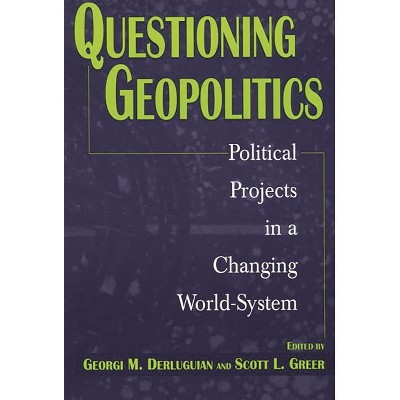
This volume takes an enlightened step back from the ongoing discussion of globalization. The authors reject the notion that globalization is an analytically useful term. Rather, this volume shows globalization as merely the framework of the current political debate on the future of world power. Some of the many other novel ideas advanced by the authors include: the explicit prediction that East Asia is not going to become the center of the world; the contention that the USSR collapsed for the same reasons that nearly brought down the United States in 1973; and the notion that the regional economic networks that are emerging from under the modern states are in fact rather old formations.
The articles in the volume are organized around three main themes. Part One explores both the changing patterns of global power from the viewpoint of geopolitics and the Gramscian approach to the study of international relations. Part Two further develops the debate among a number of eminent historians and sociologists challenging both the apologists for and the opponents of globalization in new and unexpected ways. Part Three traces the emergence of regional economic networks and explores the ambiguous problems of security and identity posed by the old-new transborder formations.
Book Synopsis
This volume takes an enlightened step back from the ongoing discussion of globalization. The authors reject the notion that globalization is an analytically useful term. Rather, this volume shows globalization as merely the framework of the current political debate on the future of world power. Some of the many other novel ideas advanced by the authors include: the explicit prediction that East Asia is not going to become the center of the world; the contention that the USSR collapsed for the same reasons that nearly brought down the United States in 1973; and the notion that the regional economic networks that are emerging from under the modern states are in fact rather old formations.
The articles in the volume are organized around three main themes. Part One explores both the changing patterns of global power from the viewpoint of geopolitics and the Gramscian approach to the study of international relations. Part Two further develops the debate among a number of eminent historians and sociologists challenging both the apologists for and the opponents of globalization in new and unexpected ways. Part Three traces the emergence of regional economic networks and explores the ambiguous problems of security and identity posed by the old-new transborder formations.
Review Quotes
.,."in the hands of a thougtful instructor, this volume might make a very useful graduate seminar textbook on global political economy precisely by forcing students to ask methodological questions concerning the various assumptions that structure each chapter's approach."-Contemporary Sociology
?...in the hands of a thougtful instructor, this volume might make a very useful graduate seminar textbook on global political economy precisely by forcing students to ask methodological questions concerning the various assumptions that structure each chapter's approach.?-Contemporary Sociology
?Theoretically rich and stylistically impeccable, this book sharply challenges much established wisdom and makes invaluable reading for students.?-Journal of Peace Research
"Theoretically rich and stylistically impeccable, this book sharply challenges much established wisdom and makes invaluable reading for students."-Journal of Peace Research
..."in the hands of a thougtful instructor, this volume might make a very useful graduate seminar textbook on global political economy precisely by forcing students to ask methodological questions concerning the various assumptions that structure each chapter's approach."-Contemporary Sociology
About the Author
GEORGI M. DERLUGUIAN is Assistant Professor of Sociology at Northwestern University. In the last decade his research focus has shifted from early modern Portuguese exploration to patterns of state collapse and guerrilla mobilization in Mozambique, Karabagh, and Chechnya.
SCOTT L. GREER is a doctoral candidate in political science at Northwestern University, currently writing a dissertation on regionalism and the politics of territorial government in Western Europe. His research includes studies of French politics and the politics of health care.
Dimensions (Overall): 9.46 Inches (H) x 6.42 Inches (W) x .98 Inches (D)
Weight: 1.33 Pounds
Suggested Age: 22 Years and Up
Number of Pages: 264
Genre: Political Science
Sub-Genre: International Relations
Series Title: Studies in the Political Economy of the World-System
Publisher: Praeger
Theme: General
Format: Hardcover
Author: Georgi M Derluguian & Scott L Greer
Language: English
Street Date: August 30, 2000
TCIN: 1008775756
UPC: 9780313310829
Item Number (DPCI): 247-06-1774
Origin: Made in the USA or Imported
If the item details aren’t accurate or complete, we want to know about it.
Shipping details
Estimated ship dimensions: 0.98 inches length x 6.42 inches width x 9.46 inches height
Estimated ship weight: 1.33 pounds
We regret that this item cannot be shipped to PO Boxes.
This item cannot be shipped to the following locations: American Samoa (see also separate entry under AS), Guam (see also separate entry under GU), Northern Mariana Islands, Puerto Rico (see also separate entry under PR), United States Minor Outlying Islands, Virgin Islands, U.S., APO/FPO
Return details
This item can be returned to any Target store or Target.com.
This item must be returned within 90 days of the date it was purchased in store, shipped, delivered by a Shipt shopper, or made ready for pickup.