Target New ArrivalsGift Ideas for MomClothing, Shoes & AccessoriesHome & DecorKitchen & DiningOutdoor Living & GardenGroceryHousehold EssentialsBabyBeautyPersonal CareHealthWellnessLuggageSports & OutdoorsToysElectronicsVideo GamesMovies, Music & BooksSchool & Office SuppliesParty SuppliesGift IdeasGift CardsPetsUlta Beauty at TargetShop by CommunityTarget OpticalDealsClearanceTarget New ArrivalsSpring OutfitsGift Ideas for MomWomen’s Festival OutfitsTop DealsTarget Circle DealsWeekly AdShop Order PickupShop Same Day DeliveryRegistryRedCardTarget CircleFind Stores
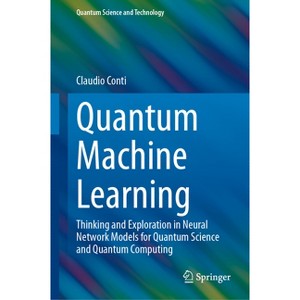
Quantum Machine Learning - (Quantum Science and Technology) by  Claudio Conti (Hardcover) - 1 of 1

Quantum Machine Learning - (Quantum Science and Technology) by Claudio Conti (Hardcover)

$129.36Save $10.63 (8% off)

In Stock

Free & easy returns

Free & easy returns

Return this item by mail or in store within 90 days for a full refund.
Eligible for registries and wish lists

About this item

Highlights

  • About the Author: Claudio Conti is an associate professor at the Department of Physics of the University Sapienza of Rome.
  • 378 Pages
  • Science, Physics
  • Series Name: Quantum Science and Technology

Description


From the Back Cover


This book presents a new way of thinking about quantum mechanics and machine learning by merging the two. Quantum mechanics and machine learning may seem theoretically disparate, but their link becomes clear through the density matrix operator which can be readily approximated by neural network models, permitting a formulation of quantum physics in which physical observables can be computed via neural networks. As well as demonstrating the natural affinity of quantum physics and machine learning, this viewpoint opens rich possibilities in terms of computation, efficient hardware, and scalability. One can also obtain trainable models to optimize applications and fine-tune theories, such as approximation of the ground state in many body systems, and boosting quantum circuits' performance. The book begins with the introduction of programming tools and basic concepts of machine learning, with necessary background material from quantum mechanics and quantum information also provided. This enables the basic building blocks, neural network models for vacuum states, to be introduced. The highlights that follow include: non-classical state representations, with squeezers and beam splitters used to implement the primary layers for quantum computing; boson sampling with neural network models; an overview of available quantum computing platforms, their models, and their programming; and neural network models as a variational ansatz for many-body Hamiltonian ground states with applications to Ising machines and solitons. The book emphasizes coding, with many open source examples in Python and TensorFlow, while MATLAB and Mathematica routines clarify and validate proofs. This book is essential reading for graduate students and researchers who want to develop both the requisite physics and coding knowledge to understand the rich interplay of quantum mechanics and machine learning.


About the Author


Claudio Conti is an associate professor at the Department of Physics of the University Sapienza of Rome. He authored over 250 articles in many fields, such as quantum physics, photonics, nonlinear science, biophysics, and complexity. His activity includes experiments and theory, such as the first observation of replica symmetry breaking mentioned in the scientific background of the Nobel prize in physics in 2021, the investigation of neuromorphic computing by quantum fluids, and the optical acceleration of natural language processing. Claudio Conti coordinates an experimental and theoretical group in Rome exploring the frontiers of artificial intelligence and physics.
Dimensions (Overall): 9.21 Inches (H) x 6.14 Inches (W) x .94 Inches (D)
Weight: 1.63 Pounds
Suggested Age: 22 Years and Up
Number of Pages: 378
Series Title: Quantum Science and Technology
Genre: Science
Sub-Genre: Physics
Publisher: Springer
Theme: Quantum Theory
Format: Hardcover
Author: Claudio Conti
Language: English
Street Date: January 3, 2024
TCIN: 91633448
UPC: 9783031442254
Item Number (DPCI): 247-38-1326
Origin: Made in the USA or Imported
If the item details aren’t accurate or complete, we want to know about it.

Shipping details

Estimated ship dimensions: 0.94 inches length x 6.14 inches width x 9.21 inches height
Estimated ship weight: 1.63 pounds
We regret that this item cannot be shipped to PO Boxes.
This item cannot be shipped to the following locations: American Samoa (see also separate entry under AS), Guam (see also separate entry under GU), Northern Mariana Islands, Puerto Rico (see also separate entry under PR), United States Minor Outlying Islands, Virgin Islands, U.S., APO/FPO, Alaska, Hawaii

Return details

This item can be returned to any Target store or Target.com.
This item must be returned within 90 days of the date it was purchased in store, delivered to the guest, delivered by a Shipt shopper, or picked up by the guest.
See the return policy for complete information.

Q: What can neural network models optimize in quantum circuits?

submitted by AI Shopping Assistant - 1 month ago
  • A: Neural network models can optimize applications and enhance the performance of quantum circuits.

    submitted byAI Shopping Assistant - 1 month ago
    Ai generated

Q: What concepts does the book merge together?

submitted by AI Shopping Assistant - 1 month ago
  • A: The book merges quantum mechanics and machine learning to create new computational perspectives.

    submitted byAI Shopping Assistant - 1 month ago
    Ai generated

Q: Who is the author of this book?

submitted by AI Shopping Assistant - 1 month ago
  • A: The author is Claudio Conti, an associate professor at the University Sapienza of Rome.

    submitted byAI Shopping Assistant - 1 month ago
    Ai generated

Q: What programming tools are discussed in the book?

submitted by AI Shopping Assistant - 1 month ago
  • A: The book covers open-source coding examples in Python and TensorFlow, along with MATLAB and Mathematica.

    submitted byAI Shopping Assistant - 1 month ago
    Ai generated

Q: What is the target audience for this book?

submitted by AI Shopping Assistant - 1 month ago
  • A: The book is intended for graduate students and researchers interested in quantum mechanics and machine learning.

    submitted byAI Shopping Assistant - 1 month ago
    Ai generated

Additional product information and recommendations

Discover more options

Trending Education Books

Get top deals, latest trends, and more.

Privacy policy