Sponsored
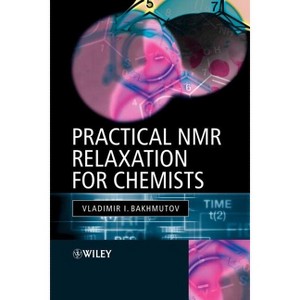
Practical NMR Relaxation for Chemists - by Vladimir I Bakhmutov Paperback
In Stock
Sponsored
About this item
Highlights
- This book demonstrates how NMR relaxation can be applied for structural diagnostics of chemical compounds, recognition of weak intermolecular interactions, determinations of internuclear distances and lengths of chemical bonds when compounds under investigation can exist only in solutions.
- About the Author: Dr. Vladimir I. Bakhmutov is a professional NMR spectroscopist at the Department of Chemistry, Texas A&M University, USA.
- 224 Pages
- Science, Chemistry
Description
Book Synopsis
This book demonstrates how NMR relaxation can be applied for structural diagnostics of chemical compounds, recognition of weak intermolecular interactions, determinations of internuclear distances and lengths of chemical bonds when compounds under investigation can exist only in solutions.
- Written as a textbook for chemists, demanding little background in physics and NMR
- Its practical approach helps the reader to apply the techniques in the lab
- First book to teach NMR Relaxation techniques to chemists
From the Back Cover
This book was written by an expert with long researching and teaching experience and is based on University NMR courses given in Russia, France, Spain, Switzerland and the USA. It is suitable both as a textbook for advanced undergraduate students and graduate students encountering nuclear magnetic relaxation for the first time, and also for professional researchers already actively using NMR spectroscopy in synthetic, physical, biological, pharmaceutical and industrial chemistry.
The book can be divided into two sections: chapters 1-6 teaching the basics and chapters 7-12 dealing with applications. Each chapter is referenced and includes well-organized illustrative material. The chapters in the first section deal with the basic theory of nuclear relaxation as physical phenomenon and are written in a simple and accessible form, thus readers do not need specialist knowledge of physics and NMR. As well as the theory behind nuclear relaxation this section considers important methodical aspects of relaxation experiments and analyzes their typical errors and problems. The aim of section is to overcome a situation where NMR is regarded by chemists as a 'black box'. Chapters 7-11 provide practical examples of 1D and 2D NMR relaxation experiments and show how nuclear relaxation can be applied to qualitative structural diagnostics in solutions, quantitative structural investigations of diamagnetic and paramagnetic molecular systems, studies of weak intermolecular interactions, molecular mobility and chemical exchanges.
Review Quotes
"...appropriate for use in an advanced undergraduate or graduate level course on this topic...an excellent starting point for an investigator who would like to begin using relaxation-based NMR experiments." (Journal of Natural Products, January 2006)
"...should be very useful to students and to researchers who use NMR." (CHOICE, September 2005)
About the Author
Dr. Vladimir I. Bakhmutov is a professional NMR spectroscopist at the Department of Chemistry, Texas A&M University, USA. He is also the author of 220 scientific publications including reviews and book chapters.
Shipping details
Return details
Trending Non-Fiction