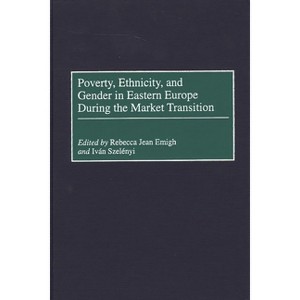
This provocative volume is the first book to offer an extensive examination of the nature of poverty and its relationship to gender and ethnicity in five post-communist societies.
About the Author: Rebecca Jean Emigh is an Assistant Professor of Sociology at UCLA.
216 Pages
Social Science, Minority Studies
Description
About the Book
This provocative volume is the first book to offer an extensive examination of the nature of poverty and its relationship to gender and ethnicity in five post-communist societies. As nations make the difficult transition from socialism to capitalism, the extent and nature of poverty tends to change and, because of this, the proportion of the population living in poverty tends to change. As a result, the proportion of the population living in poverty has increased sharply in these countries. The contributors contend that a new poverty is in the making and that the growing underclass is strongly related to ethnicity, as such an underclass is more likely to form if there is a sizeable Roma (Gypsy) minority. The question of whether gender interacts with poverty the same way ethnicity does is the subject of intense controversy and is addressed here in lucid, accessible prose. In this comprehensive analysis of the interaction between poverty, ethnicity, and gender in East European transitional societies, the contributors thoughtfully address the relevant issues and relationships and conclude that poverty has become deeper and increasingly long-term in Eastern European nations.
Although it is clear that poverty increased in Eastern Europe during the market transition, the extent and nature of the changes have not yet been illuminated. Covering Bulgaria, Hungary, Poland, Romania, and Slovakia, the contributors analyze the interaction between poverty, ethnicity, and gender in an effort to explain the changing nature of poverty and the formation of an underclass in these countries. Roma (Gypsies) arise as the most likely candidates for membership in the new underclass, as they were always economically disadvantaged and the targets of discriminatory practices. On the other hand, however because they were often better educated than men during socialism, women may have been relatively advantaged, at least temporarily, during the market transition. Thus while poverty may be racialized during the transformation, it may not yet be feminized. In this comparative assessment of social trends in this region, the contributors consider what they mean for the countries where they occur.
Book Synopsis
This provocative volume is the first book to offer an extensive examination of the nature of poverty and its relationship to gender and ethnicity in five post-communist societies. As nations make the difficult transition from socialism to capitalism, the extent and nature of poverty tends to change and, because of this, the proportion of the population living in poverty tends to change. As a result, the proportion of the population living in poverty has increased sharply in these countries. The contributors contend that a new poverty is in the making and that the growing underclass is strongly related to ethnicity, as such an underclass is more likely to form if there is a sizeable Roma (Gypsy) minority. The question of whether gender interacts with poverty the same way ethnicity does is the subject of intense controversy and is addressed here in lucid, accessible prose. In this comprehensive analysis of the interaction between poverty, ethnicity, and gender in East European transitional societies, the contributors thoughtfully address the relevant issues and relationships and conclude that poverty has become deeper and increasingly long-term in Eastern European nations.
Although it is clear that poverty increased in Eastern Europe during the market transition, the extent and nature of the changes have not yet been illuminated. Covering Bulgaria, Hungary, Poland, Romania, and Slovakia, the contributors analyze the interaction between poverty, ethnicity, and gender in an effort to explain the changing nature of poverty and the formation of an underclass in these countries. Roma (Gypsies) arise as the most likely candidates for membership in the new underclass, as they were always economically disadvantaged and the targets of discriminatory practices. On the other hand, however because they were often better educated than men during socialism, women may have been relatively advantaged, at least temporarily, during the market transition. Thus while poverty may be racialized during the transformation, it may not yet be feminized. In this comparative assessment of social trends in this region, the contributors consider what they mean for the countries where they occur.
About the Author
Rebecca Jean Emigh is an Assistant Professor of Sociology at UCLA. She has published numerous articles on economic sociology and historical sociology, among other topics.
Iván Szelényi is William Graham Sumner Professor of Sociology and Professor of Political Science at Yale University. He is author or coauthor of The Intellectuals on the Road to Class Power (1979), Urban Inequalities (1983), Socialist Entrepreneurs (1988), and Making Capitalism Without Capitalists (1998). He has also published numerous papers in leading journals.
Dimensions (Overall): 9.48 Inches (H) x 6.32 Inches (W) x .83 Inches (D)
Weight: 1.14 Pounds
Suggested Age: 22 Years and Up
Number of Pages: 216
Genre: Social Science
Sub-Genre: Minority Studies
Publisher: Praeger
Format: Hardcover
Author: Rebecca J Emigh & Ivan Szelenyi
Language: English
Street Date: November 30, 2000
TCIN: 1005058934
UPC: 9780275968816
Item Number (DPCI): 247-29-0637
Origin: Made in the USA or Imported
If the item details aren’t accurate or complete, we want to know about it.
Shipping details
Estimated ship dimensions: 0.83 inches length x 6.32 inches width x 9.48 inches height
Estimated ship weight: 1.14 pounds
We regret that this item cannot be shipped to PO Boxes.
This item cannot be shipped to the following locations: American Samoa (see also separate entry under AS), Guam (see also separate entry under GU), Northern Mariana Islands, Puerto Rico (see also separate entry under PR), United States Minor Outlying Islands, Virgin Islands, U.S., APO/FPO
Return details
This item can be returned to any Target store or Target.com.
This item must be returned within 90 days of the date it was purchased in store, shipped, delivered by a Shipt shopper, or made ready for pickup.