Sponsored
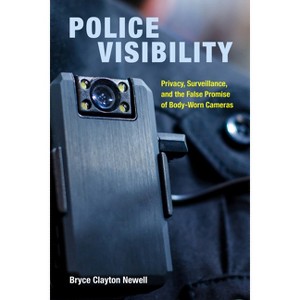
Police Visibility - by Bryce Clayton Newell Paperback
In Stock
Sponsored
About this item
Highlights
- Police Visibility presents empirically grounded research into how police officers experience and manage the information politics of surveillance and visibility generated by the introduction of body cameras into their daily routines and the increasingly common experience of being recorded by civilian bystanders.
- About the Author: Bryce Clayton Newell is Assistant Professor of Media Law and Policy in the School of Journalism and Communication at the University of Oregon.
- 260 Pages
- Freedom + Security / Law Enforcement, Media & the Law
Description
About the Book
"Police Visibility presents empirically grounded research into how police officers experience and manage the information politics of surveillance and visibility generated by the introduction of body cameras into their daily routines and the increasingly common experience of being recorded by civilian bystanders. Newell elucidates how these activities intersect with privacy, free speech, and access to information law and argues that rather than being emancipatory systems of police oversight, body-worn cameras are an evolution in police image work and state surveillance expansion. Throughout the book, he catalogs how surveillance generates information, the control of which creates and facilitates power, and potentially fuels state domination. The antidote, he argues, is a robust information law and policy that puts the power to monitor and regulate the police squarely in the hands of citizens"--
Book Synopsis
Police Visibility presents empirically grounded research into how police officers experience and manage the information politics of surveillance and visibility generated by the introduction of body cameras into their daily routines and the increasingly common experience of being recorded by civilian bystanders. Newell elucidates how these activities intersect with privacy, free speech, and access to information law and argues that rather than being emancipatory systems of police oversight, body-worn cameras are an evolution in police image work and state surveillance expansion. Throughout the book, he catalogs how surveillance generates information, the control of which creates and facilitates power and potentially fuels state domination. The antidote, he argues, is robust information law and policy that puts the power to monitor and regulate the police squarely in the hands of citizens.
From the Back Cover
"There is a growing literature on the perils as well as harm prevention potential of police regulation by recording. As a scholar of information studies, Bryce Newell offers intriguing theoretical and philosophical frames attentive to information politics and informed by fieldwork."--Mary D. Fan, author of Camera Power: Policing, Proof, Privacy, and Audiovisual Big Data
"Significantly advances our understanding of police and society and the politics of information under the deluge of creeping (or perhaps better) galloping new surveillance technologies. Newell's clear-headed interdisciplinary exploration drops gentle rain on the arid parade of unreflective, optimistic narratives, viewing police-worn cameras and their visual records as salvation. A foundational text for scholars and practitioners."--Gary T. Marx, author of Windows Into the Soul: Surveillance and Society in an Age of High Technology
Review Quotes
"Bryce Newell has produced a well-researched study. . . .for those researching and writing on the efficacy and potential pitfalls of police [body-worn cameras]s, Newell's necessary and impressive work should be your starting point."-- "Criminal Law and Criminal Justice Books"
"An exemplary case of an ethnography of a particularly difficult to reach group."-- "Surveillance & Society"
"Newell's informed recommendations move the policy conversation in a productive direction. They serve as an important bulwark against the 'surveil now, ask questions later' ethos undergirding much of the body camera policies currently in place."
-- "Jotwell"About the Author
Bryce Clayton Newell is Assistant Professor of Media Law and Policy in the School of Journalism and Communication at the University of Oregon. He is the editor of Police on Camera, Privacy in Public Space, and Surveillance, Privacy, and Public Space.
Shipping details
Return details
Frequently bought together



Trending Non-Fiction



Discover more options