Sponsored
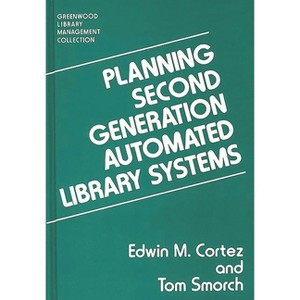
Planning Second Generation Automated Library Systems - (Libraries Unlimited Library Management Collection) by Edwin Cortez & Tom Smorch (Hardcover)
In Stock
Sponsored
About this item
Highlights
- This guide focuses on the implementation and management of second-generation automated library systems.
- About the Author: EDWIN M. CORTEZ is an Associate Professor in the School of Library and Information Sciences at the University of Wisconsin-Madison.
- 248 Pages
- Language + Art + Disciplines, Library & Information Science
- Series Name: Libraries Unlimited Library Management Collection
Description
About the Book
This guide focuses on the implementation and management of second-generation automated library systems. It advances knowledge of the field by describing the migration path of library automated systems. Specifically, the book is intended to give practical directions in procuring a replacement library automated system. As such, the text reviews new approaches to library automation which rely on knowledge gained over the past two decades. In charting the procurement process, the book indicates how to migrate the library's database. It discusses state-of-the-art technology such as scanning and imaging devices, and provides descriptions and analyses of telecommunications and networking technology and issues.
This book is intended as an automation planning guide for librarians and library administrators. The book expands the subject to include special, public and academic libraries and takes into account the experience of those libraries which have already automated and are now considering migration to more powerful automated library systems. Special attention is given to integrated library systems and to innovative and still-emerging technologies which complement these systems. No other text exists that is written at a level that acknowledges the increased sophistication of librarians with automation.
Book Synopsis
This guide focuses on the implementation and management of second-generation automated library systems. It advances knowledge of the field by describing the migration path of library automated systems. Specifically, the book is intended to give practical directions in procuring a replacement library automated system. As such, the text reviews new approaches to library automation which rely on knowledge gained over the past two decades. In charting the procurement process, the book indicates how to migrate the library's database. It discusses state-of-the-art technology such as scanning and imaging devices, and provides descriptions and analyses of telecommunications and networking technology and issues.
This book is intended as an automation planning guide for librarians and library administrators. The book expands the subject to include special, public and academic libraries and takes into account the experience of those libraries which have already automated and are now considering migration to more powerful automated library systems. Special attention is given to integrated library systems and to innovative and still-emerging technologies which complement these systems. No other text exists that is written at a level that acknowledges the increased sophistication of librarians with automation.
Review Quotes
.,."provides a good academic overview of the process of replacing an automated library system."-Canadian Journal of Information and Library Science
?...provides a good academic overview of the process of replacing an automated library system.?-Canadian Journal of Information and Library Science
?A concise and timely summary of experience and wisdom that librarians have gained in a computerized environment. Especially valuable are chapters on hardware and software, special automation needs, and networking and connectivity issues.?-RQ
?It is certainly recommended reading for anyone involved with the automated library system or the procurement processes in a library about to embark on this journey.?-Library Software Review
..."provides a good academic overview of the process of replacing an automated library system."-Canadian Journal of Information and Library Science
"It is certainly recommended reading for anyone involved with the automated library system or the procurement processes in a library about to embark on this journey."-Library Software Review
"A concise and timely summary of experience and wisdom that librarians have gained in a computerized environment. Especially valuable are chapters on hardware and software, special automation needs, and networking and connectivity issues."-RQ
About the Author
EDWIN M. CORTEZ is an Associate Professor in the School of Library and Information Sciences at the University of Wisconsin-Madison.
TOM SMORCH is a library automation supervisor in California.
Shipping details
Return details
Trending Non-Fiction