Sponsored
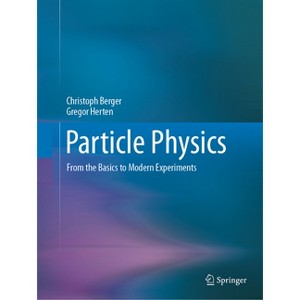
Particle Physics - 2nd Edition by Christoph Berger & Gregor Herten Paperback
In Stock
Sponsored
About this item
Highlights
- This textbook provides an introduction from the basics to modern experiments and the latest developments in particle physics.
- About the Author: Christoph Berger, born in 1939, received his Ph.D. in Bonn in 1968 and his habilitation in Aachen in 1973.
- 653 Pages
- Science, Physics
Description
Book Synopsis
This textbook provides an introduction from the basics to modern experiments and the latest developments in particle physics. Experimental tools such as accelerators and detectors, as well as symmetry principles and their applications, are also thoroughly presented. Additionally, the Standard Model--which largely dominates today's experimental and theoretical discussions--is introduced. This book explains essential areas of quantum electrodynamics, the quark model, quantum chromodynamics, and the electroweak theory. The Lagrangian formalism formulates the Standard Model as a gauge theory, and the Higgs mechanism is described in detail. Extensive chapters on hadron collider physics and neutrino physics connect to current research and explore possible extensions of the Standard Model in light of recent experimental results. The appealing design of the textbook and the 207 exercises with solution hints and supplements as Jupyter Notebooks on GitHub serve for further in-depth study.
From the Back Cover
This textbook provides an introduction from the basics to modern experiments and the latest developments in particle physics. Experimental tools such as accelerators and detectors, as well as symmetry principles and their applications, are also thoroughly presented. Additionally, the Standard Model--which largely dominates today's experimental and theoretical discussions--is introduced.
This book explains essential areas of quantum electrodynamics, the quark model, quantum chromodynamics, and the electroweak theory. The Lagrangian formalism formulates the Standard Model as a gauge theory, and the Higgs mechanism is described in detail. Extensive chapters on hadron collider physics and neutrino physics connect to current research and explore possible extensions of the Standard Model in light of recent experimental results. The appealing design of the textbook and the 207 exercises with solution hints and supplements as Jupyter Notebooks on GitHub serve for further in-depth study.
Christoph Berger, born in 1939, received his Ph.D. in Bonn in 1968 and his habilitation in Aachen in 1973. From 1974 to 2004, he was a professor of high-energy physics at RWTH Aachen University. He had various research stays at DESY, CERN, and Cornell University.
Gregor Herten, born in 1955, received his Ph.D. in Aachen in 1983. From 1986 to 1992, he was a professor at MIT, Cambridge, USA, and from 1992 to 2023, a professor of physics at the University of Freiburg. He had research stays at DESY and CERN.
About the Author
Christoph Berger, born in 1939, received his Ph.D. in Bonn in 1968 and his habilitation in Aachen in 1973. From 1974 to 2004, he was a professor of high-energy physics at RWTH Aachen University. He had various research stays at DESY, CERN, and Cornell University. Gregor Herten, born in 1955, received his Ph.D. in Aachen in 1983. From 1986 to 1992, he was a professor at MIT, Cambridge, USA, and from 1992 to 2023, a professor of physics at the University of Freiburg. He had research stays at DESY and CERN.
Shipping details
Return details
Trending Non-Fiction