Sponsored
About this item
Highlights
- Discusses EU member state institutions that take their decisions either by unanimity or by qualified majority (about two-thirds) This book discusses several EU intuitions based upon how they vote.
- About the Author: Dr. Axel Huelsemeyer is Associate Professor in the Department of Political Science at Concordia University in Montreal, Canada.
- 178 Pages
- Political Science, World
Description
About the Book
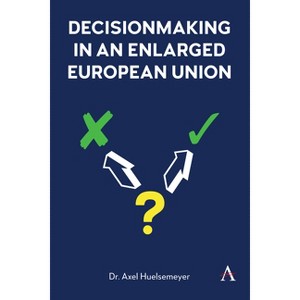
This book discusses EU member state institutions that vote either by unanimity or by two-thirds majority
Book Synopsis
Discusses EU member state institutions that take their decisions either by unanimity or by qualified majority (about two-thirds)
This book discusses several EU intuitions based upon how they vote. Two of the seven official EU institutions represent only the member states: they are the European Council (27 heads of state or government) and the Council of the European Union (government ministers from the member states, e.g., 27 agricultural ministers). First, the so-called European Council exclusively decides by unanimity. The extant literature holds that this slows down the decisionmaking process considerably, as the number of member states increases. This is the case because any given member country could take all others "hostage" by refusing to consent without extracting concessions.
On the other end of the spectrum, the so-called Council of the European Union takes the vast majority of its decisions by what is termed qualified majority--55% of the members (i.e., with the current 27 countries, this means 15) representing at least 65% of the total EU population. In this case, the former hostage holders can now simply be outvoted. Hence, the latter European Union institution could be a likely candidate for a practical solution to the unanimity-voting quagmire.
Review Quotes
"Decisionmaking in an Enlarged European Union is a very readable introduction to the European Union. It is up-to-date and useful for readers unfamiliar with the institu-tional and governance structures of the enlarging EU. As the geopolitical winds change, the book should feature prominently on bookshelves and in libraries across the globe." -- Amy Verdun, Professor of Political Science, the University of Victoria, and Guest Professor, Leiden University, The Netherlands
"Decisionmaking in an Enlarged European Union explores the institutions of the EU in connection with their rules concerning unanimity versus qualified majority and with regard to a wide range of policies. The findings of this authoritative volume will be of interest to students of European Studies, Political Science, and many other fields." -- Patrick James, Dornsife Dean's Professor Emeritus of International Relations, the Univer-sity of Southern California
"This is a wide-ranging text that nicely introduces students to the academic study of the European Union. It is well-organized, thorough, clear, and up-to-date, making it an excellent companion to courses on the institutions and politics of European integration. Axel Huelsemeyer is to be congratulated on providing students with such a comprehensive introductory textbook." -- Randall Germain, Department of Political Science, Carleton University, Ottawa, ON
About the Author
Dr. Axel Huelsemeyer is Associate Professor in the Department of Political Science at Concordia University in Montreal, Canada.
Shipping details
Return details
Frequently bought together

Trending Non-Fiction