Sponsored
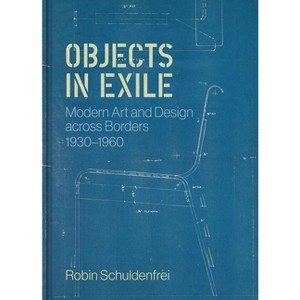
Objects in Exile - by Robin Schuldenfrei (Hardcover)
In Stock
Sponsored
About this item
Highlights
- An essential examination of how emigration and resettlement defined modernism In the fraught years leading up to World War II, many modern artists and architects emigrated from continental Europe to the United States and Britain.
- About the Author: Robin Schuldenfrei is the Tangen Reader in 20th-Century Modernism at the Courtauld Institute of Art, University of London.
- 352 Pages
- Art, History
Description
About the Book
"An innovative new history of how the migration of designers in the 20th century shaped modernist art and architecture"--
Book Synopsis
An essential examination of how emigration and resettlement defined modernism
In the fraught years leading up to World War II, many modern artists and architects emigrated from continental Europe to the United States and Britain. The experience of exile infused their modernist ideas with new urgency and forced them to use certain materials in place of others, modify existing works, and reconsider their approach to design itself. In Objects in Exile, Robin Schuldenfrei reveals how the process of migration was crucial to the development of modernism, charting how modern art and architecture was shaped by the need to constantly face--and transcend--the materiality of things.
Taking readers from the prewar era to the 1960s, Schuldenfrei explores the objects these émigrés brought with them, what they left behind, and the new works they completed in exile. She argues that modernism could only coalesce with the abandonment of national borders in a process of emigration and resettlement, and brings to life the vibrant postwar period when avant-garde ideas came together and emerged as mainstream modernism. Examining works by Walter Gropius, László Moholy-Nagy, Lucia Moholy, Herbert Bayer, Anni and Josef Albers, and others, Schuldenfrei demonstrates the social impact of art objects produced in exile.
Shedding critical light on how the pressures of dislocation irrevocably altered the course of modernism, Objects in Exile shows how artists and designers, forced into exile by circumstances beyond their control, changed in unexpected ways to meet the needs and contexts of an uncertain world.
Review Quotes
"Excellent. . . .Persuasive."---Hal Foster, London Review of Books
"Meticulously researched, Objects in Exile: Modern Art and Design across Borders, 1930-1960 provides a richly nuanced appraisal of European modernism's migration to America. [Schuldenfrei] makes generous use of the well-established literature and forges new directions."-- "Choice"
"Densely researched and thoughtfully illustrated."-- "Harvard Magazine"
"A fascinating account on the Modernist period in the history of art, the focal point of the analysis being on the significance of migration and its impact on Modernist ideas. Schuldenfrei details an absorbing account of how the Modernist legacy was developed and maintained, evidenced by stunning prints of various artworks and insightful records of exchanges between artists and critics across borders."---Lizzie Smolenskaia, Redbrick Culture
"Shortlisted for the Architectural Book Awards, Treatises Category"
"One of the most interesting and essential texts on modernism to be written in the last decade. . . . Schuldenfrei has made a fairly niche art historical subject incredibly approachable with brilliant but accessible text. . . . [Objects in Exile] is a phenomenally well researched and important text on the subject and should be required reading for anyone interested in modern art and design."---Angelina Lippert, New York Journal of Books
"Refreshingly anti-parochial. . . .Impressively done."---Owen Hatherley, Apollo: The International Art Magazine
"A thought-provoking read that sheds light on the hidden narratives of objects and their profound influence on our collective heritage."-- "Metropolis"
About the Author
Robin Schuldenfrei is the Tangen Reader in 20th-Century Modernism at the Courtauld Institute of Art, University of London. Her books include Luxury and Modernism: Architecture and the Object in Germany, 1900-1933 (Princeton), Iteration: Episodes in the Mediation of Art and Architecture, and Atomic Dwelling: Anxiety, Domesticity, and Postwar Architecture.
Shipping details
Return details
Frequently bought together
Trending Non-Fiction




Discover more options