Sponsored
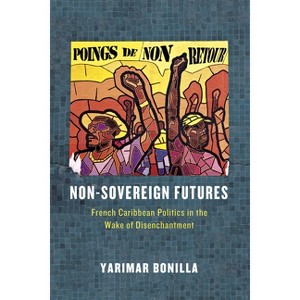
Non-Sovereign Futures - by Yarimar Bonilla Paperback
In Stock
Sponsored
About this item
Highlights
- As an overseas department of France, Guadeloupe is one of a handful of non-independent societies in the Caribbean that seem like political exceptions--or even paradoxes--in our current postcolonial era.
- About the Author: Yarimar Bonilla is associate professor of anthropology and Caribbean studies at Rutgers University.
- 232 Pages
- Social Science, Anthropology
Description
About the Book
In this book anthropologist Yarimar Bonilla examines labor activism in Guadeloupe as it sheds light on issues of colonialism and sovereignty. Specifically, she shows how Guadeloupean workers use ideas from anti-colonial resistance movements as part of their strategy to promote workers rights. She shows how concepts such as "marronage" or the legacy of the Caribbean rebel slave are worked into contemporary labor union discourse in order to develop a new, Guadeloupean political consciousness. Bonilla calls for a reevaluation of contemporary political theorizing about the Caribbean and suggests that her model of a non-sovereign future calls into question the idea that political entities like Guadeloupe are exceptional; rather, she argues, that notions of political sovereignty are deeply problematic, especially in the Caribbean with its long history of European and U.S. domination. Combining rigorous ethnographic research with a careful critique of so-called postcolonial sovereignty, Bonilla sets the standard for future anthropological work in Caribbean societies."
Book Synopsis
As an overseas department of France, Guadeloupe is one of a handful of non-independent societies in the Caribbean that seem like political exceptions--or even paradoxes--in our current postcolonial era. In Non-Sovereign Futures, Yarimar Bonilla wrestles with the conceptual arsenal of political modernity--challenging contemporary notions of freedom, sovereignty, nationalism, and revolution--in order to recast Guadeloupe not as a problematically non-sovereign site but as a place that can unsettle how we think of sovereignty itself.
Through a deep ethnography of Guadeloupean labor activism, Bonilla examines how Caribbean political actors navigate the conflicting norms and desires produced by the modernist project of postcolonial sovereignty. Exploring the political and historical imaginaries of activist communities, she examines their attempts to forge new visions for the future by reconfiguring narratives of the past, especially the histories of colonialism and slavery. Drawing from nearly a decade of ethnographic research, she shows that political participation--even in failed movements--has social impacts beyond simple material or economic gains. Ultimately, she uses the cases of Guadeloupe and the Caribbean at large to offer a more sophisticated conception of the possibilities of sovereignty in the postcolonial era.
Review Quotes
"Non-Sovereign Futures brilliantly asks us to reexamine what political sovereignty looks like by chronicling labor activists' visions of political and economic change in Guadeloupe. Here, history and memory make material the affective dimensions of belonging and struggle, and everyday performative practices and social experiences offer alternative modes of community formation and sociality to what has otherwise been an extremely high (foreign) consumerist orientation and a somewhat fragmented political base. For scholars and advocates now searching for the next political horizon for the Caribbean and beyond, Non-Sovereign Futures is provocative, illuminating, and necessary!"--Deborah A. Thomas, author of Exceptional Violence
About the Author
Yarimar Bonilla is associate professor of anthropology and Caribbean studies at Rutgers University.
Shipping details
Return details
Frequently bought together


Trending Non-Fiction





Discover more options