Sponsored
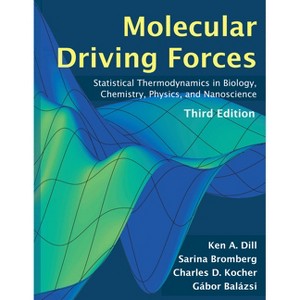
Molecular Driving Forces, Third Edition - by Ken Dill & Sarina Bromberg & Charles D Kocher & Gabor Balazsi (Paperback)
Pre-order
Sponsored
About this item
Highlights
- The comprehensively updated third edition of a popular introductory statistical thermodynamics text that describes the principles and forces that drive chemical and biological processes.
- About the Author: Ken Dill is a SUNY Distinguished Professor of Physics and Chemistry, Affiliated Distinguished Professor in Applied Math, the Louis and Beatrice Laufer Endowed Chair of Physical and Quantitative Biology, founding director of the Laufer Center for Physical and Quantitative Biology at Stony Brook, and coauthor of Protein Actions: Principles and Modeling.
- 832 Pages
- Science, Life Sciences
Description
Book Synopsis
The comprehensively updated third edition of a popular introductory statistical thermodynamics text that describes the principles and forces that drive chemical and biological processes.
This widely used, comprehensively updated introductory text on statistical thermodynamics describes the principles and forces that drive chemical and biological processes. It explains how a few simple physical principles cause the complex behaviors of molecules, and how simple models provide surprisingly accurate insights into the workings of the molecular world. Written in an accessible, student-friendly style without compromising rigor, Molecular Driving Forces offers an excellent introduction to the subject for beginners and a valuable resource for experts.
3rd edition highlights:
- New chapter on the nonequilibrium dynamics of driven, adaptive, and evolving systems
- New appendix on stochastic dynamics, including master equations and the Fokker-Planck model
- New vignettes on the Bayes Theorem, reverse osmosis membranes, and the chemiosmotic hypothesis
- Comprehensively updated examples, references, and end-of-chapter questions
- Instructor resources available
About the Author
Ken Dill is a SUNY Distinguished Professor of Physics and Chemistry, Affiliated Distinguished Professor in Applied Math, the Louis and Beatrice Laufer Endowed Chair of Physical and Quantitative Biology, founding director of the Laufer Center for Physical and Quantitative Biology at Stony Brook, and coauthor of Protein Actions: Principles and Modeling.
Sarina Bromberg holds a PhD in molecular biophysics and writes, edits, and illustrates scientific textbooks.
Charles D. Kocher is a Research Fellow at Memorial Sloan Kettering Cancer Center.
Gábor Balázsi is the Henry Laufer Professor of Physical and Quantitative Biology at Stony Brook University.
Shipping details
Return details
Frequently bought together






Trending Non-Fiction






Discover more options