Sponsored
In Stock
Sponsored
About this item
Highlights
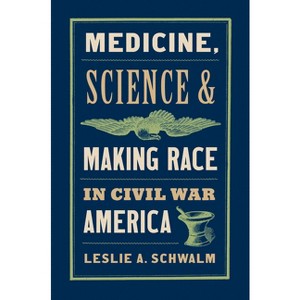
- This social and cultural history of Civil War medicine and science sheds important light on the question of why and how anti-Black racism survived the destruction of slavery.
- Author(s): Leslie A Schwalm
- 232 Pages
- Nature, Animals
Description
Book Synopsis
This social and cultural history of Civil War medicine and science sheds important light on the question of why and how anti-Black racism survived the destruction of slavery. During the war, white Northerners promoted ideas about Black inferiority under the guise of medical and scientific authority. In particular, the Sanitary Commission and Army medical personnel conducted wartime research aimed at proving Black medical and biological inferiority. They not only subjected Black soldiers and refugees from slavery to substandard health care but also scrutinized them as objects of study. This mistreatment of Black soldiers and civilians extended after life to include dissection, dismemberment, and disposal of the Black war dead in unmarked or mass graves and medical waste pits. Simultaneously, white medical and scientific investigators enhanced their professional standing by establishing their authority on the science of racial difference and hierarchy.
Drawing on archives of the U.S. Sanitary Commission, recollections of Civil War soldiers and medical workers, and testimonies from Black Americans, Leslie A. Schwalm exposes the racist ideas and practices that shaped wartime medicine and science. Painstakingly researched and accessibly written, this book helps readers understand the persistence of anti-Black racism and health disparities during and after the war.
Review Quotes
"A valuable expansion upon [George M. Frederickson]'s thesis, clearly documenting how Civil War organizations including the United States Sanitary Commission, military medicine, and the Army Medical Museum strengthened and deepened racial science. . . . I look forward to more studies like Schwalm's."--Journal of the Civil War Era
"An excellent, accessible teaching text. . . . [A] powerful and fairly argued study that conducts what historian Nell Painter has called a 'fully loaded cost accounting' of Civil War medicine."--Register of the Kentucky Historical Society
"An imaginatively researched, provocatively argued, and exceedingly readable book."--Journal of American History
"An important contribution to both the history of medicine and science and to critical studies of race and racism."-Journal of Ethnic and Racial Studies
"Leslie A. Schwalm has put her impressive skills to work. . . . While this story of commodifying Black people's bodies in the name of medicine may be familiar to specialists working in the history of race and medicine, it remains an instructive story that needs to be shared among scholars with broad interests in the Civil War, race, and the history of African American experiences in wartime."--Journal of Southern History
"Leslie A. Schwalm has written an important book that explores the ways white Northerners used medicine, anatomy, and race to ensure the subordination of black Americans following the Civil War."--H-Sci-Med-Tech
"Leslie A. Schwalm's impressive new book tells the story of another Civil War era advancement that casts a much darker shadow: the intensification of racial science in medicine. . . . Schwalm wisely focuses on Union physicians and medical personnel who, compared to their southern counterparts, were not as steeped in proslavery racial ideologies [which] helps Schwalm to demonstrate a marked increase of racial ideas in northern medical thinking, practice, and research, which occurred in the span of a few years."--Isis
"Schwalm . . . [makes] great effort to go into detail about the ways in which Black people and Black bodies were abused by scientists, doctors, slaveholders, circus owners, and spectators. . . . Schwalm [has] added valuable new analyses to the literature on the history of science."--Technology and Culture
"This deeply researched, engaging, and sensitively written book will surely appeal to anyone interested in the history of slavery, the Civil War, medicine, biopolitics and the state, and collecting and exhibiting. Schwalm draws from an impressive array of sources, including diaries, medical print culture, autopsy reports, social surveys, court-martial records, pension applications, as well as a number of visual sources, to craft a compelling narrative."-North Carolina Historical Review
Shipping details
Return details
Trending Non-Fiction




Discover more options