Sponsored
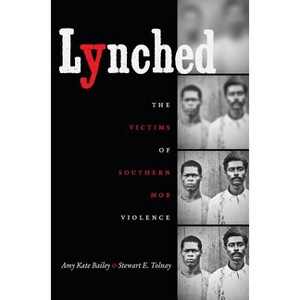
Lynched - by Amy Kate Bailey & Stewart E Tolnay Paperback
In Stock
Sponsored
About this item
Highlights
- On July 9, 1883, twenty men stormed the jail in Morehouse Parish, Louisiana, kidnapped Henderson Lee, a black man charged with larceny, and hanged him.
- About the Author: Amy Kate Bailey is assistant professor of sociology at the University of Illinois-Chicago.
- 296 Pages
- History, United States
Description
Book Synopsis
On July 9, 1883, twenty men stormed the jail in Morehouse Parish, Louisiana, kidnapped Henderson Lee, a black man charged with larceny, and hanged him. Events like this occurred thousands of times across the American South in the late nineteenth and early twentieth centuries, yet we know scarcely more about any of these other victims than we do about Henderson Lee. Drawing on new sources to provide the most comprehensive portrait of the men and women lynched in the American South, Amy Bailey and Stewart Tolnay's revealing profiles and careful analysis begin to restore the identities of -- and lend dignity to -- hundreds of lynching victims about whom we have known little more than their names and alleged offenses.
Comparing victims' characteristics to those of African American men who were not lynched, Bailey and Tolnay identify the factors that made them more vulnerable to being targeted by mobs, including how old they were; what work they did; their marital status, place of birth, and literacy; and whether they lived in the margins of their communities or possessed higher social status. Assessing these factors in the context of current scholarship on mob violence and reports on the little-studied women and white men who were murdered in similar circumstances, this monumental work brings unprecedented clarity to our understanding of lynching and its victims.
Review Quotes
"Lynched breaks new ground with a truly impressive data collection effort that allows the authors to ask and analyze new and important questions about lynching. It allows us to consider the extent to which our theories of racial violence hold water when confronted with evidence about the attributes of individual victims. The authors present their work in a way that is both accessible to a general audience and also deeply meaningful for ongoing debates about conflict and racial violence." -- Rory McVeigh, University of Notre Dame
"A landmark contribution to the literature about lynching. . . . All future scholars in the field will be indebted to [this] work." -- Journal of Interdisciplinary History
"A phenomenal study in many ways -- deeply researched and convincingly argued. . . . Scholars of lynching will be indebted to their work for years to come." -- American Journal of Sociology
"A smart, fruitful foray into an important, tragic epoch of the American past." -- North Carolina Historical Review
"An indispensable resource for a wide range of scholars, not only those studying racial and ethnic violence but those studying other hate crimes as well." -- American Historical Review
"I strongly recommend anyone with an interest in the history of racial violence and race relations in the late nineteenth and early twentieth centuries to read Lynched." -- H-Net Reviews
"Not only does [Lynched] rescue hundreds of lynching victims from anonymity, it also models a way forward for further study of the phenomenon." -- Arkansas Historical Quarterly
"The book that many lynching scholars have been waiting for." -- Journal of American History
"The single most important piece of scholarship yet produced on the victims of lynching." -- Journal of Southern History
About the Author
Amy Kate Bailey is assistant professor of sociology at the University of Illinois-Chicago.
Stewart E. Tolnay is S. Frank Miyamoto Professor of Sociology at the University of Washington.
Shipping details
Return details
Trending Non-Fiction






Discover more options