Sponsored
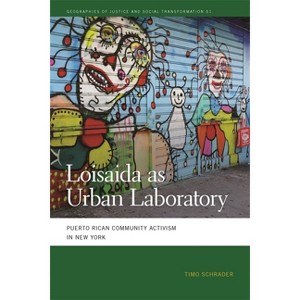
Loisaida as Urban Laboratory - (Geographies of Justice and Social Transformation) by Timo Schrader (Paperback)
In Stock
Sponsored
About this item
Highlights
- Loisaida as Urban Laboratory is the first in-depth analysis of the network of Puerto Rican community activism in New York City's Lower East Side from 1964 to 2001.
- About the Author: TIMO SCHRADER is a visiting research fellow at the University of Warwick.
- 204 Pages
- Social Science, Human Geography
- Series Name: Geographies of Justice and Social Transformation
Description
About the Book
"Loisaida as Urban Laboratory is the first in-depth analysis of the network of Puerto Rican community activism in New York City's Lower East Side from 1964 to 2001. Combining social history, cultural history, Latino studies, ethnic studies, studies of social movements, and urban studies, Timo Schrader uncovers the radical history of the Lower East Side. As little scholarship exists on the roles of institutions and groups in twentieth and twenty-first-century Puerto Rican community activism, Schrader enriches a growing discussion around alternative urbanisms. Loisaida was among a growing number of neighborhoods that pioneered a new form of urban living. The term Loisaida was coined, and then widely adopted, by the activist and poet Bittman "Bimbo" Rivas in an unpublished 1974 poem called "Loisaida" to refer to a part of the Lower East Side. Using this Spanglish version instead of other common labels honors the name that the residents chose themselves to counter real estate developers who called the area East Village or Alphabet City in an attempt to attract more artists and ultimately gentrify the neighborhood. Since the 1980s, urban planners and scholars have discussed strategies of urban development that revisit the pre-World War II idea of neighborhoods as community-driven and ecologically conscious entities. These "new urbanist" ideals are reflected in Schrader's rich historical and ethnographic study of activism in Loisaida, telling a vivid story of the Puerto Rican community's struggles for the right to stay and live with dignity in its home neighborhood"--
Book Synopsis
Loisaida as Urban Laboratory is the first in-depth analysis of the network of Puerto Rican community activism in New York City's Lower East Side from 1964 to 2001. Combining social history, cultural history, Latino studies, ethnic studies, studies of social movements, and urban studies, Timo Schrader uncovers the radical history of the Lower East Side. As little scholarship exists on the roles of institutions and groups in twentieth and twenty-first-century Puerto Rican community activism, Schrader enriches a growing discussion around alternative urbanisms.
Loisaida was among a growing number of neighborhoods that pioneered a new form of urban living. The term Loisaida was coined, and then widely adopted, by the activist and poet Bittman "Bimbo" Rivas in an unpublished 1974 poem called "Loisaida" to refer to a part of the Lower East Side. Using this Spanglish version instead of other common labels honors the name that the residents chose themselves to counter real estate developers who called the area East Village or Alphabet City in an attempt to attract more artists and ultimately gentrify the neighborhood.
Since the 1980s, urban planners and scholars have discussed strategies of urban development that revisit the pre-World War II idea of neighborhoods as community-driven and ecologically conscious entities. These "new urbanist" ideals are reflected in Schrader's rich historical and ethnographic study of activism in Loisaida, telling a vivid story of the Puerto Rican community's struggles for the right to stay and live with dignity in its home neighborhood.
Review Quotes
[O]ne of a very few works that treats the Puerto Rican movements of the 1970s and 1980s as part of a broad, collective revisioning of urban life, around shared identity, community control, and creative expression.--Miranda Martinez "CENTRO: Journal of the Center for Puerto Rican Studies"
About the Author
TIMO SCHRADER is a visiting research fellow at the University of Warwick. His work has appeared in the Journal for the Study of Radicalism and the Journal of Urban History.
Shipping details
Return details
Trending Non-Fiction




Discover more options