Sponsored
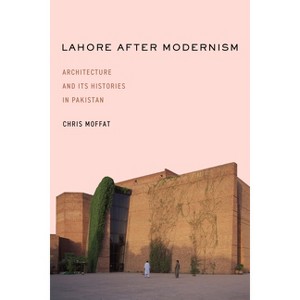
Lahore After Modernism - South Asia in Motion by Chris Moffat
Pre-order
Sponsored
About this item
Highlights
- In the decades after independence in 1947, architects in Pakistan were enlisted to build a postcolonial future--a new world after empire.
- About the Author: Chris Moffat is Senior Lecturer in South Asian History at Queen Mary University of London.
- 264 Pages
- History, Asia
- Series Name: South Asia in Motion
Description
About the Book
"In the decades after independence in 1947, architects in Pakistan were enlisted to build a postcolonial future - a new world after empire. But the debris of the past could not be so easily swept aside. The recalcitrance of local and regional histories was fiercely evident in Lahore, the centuries-old capital of Punjab and a city scarred by the partition of British India. Studying its streets, neighborhoods and historic buildings, Pakistani architects came to challenge the global consensus around "development" and its close association with modernist architecture. Their designs and structures became opportunities for thinking anew about the power of history, the boundaries of the nation, and the constitution of community in a postcolonial polity. This book is a pioneering study of architecture and the politics of construction, destruction and conservation in urban Pakistan. Chris Moffat introduces Pakistan's first postcolonial generation of architects - figures born around the time of partition, who began practicing in the 1960s and whose early careers navigated popular rebellions, military coups and emergent, pan-Islamic alignments. Moving from housing schemes to monuments, shrines to shopping malls, Moffat forges a new conversation between histories of architecture and the history of ideas in South Asia, and locates Lahore at the center of debates around contemporary urbanization, postcolonial aesthetics, and the ethics of dwelling in the modern world"--
Book Synopsis
In the decades after independence in 1947, architects in Pakistan were enlisted to build a postcolonial future--a new world after empire. But the debris of the past could not be so easily swept aside. The recalcitrance of local and regional histories was fiercely evident in Lahore, the centuries-old capital of Punjab and a city scarred by the partition of British India. Studying its streets, neighborhoods and historic buildings, Pakistani architects came to challenge the global consensus around "development" and its close association with modernist architecture. Their designs and structures became opportunities for thinking anew about the power of history, the boundaries of the nation, and the constitution of community in a postcolonial polity.
This book is a pioneering study of architecture and the politics of construction, destruction and conservation in urban Pakistan. Chris Moffat introduces Pakistan's first postcolonial generation of architects--figures born around the time of partition, who began practicing in the 1960s and whose early careers navigated popular rebellions, military coups and emergent, pan-Islamic alignments. Moving from housing schemes to monuments, shrines to shopping malls, Moffat forges a new conversation between histories of architecture and the history of ideas in South Asia, and locates Lahore at the center of debates around contemporary urbanization, postcolonial aesthetics, and the ethics of dwelling in the modern world.
Review Quotes
"It is about time that we give an account of world-making in the aftermath of empire from the perspective of its postcolonial dreamers and builders. Chris Moffat offers us more than just an itinerary of modernism from the global south--this is a truly vibrant intellectual history."--Vazira Zamindar, Brown University
"While the expediencies and profanations of architectural expressions of modernity often cause them to escape the attention of serious historians and theorists--as ethnonationalist and ideological entanglements, or commercial and other contingent forces limit modern architecture's integrity as an object for intensive scholarly philosophical inquiry--Chris Moffat recovers architectural modernism, with custodial generosity, as a subject of intellectual history. Restoring the capacity of architectural form, environments, and practices to accommodate the profound problem of the postcolony, one embedded in the vexations and potentials ever present in the idea of Pakistan--and, indeed, through the visions, memories, and hands of its makers--Lahore after Modernism brings capacious architectural histories into the narrative, along with a persistent demand to leave big questions of meaning-making under negotiation."--Anooradha Iyer Siddiqi, Barnard College, Columbia University
About the Author
Chris Moffat is Senior Lecturer in South Asian History at Queen Mary University of London. He is author of India's Revolutionary Inheritance: Politics and the Promise of Bhagat Singh (2019).
Shipping details
Return details
Frequently bought together



Trending Non-Fiction