Sponsored
Pre-order
Sponsored
About this item
Highlights
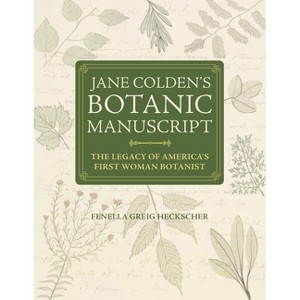
- A richly illustrated account of the life and work of Jane Colden, America's first woman botanist Jane Colden (1724-1760) was America's first woman botanist, yet her contributions to the field of early American botany remain little-known and her writings are mostly unpublished.
- About the Author: Fenella Greig Heckscher's interest in biology began with the study of wildflowers as a child in England.
- 144 Pages
- Science, Life Sciences
Description
Book Synopsis
A richly illustrated account of the life and work of Jane Colden, America's first woman botanist
Jane Colden (1724-1760) was America's first woman botanist, yet her contributions to the field of early American botany remain little-known and her writings are mostly unpublished. Looking at Colden's original writing, the correspondence of her father, Dr. Cadwallader Colden, and eighteenth-century botanic sources, Fenella Greig Heckscher provides a full account of her life and work.
Born into an educated family of Scottish heritage, Colden's interest in botany began at an early age, when she learned the Linnaean system of plant classification from her father and followed his example to study and classify the plants of New York's Hudson Valley. Colden's acute powers of observation enabled her to create detailed descriptions and illustrations of more than 300 plant species in the province of New York. By the time of her death, her Botanic Manuscript remained a work-in-progress and little appreciated beyond European botany circles.
Richly illustrated with her own sketches and handwriting, this volume presents a full examination of Jane Colden's Manuscript, highlights its important contributions to the early study of America's flora, and, three hundred years after her birth, restores Colden's legacy as one of the country's great botanists.
Review Quotes
"Fenella Heckscher brings the brilliant but neglected Jane Colden to life in this valuable book. Situating Colden in her extraordinary scientific and political times, Heckscher offers an engaging and original guide to Colden's seminal 'Botanic Manuscript.' Colden, a pioneering American scientist, fully deserves the attention."--Victoria Johnson, author of American Eden: David Hosack, Botany, and Medicine in the Garden of the Early Republic
"Jane Colden's extraordinary achievement was barely acknowledged in her short life and her pioneering botanical work has remained uncredited until now. From scant biographical records and Colden's single surviving manuscript, Heckscher has succeeded in bringing a remarkable eighteenth-century woman to life, and with the aid of exquisite color photographs, presents her plant discoveries to a modern audience. The book reinstates the significant contribution of a woman in the history of plant discovery in America."--Henrietta McBurney, art historian and curator
"Every so often a book comes along that makes one say, 'I wish I'd written that!' This exceptional piece of scholarship on the unjustly neglected godmother of North American botany is long overdue and will deservedly bring the groundbreaking work of Jane Colden out from under the shadow of John Torrey and Asa Gray."--Michael Hagen, Curator of Native Plant Garden and Rock Garden, New York Botanical Garden
"Perhaps the value of North America's flora is self-evident, but few appreciate how these wonderful plants became garden stalwarts. The remarkable story of Jane Colden, America's first woman botanist, finally receives the recognition it deserves through the insightful writing of Fenella Heckscher, who weaves an engaging narrative of a time when the colonial patriarchy dominated the science of botany."--Uli Lorimer, Director of Horticulture, Native Plant Trust
"Long overlooked in the Natural History Museum in London, Jane Colden's eighteenth-century inventory of the plants in New York's Hudson River Valley has been brought to life by Fenella Heckscher. Her thorough update of Colden's manuscript, and her thoughtful analysis of Colden's role as America's first female botanist, makes this an important contribution to the history of horticulture in North America."--Robert McCracken Peck, Senior Fellow, Emeritus, The Academy of Natural Sciences of Drexel University
About the Author
Fenella Greig Heckscher's interest in biology began with the study of wildflowers as a child in England. She went on to study zoology at Oxford University and then practiced medicine in New York. From there, she and her husband, Morrison Heckscher, moved to a historic house in New York's Hudson Valley, which offered a landscape of wildflowers waiting to be explored, as well as opportunities to meet new gardening friends. She learned of Jane Colden and her Botanic Manuscript at a meeting of the Garden Club of America and became fascinated by Colden's descriptions of plants native to the United States. Since her retirement from medical practice, she has devoted much of her time to the study of Jane Colden's contributions to the American botanical Enlightenment.
Shipping details
Return details
Frequently bought together




Trending Non-Fiction






Discover more options