Sponsored
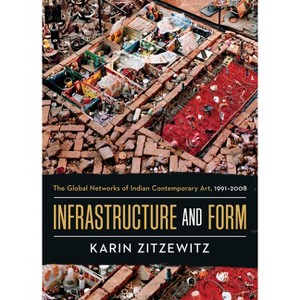
Infrastructure and Form - by Karin Zitzewitz (Hardcover)
In Stock
Sponsored
About this item
Highlights
- In the 1990s and 2000s, contemporary art in India changed radically in form, as an art world once dominated by painting began to support installation, new media, and performance.
- About the Author: Karin Zitzewitz is Associate Professor of Art History and Visual Culture at Michigan State University and the author of The Art of Secularism: The Cultural Politics of Modernist Art in Contemporary India.
- 288 Pages
- Art, Asian
Description
About the Book
"In the 1990s and 2000s, contemporary art in India changed radically in form, as an art world once dominated by painting began to support installation, new media, and performance. State-run institutions decreased the support they had given a modernist avant-garde, and art was cultivated instead by a booming market as well as new nonprofit institutions that combined strong local roots and transnational connections. The result was an unprecedented efflorescence of contemporary art in India. Among the first studies of contemporary South Asian art, Infrastructure and Form engages deeply with sixteen of India's leading contemporary artists and art collectives to examine what made this development possible. Karin Zitzewitz articulates the connections between formal trajectories of medium and material, curatorial frames and networks of circulation, and the changing conditions of everyday life after economic liberalization. By untangling the complex interactions of infrastructure and form, the book offers a discussion of the barriers and conduits that continue to shape global contemporary art and its relationship to capital more broadly"--
Book Synopsis
In the 1990s and 2000s, contemporary art in India changed radically in form, as an art world once dominated by painting began to support installation, new media, and performance. In response to the liberalization of India's economy, art was cultivated by a booming market as well as by new nonprofit institutions that combined strong local roots and transnational connections. The result was an unprecedented efflorescence of contemporary art and growth of a network of institutions radiating out from India.
Among the first studies of contemporary South Asian art, Infrastructure and Form engages with sixteen of India's leading contemporary artists and art collectives to examine what made this development possible. Karin Zitzewitz articulates the connections among formal trajectories of medium and material, curatorial frames and networks of circulation, and the changing conditions of everyday life after economic liberalization. By untangling the complex interactions of infrastructure and form, the book offers a discussion of the barriers and conduits that continue to shape global contemporary art and its relationship to capital more broadly.
From the Back Cover
"Karin Zitzewitz's Infrastructure and Form represents an important contribution to the literature on global contemporary art, making a crucial argument about the importance of infrastructure to the formats, themes, materials, and very forms of contemporary art."--Ming Tiampo, Professor of Art History, Carleton University
"Infrastructure and Form marks a signal intervention by rigorously articulating an approach via 'infrastructure.' Through this lens, we see the art between 1991 and 2008 as emergent from and embedded in institutions, funders, physical spaces, nation-states, and the intimate networks of friendship and gossip. Infrastructure and Form thoroughly reinvigorates art historical study of this important period and its vibrant art infrastructures."--Rebecca M. Brown, Professor, Johns Hopkins University
About the Author
Karin Zitzewitz is Associate Professor of Art History and Visual Culture at Michigan State University and the author of The Art of Secularism: The Cultural Politics of Modernist Art in Contemporary India.
Shipping details
Return details
Frequently bought together




Trending Non-Fiction






Discover more options