Sponsored
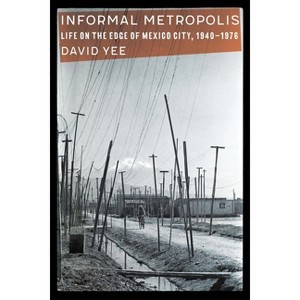
Informal Metropolis - (Confluencias) by David Yee (Paperback)
In Stock
Sponsored
About this item
Highlights
- In the 1940s, as Mexican families trekked north to the United States in search of a better life, tens of millions also left their towns and villages for Mexico's major cities.
- About the Author: David Yee is an assistant professor of history at Metropolitan State University of Denver.
- 306 Pages
- History, Latin America
- Series Name: Confluencias
Description
About the Book
Informal Metropolis uncovers how a former lake bed on the edge of Mexico City grew into the world's largest shantytown--Ciudad Nezahualcóyotl--and rethinks the relationship between urban space and inequality in twentieth-century Mexico.
Book Synopsis
In the 1940s, as Mexican families trekked north to the United States in search of a better life, tens of millions also left their towns and villages for Mexico's major cities. In Mexico City migrant families excluded from new housing programs began to settle on a dried-out lake bed near the airport, eventually transforming its dusty plains into an informal city of more than one million people.
In Informal Metropolis David Yee uncovers how this former lake bed grew into the world's largest shantytown--Ciudad Nezahualcóyotl--and rethinks the relationship between urban space and inequality in twentieth-century Mexico. By chronicling the residents' struggles to build their own homes and gain land rights in the face of extreme adversity, Yee presents a hidden history of land fraud, political corruption, and legal impunity underlying the rise of Mexico City's informal settlements. When urban social movements erupted across Mexico in the 1970s, Ciudad Nezahualcóyotl's residents organized to demand land, water, and humane living conditions. Though guided by demands for basic needs, these movements would ultimately achieve a more lasting significance as a precursor to a new urban citizenry in Mexico.
In the first comprehensive history of modern housing in Mexico City, Yee challenges widely held assumptions about urban inequality and politics in Mexico.
Review Quotes
"Informal Metropolis amply deserves the attention of historians interested in the complicated political, cultural, and social entrails of a twentieth-century unprecedented dual enigma: the megalopolis vis-à-vis the emergence of the modern welfare state."--Mauricio Tenorio-Trillo, American Historical Review
"Yee's compelling study of urban marginality and community agency offers a critical perspective on the social fabric of Mexico City during a transformative era."--M. C. Galván, Choice
"By focusing on how state policy, informal markets, and popular mobilization interacted to shape the city's edge, Yee offers both a rich case study to study informality in Latin America and the Global South in general in the second half of the twentieth century. His work invites us to rethink informality not as a failure or deviation, but as a key mechanism of state formation and urban life."--Leandro Benmergui, Planning Perspectives
"A rich and compelling history of impunity and economic inequality during the long decade of the 1960s [in Mexico]. . . . Informal Metropolis is a remarkable work of historical scholarship and a must-read for all historians of Latin America interested in democracy, urbanization, labor, discrimination, corruption, state repression, and economic development. In its complex historical study of civil society, it successfully integrates local, national, and international levels of analysis."--Jaime M. Pensado, author of Love and Despair: How Catholic Activism Shaped Politics and the Counterculture in Modern Mexico
"Extraordinary in its contribution to the important and largely unexplored historical treatment of the dynamics of informal human settlements. The writing is accessible and engaging and will appeal to specialists in Mexican and Latin American studies as well as comparative urban historians, sociologists, economists, and urban planners."--Christina M. Jiménez, author of Making an Urban Public: Popular Claims to the City in Mexico, 1879-1923
About the Author
David Yee is an assistant professor of history at Metropolitan State University of Denver.
Shipping details
Return details
Frequently bought together


Trending Non-Fiction



Discover more options