Sponsored
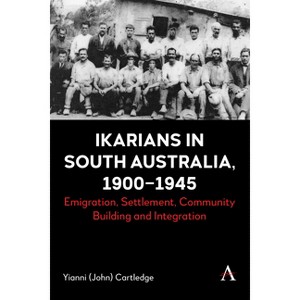
About this item
Highlights
- Examines the little-known Ikarian Greek diaspora, focusing on Ikarians' emigration, settlement, community building and integration in South Australia between 1900 and 1945.
- About the Author: Dr Yianni Cartledge is a lecturer in History at the Faculty of Education, Tabor College; and previously a lecturer in Greek Studies (culture) at the College of Humanities, Arts & Social Sciences, Flinders University.
- 196 Pages
- History, Europe
- Series Name: Anthem Studies in Mediterranean History
Description
About the Book
This book explores the migration of Greeks from the island of Ikaria to South Australia between 1900 and 1945. This little-researched diaspora is examined alongside the key themes of emigration, settlement, community building and integration.
Book Synopsis
Examines the little-known Ikarian Greek diaspora, focusing on Ikarians' emigration, settlement, community building and integration in South Australia between 1900 and 1945.
This scholarly monograph looks at a little-researched diaspora, originating on the Greek Aegean Island of Ikaria. Ikaria itself is a small, isolated island, close to the Turkish coast. It has had a long and independent history, with periods of autonomy and self-rule, including the short-lived Free State of Ikaria in 1912, which was the outcome of the Ikarian Revolution against the Ottoman Empire. Ikarians themselves remained quite insular until the nineteenth century, when they began emigrating. Ottoman port-cities and urban centres, as well as nearby Aegean islands, received the first Ikarian emigrants.
Eventually, Ikarians found themselves in growing hubs of migration such as Egypt and the United States. By 1910, the first Ikarians had arrived in Port Pirie, South Australia, beginning a long tradition of Ikarian migration and settlement in the state. This book explores the Ikarians in South Australia between 1900 and 1945 - an under-researched period, and a contrast from most studies on Greeks in Australia, which have focused heavily on the mass migration post-World War II and post-Greek Civil War. This also leaves a gap for a later study on Ikarians in South Australia beyond 1945. The book positions itself around four key themes: emigration, settlement, community building and integration, with ideas such as localism and identity being explored as facets within those themes.
Review Quotes
'Ikarians in South Australia makes an outstanding contribution to the scholarship of emigration to Australia. By focusing on the first half of the twentieth century, this work opens up an unexplored and unexamined period in emigration history in innovative ways. It captures through a sophisticated analysis the centrality of emigration by Greek Aegean Islander communities and sheds new perspectives on the complexity of the Greek diaspora in Australia.' --Professor Joy Damousi, Redmond Barry Distinguished Professor, School of Historical and Philosophical Studies, the University of Melbourne, Australia
'Yianni Cartledge has done an exceptionally well-researched study of the Ikarians in South Australia, which will become the standard work on the subject. It traces the history of this group from its origins in the Aegean to the migration process through to integration into wider Australian society, providing a fascinating case study of the migrant story.' --Professor Panikos Panayi, Professor of European History, De Montfort University, Leicester, UK
'Through painstaking research, Cartledge unearths the story of South Australia's Ikarians during the early twentieth century. He shows with impressive detail how these islanders, with energy and determination, rebuilt their lives and participated in the making of the state's Greek community. An important contribution to Greek Australian history!' --Nicholas Doumanis, Professor and Illinois Chair in Hellenic Studies, the University of Illinois Chicago, USA
'Ikarians in South Australia is a fascinating exploration of how diaspora identity is formed, examining how Ikarians identified as both a specific community attached to the island of Ikaria and part of the broader Greek community in Australia. Cartledge expertly shows how Ikarians built their communities and thrived amid the assimilationist environment of white Australia in the first half of the twentieth century.' --Dr Evan Smith, Visiting Fellow, College of Humanities, Arts and Social Sciences, Flinders University, Australia
About the Author
Dr Yianni Cartledge is a lecturer in History at the Faculty of Education, Tabor College; and previously a lecturer in Greek Studies (culture) at the College of Humanities, Arts & Social Sciences, Flinders University. His research interests include migration and the migrant experience, diaspora studies, Mediterranean histories (particularly the British and Ottoman Empires), and the history of modern Greece.
Shipping details
Return details
Frequently bought together


Trending Non-Fiction