Target New ArrivalsGift Ideas for MomClothing, Shoes & AccessoriesHome & DecorKitchen & DiningOutdoor Living & GardenGroceryHousehold EssentialsBabyBeautyPersonal CareHealthWellnessLuggageSports & OutdoorsToysElectronicsVideo GamesMovies, Music & BooksSchool & Office SuppliesParty SuppliesGift IdeasGift CardsPetsUlta Beauty at TargetShop by CommunityTarget OpticalDealsClearanceTarget New ArrivalsSpring OutfitsGift Ideas for MomWomen’s Festival OutfitsTop DealsTarget Circle DealsWeekly AdShop Order PickupShop Same Day DeliveryRegistryRedCardTarget CircleFind Stores
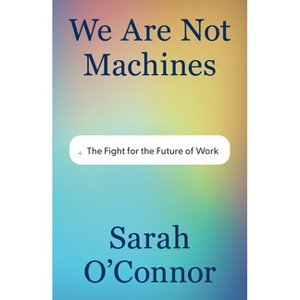
We Are Not Machines - by  Sarah O'Connor (Hardcover) - 1 of 1

We Are Not Machines - by Sarah O'Connor (Hardcover)

$30.00

Pre-order

Free & easy returns

Free & easy returns

Return this item by mail or in store within 90 days for a full refund.
Eligible for registries and wish lists

About this item

Highlights

  • From award-winning Financial Times journalist Sarah O'Connor, a deeply reported investigation into how AI and robotics are transforming the way we work.
  • About the Author: Sarah O'Connor is a columnist, reporter and associate editor at the Financial Times.
  • 248 Pages
  • Business + Money Management, Industries

Description


Book Synopsis


From award-winning Financial Times journalist Sarah O'Connor, a deeply reported investigation into how AI and robotics are transforming the way we work.

Automation, we were told, was meant to do away with dull and dangerous tasks, freeing us to pursue more fulfilling work. But AI now threatens to turn even creative tasks into dehumanizing labor.

Investigative journalist Sarah O'Connor has spent the last few years gathering stories of burned-out Amazon warehouse workers, Orwellian employee surveillance softwares, AI job interviews, translators frantically trying to keep up with machines, and truck drivers endlessly on the road.

As Sarah O'Connor writes, "Automation was meant to do away with dull, dirty, dangerous tasks. It was meant to free us up for more interesting and creative work. So why was my notebook filling up with stories of good jobs turned bad, and bad jobs turned worse? These people were not being liberated by machines. Instead, they were being crunched into systems run by machines and paced by machines, in which important concepts such as fairness, intelligence, even human-ness itself, were being quietly redefined by machines. And that left me with a question. A question that prompted me to write this book. We think we're robotizing our work, but what if we're actually robotizing ourselves?"

Our fear that machines will make us more robotic, O'Connor argues, is not new and has its origins in the industrial revolution, when workers fought against the expectation that they should toil like tireless machines. Inspired by campaigners from nineteenth-century English cotton mills to twenty-first century Swedish mines, O'Connor lays out a path where we can fight for work that is more respectful of our limits, and more worthy of the capacity of our minds.


Review Quotes


Praise for We Are Not Machines


"A fierce, wise, beautiful book."

--Tim Harford, author of The Data Detective


"A lively and engaging read which teases out some compelling human stories. O'Connor describes both the peril and promise unleashed hy AI-and issues a powerful call to arms for us all about how to respond. A must-read for educators, policy makers, executives, and employees."

--Gillian Tett, author of Anthro-Vision


"Brilliantly insightful...no one provides a better worm's eye view of the world of work than Sarah O'Connor."

--Andy Haldane, former Bank of England chief economist


"Sarah is the best writer out there on the world of work, and her debut is as insightful, surprising and illuminating as I hoped."

--Sathnam Sanghera, author of Empireland


"An invaluable guide to one of the biggest economic stories of our age. Most books about AI lurch between hype and despair but Sarah O'Connor has captured something far rarer: a glimpse of how machines are actually reshaping our lives and livelihoods."

--Ed Conway, author of Material World


"A hopeful and urgent reminder that the future of work is what we make it. Her warning is important and grounded: there is a better path."

--Carl Benedikt Frey, author of How Progress Ends


About the Author


Sarah O'Connor is a columnist, reporter and associate editor at the Financial Times. She writes a weekly column focused on the world of work, as well as longer features and investigations. She has won the Orwell Prize for Exposing Britain's Social Evils, the Wincott Award for financial journalism, Business Commentator of the Year at the Comment Awards, Financial/Economic story of the year at the Foreign Press Awards and Business and Finance Journalist of the year at the British Press Awards.

Dimensions (Overall): 8.5 Inches (H) x 5.25 Inches (W) x .75 Inches (D)
Suggested Age: 22 Years and Up
Number of Pages: 248
Genre: Business + Money Management
Sub-Genre: Industries
Publisher: David R. Godine Publisher
Theme: Computers & Information Technology
Format: Hardcover
Author: Sarah O'Connor
Language: English
Street Date: August 11, 2026
TCIN: 1004095713
UPC: 9781567928365
Item Number (DPCI): 247-20-7335
Origin: Made in the USA or Imported
If the item details aren’t accurate or complete, we want to know about it.

Shipping details

Estimated ship dimensions: 0.75 inches length x 5.25 inches width x 8.5 inches height
Estimated ship weight: 1 pounds
We regret that this item cannot be shipped to PO Boxes.
This item cannot be shipped to the following locations: American Samoa (see also separate entry under AS), Guam (see also separate entry under GU), Northern Mariana Islands, Puerto Rico (see also separate entry under PR), United States Minor Outlying Islands, Virgin Islands, U.S., APO/FPO, Alaska, Hawaii

Return details

This item can be returned to any Target store or Target.com.
This item must be returned within 90 days of the date it was purchased in store, delivered to the guest, delivered by a Shipt shopper, or picked up by the guest.
See the return policy for complete information.

Q: What does the book suggest about automation's impact on jobs?

submitted by AI Shopping Assistant - 1 month ago
  • A: It suggests automation has turned fulfilling jobs into dehumanizing labor rather than liberating workers.

    submitted byAI Shopping Assistant - 1 month ago
    Ai generated

Q: How does the book relate to historical labor movements?

submitted by AI Shopping Assistant - 1 month ago
  • A: It draws parallels between modern automation issues and historical struggles against dehumanizing labor conditions.

    submitted byAI Shopping Assistant - 1 month ago
    Ai generated

Q: What inspired Sarah O'Connor to write this book?

submitted by AI Shopping Assistant - 1 month ago
  • A: Her investigations revealed stories of workers negatively affected by automation and the changing nature of work.

    submitted byAI Shopping Assistant - 1 month ago
    Ai generated

Q: Who is the author of this book?

submitted by AI Shopping Assistant - 1 month ago
  • A: The author is Sarah O'Connor, an award-winning journalist at the Financial Times.

    submitted byAI Shopping Assistant - 1 month ago
    Ai generated

Q: What is the central theme of the book?

submitted by AI Shopping Assistant - 1 month ago
  • A: The book investigates the impact of AI and robotics on the nature of work and worker experiences.

    submitted byAI Shopping Assistant - 1 month ago
    Ai generated

Additional product information and recommendations

Discover more options

Frequently bought together

Trending Business & Law Books

Get top deals, latest trends, and more.

Privacy policy