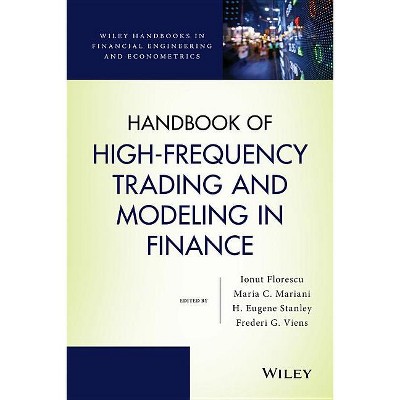
CUTTING-EDGE DEVELOPMENTS IN HIGH-FREQUENCY FINANCIAL ECONOMETRICS In recent years, the availability of high-frequency data and advances in computing have allowed financial practitioners to design systems that can handle and analyze this information.
About the Author: Frederi G. Viens, PhD, is Director and Coordinator of the Computational Finance Program at Purdue University, where he also serves as Professor of Statistics and Mathematics.
464 Pages
Business + Money Management, Finance
Series Name: Wiley Handbooks in Financial Engineering and Econometrics
Description
About the Book
"This exciting volume presents cutting-edge developments in high frequency financial econometrics, spanning a diverse range of topics: stochastic modeling, statistical analysis of high-frequency data, models in econophysics, applications to the analysis of high-frequency data, systems and complex adaptive systems in finance, among a host of others. Written, in part, on the outgrowth of several recent conferences in the subject matter and in concert with over two-dozen experts in the field, the main purpose of the handbook is to mathematically illustrate the fundamental implementation of high-frequency models in the banking and financial industries, both at home and abroad, through use of real-world, time-sensitive applications. By using examples derived from consulting projects, current research and course instruction, each chapter in the book offers a systematic understanding of the recent advances in high-frequency modeling related to real-world situations. Every effort is made to present a balanced treatment between theory and practice, as well as to showcase how accuracy and efficiency in implementing various methods can be used as indispensable tools. To by-pass tedious computation, software illustrations are presented in an assortment of packages, ranging from R, C++, EXCEL-VBA, Minitab, to JMP/SAS. Shedding light on some of the most relevant open questions in the analysis of high-frequency data, this volume will be of interest to graduate students, researchers and industry professionals"--
Book Synopsis
CUTTING-EDGE DEVELOPMENTS IN HIGH-FREQUENCY FINANCIAL ECONOMETRICS
In recent years, the availability of high-frequency data and advances in computing have allowed financial practitioners to design systems that can handle and analyze this information. Handbook of Modeling High-Frequency Data in Finance addresses the many theoretical and practical questions raised by the nature and intrinsic properties of this data.
A one-stop compilation of empirical and analytical research, this handbook explores data sampled with high-frequency finance in financial engineering, statistics, and the modern financial business arena. Every chapter uses real-world examples to present new, original, and relevant topics that relate to newly evolving discoveries in high-frequency finance, such as:
Designing new methodology to discover elasticity and plasticity of price evolution
Constructing microstructure simulation models
Calculation of option prices in the presence of jumps and transaction costs
Using boosting for financial analysis and trading
The handbook motivates practitioners to apply high-frequency finance to real-world situations by including exclusive topics such as risk measurement and management, UHF data, microstructure, dynamic multi-period optimization, mortgage data models, hybrid Monte Carlo, retirement, trading systems and forecasting, pricing, and boosting. The diverse topics and viewpoints presented in each chapter ensure that readers are supplied with a wide treatment of practical methods.
Handbook of Modeling High-Frequency Data in Finance is an essential reference for academics and practitioners in finance, business, and econometrics who work with high-frequency data in their everyday work. It also serves as a supplement for risk management and high-frequency finance courses at the upper-undergraduate and graduate levels.
From the Back Cover
CUTTING-EDGE DEVELOPMENTS IN HIGH-FREQUENCY FINANCIAL ECONOMETRICS
In recent years, the availability of high-frequency data and advances in computing have allowed financial practitioners to design systems that can handle and analyze this information. Handbook of Modeling High-Frequency Data in Finance addresses the many theoretical and practical questions raised by the nature and intrinsic properties of this data.
A one-stop compilation of empirical and analytical research, this handbook explores data sampled with high-frequency finance in financial engineering, statistics, and the modern financial business arena. Every chapter uses real-world examples to present new, original, and relevant topics that relate to newly evolving discoveries in high-frequency finance, such as:
Designing new methodology to discover elasticity and plasticity of price evolution
Constructing microstructure simulation models
Calculation of option prices in the presence of jumps and transaction costs
Using boosting for financial analysis and trading
The handbook motivates practitioners to apply high-frequency finance to real-world situations by including exclusive topics such as risk measurement and management, UHF data, microstructure, dynamic multi-period optimization, mortgage data models, hybrid Monte Carlo, retirement, trading systems and forecasting, pricing, and boosting. The diverse topics and viewpoints presented in each chapter ensure that readers are supplied with a wide treatment of practical methods.
Handbook of Modeling High-Frequency Data in Finance is an essential reference for academics and practitioners in finance, business, and econometrics who work with high-frequency data in their everyday work. It also serves as a supplement for risk management and high-frequency finance courses at the upper-undergraduate and graduate levels.
About the Author
Frederi G. Viens, PhD, is Director and Coordinator of the Computational Finance Program at Purdue University, where he also serves as Professor of Statistics and Mathematics. He has published extensively in the areas of mathematical finance, probability theory, and stochastic processes. Dr. Viens is co-organizer of the annual Conference on Modeling High-Frequency Data in Finance.
Maria C. Mariani, PhD, is Pro-fessor and Chair in the Department of Mathematical Sciences at The University of Texas at El Paso. She currently focuses her research on mathematical finance, applied mathematics, and numerical methods. Dr. Mariani is co-organizer of the annual Conference on Modeling High-Frequency Data in Finance.
Ionut Florescu, PhD, is Assistant Professor of Mathematics at Stevens Institute of Technology. He has published in research areas including stochastic volatility, stochastic partial differential equations, Monte Carlo methods, and numerical methods for stochastic processes. Dr. Florescu is lead organizer of the annual Conference on Modeling High-Frequency Data in Finance.
Dimensions (Overall): 9.3 Inches (H) x 6.2 Inches (W) x 1.1 Inches (D)
Weight: 1.58 Pounds
Suggested Age: 22 Years and Up
Number of Pages: 464
Genre: Business + Money Management
Sub-Genre: Finance
Series Title: Wiley Handbooks in Financial Engineering and Econometrics
Publisher: Wiley
Theme: General
Format: Hardcover
Author: Frederi G Viens & Maria Cristina Mariani & Ionut Florescu
Language: English
Street Date: December 20, 2011
TCIN: 1008778847
UPC: 9780470876886
Item Number (DPCI): 247-16-9659
Origin: Made in the USA or Imported
If the item details aren’t accurate or complete, we want to know about it.
Shipping details
Estimated ship dimensions: 1.1 inches length x 6.2 inches width x 9.3 inches height
Estimated ship weight: 1.58 pounds
We regret that this item cannot be shipped to PO Boxes.
This item cannot be shipped to the following locations: American Samoa (see also separate entry under AS), Guam (see also separate entry under GU), Northern Mariana Islands, Puerto Rico (see also separate entry under PR), United States Minor Outlying Islands, Virgin Islands, U.S., APO/FPO
Return details
This item can be returned to any Target store or Target.com.
This item must be returned within 90 days of the date it was purchased in store, shipped, delivered by a Shipt shopper, or made ready for pickup.