Sponsored
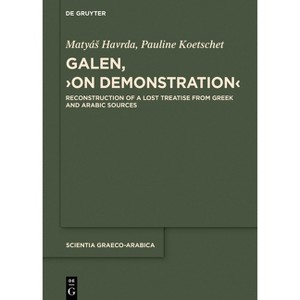
Galen, >On Demonstration - (Scientia Graeco-Arabica) by Matyás Havrda & Pauline Koetschet (Hardcover)
In Stock
Sponsored
About this item
Highlights
- Galen's On Demonstration (written c. 160 C.E.) was a tour de force of scientific methodology, loosely based on Aristotle's (and Theophrastus') Posterior Analytics and suited to the needs of a philosophically minded doctor.
- About the Author: M. Havrda, Acad.
- 249 Pages
- History, Ancient
- Series Name: Scientia Graeco-Arabica
Description
About the Book
Die Reihe widmet sich grundlegenden Texten der Wissenschaft und Philosophie der Antike und der islamischen Welt, die arabisch überliefert sind. Durch Bereitstellung kritischer Textausgaben und monographischer Untersuchungen werden der Forschung diejenigen Themenbereiche zugänglich gemacht, in denen sich die Wissenschaft zwischen der Antike und der Moderne kontinuierlich dargestellt und entwickelt hat. Die Textausgaben werden von Übersetzungen begleitet und durch inhaltliche Erläuterungen und philologische Anmerkungen erschlossen.
Book Synopsis
Galen's On Demonstration (written c. 160 C.E.) was a tour de force of scientific methodology, loosely based on Aristotle's (and Theophrastus') Posterior Analytics and suited to the needs of a philosophically minded doctor. In its fifteen volumes, Galen outlined the theory of demonstration and the method of discovering premisses in natural-philosophical arguments, and rehearsed exemplary discussions to show how one should proceed when dealing with scientific problems. His polemics on issues in Aristotle's physics attracted the attention of Alexander of Aphrodisias and the Greek Neoplatonists and made a significant impact on Arabic philosophy. On Demonstration is lost, but parts of it can be reconstructed from Greek and Arabic sources. This book is a collection of all available testimonia, some published for the first time. They are accompanied by notes, translation, and a substantive introduction that deals with the sources, the history of scholarship, the purpose, structure and contents of the treatise, and its Arabic reception. The book will be useful for students and scholars of ancient and medieval medicine and philosophy, as well as those engaged in the study of the classical world, Graeco-Arabic studies or Islamic studies.
Review Quotes
n/a
About the Author
M. Havrda, Acad. of Sciences, Prague; P. Koetschet, Inst. français du Proche-Orient, Beyrouth.
Shipping details
Return details
Frequently bought together






Trending Non-Fiction