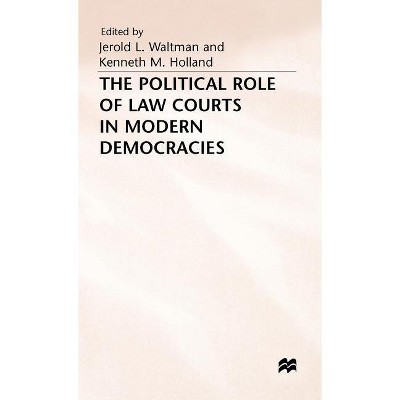
This edited volume is a comprehensive examination of the legal framework in which environmental policy is fashioned in the major English-speaking federations--the United States, Canada, and Australia.
About the Author: KENNETH M. HOLLAND is Professor of Political Science the University of Memphis.
240 Pages
Political Science, Public Policy
Series Name: Contributions in Political Science
Description
About the Book
This edited volume is a comprehensive examination of the legal framework in which environmental policy is fashioned in the major English-speaking federations--the United States, Canada, and Australia. The need for national solutions to environmental problems emerged long after the largest share of governmental power was allotted to states or provinces. This volume attempts to solve the paradox of how a country can have effective laws protecting the environment, vigorously enforced, when legislative and administrative powers are divided between two tiers of government.
The contributors analyze environmental lawmaking along three dimensions. Part I describes the formal constitutional allocation of powers between states or provinces and the federal government, concluding that on paper environmental protection is essentially a local responsibility, although the reality is far different. In Part II the contributors explore the extent to which governments resort to informal negotiations among themselves to resolve environmental disputes. Part III is a thorough canvassing of the judiciary's role in making environmental policy and resolving disputes between levels and branches of government. In Australia and Canada, the courts play a relatively less important role in formulating policy than in the United States. In conclusion, the work shows that the level of environmental protection is relatively high in these three federations. Environmental politics, the work suggests, may be less divisive in federations than in unitary systems with comparable levels of development.
Book Synopsis
This edited volume is a comprehensive examination of the legal framework in which environmental policy is fashioned in the major English-speaking federations--the United States, Canada, and Australia. The need for national solutions to environmental problems emerged long after the largest share of governmental power was allotted to states or provinces. This volume attempts to solve the paradox of how a country can have effective laws protecting the environment, vigorously enforced, when legislative and administrative powers are divided between two tiers of government.
The contributors analyze environmental lawmaking along three dimensions. Part I describes the formal constitutional allocation of powers between states or provinces and the federal government, concluding that on paper environmental protection is essentially a local responsibility, although the reality is far different. In Part II the contributors explore the extent to which governments resort to informal negotiations among themselves to resolve environmental disputes. Part III is a thorough canvassing of the judiciary's role in making environmental policy and resolving disputes between levels and branches of government. In Australia and Canada, the courts play a relatively less important role in formulating policy than in the United States. In conclusion, the work shows that the level of environmental protection is relatively high in these three federations. Environmental politics, the work suggests, may be less divisive in federations than in unitary systems with comparable levels of development.
Review Quotes
?[A] superb comparative analysis of environmental policymaking three federal systems: Australia, Canada, and the United States....Unlike many edited volumes, Federalism and the Environment is clearly and tightly organized....Scholars and policymakers interested in understanding both the challenges posed by federalism and the opportunites it offers to coherent environmental policymaking will find Federalism and the Environment to be a most useful contribution.?-Politics and the Life Sciences
"ÝA¨ superb comparative analysis of environmental policymaking three federal systems: Australia, Canada, and the United States....Unlike many edited volumes, Federalism and the Environment is clearly and tightly organized....Scholars and policymakers interested in understanding both the challenges posed by federalism and the opportunites it offers to coherent environmental policymaking will find Federalism and the Environment to be a most useful contribution."-Politics and the Life Sciences
"[A] superb comparative analysis of environmental policymaking three federal systems: Australia, Canada, and the United States....Unlike many edited volumes, Federalism and the Environment is clearly and tightly organized....Scholars and policymakers interested in understanding both the challenges posed by federalism and the opportunites it offers to coherent environmental policymaking will find Federalism and the Environment to be a most useful contribution."-Politics and the Life Sciences
About the Author
KENNETH M. HOLLAND is Professor of Political Science the University of Memphis./e His published works include Comparative Politics in the New World Order, Law and Politics: The Political Role of Courts in the United States, Judicial Activism in Comparative Perspectives, The Political Role of Law Courts in Modern Democracies, and articles appearing in Justice System Journal, Law and Policy Quarterly, Quebec Studies, and Canadian Journal of Law and Society.
F. L. MORTON is Professor of Political Science at the University of Calgary. He is the author of Pro-Choice v. Pro-Life: Abortion and the Courts in Canada, and Charter Politics (with Rainer Knopff) as well as articles in Canadian Journal of Political Science, Pouvoirs, Polity, and Publius.
BRIAN GALLIGAN is Professor of Political Science at the University of Melbourne. His publications include Politics of the High Court, Utah and Queensland Coal, Beyond the Protective State, and A Federal Republic: Australia's Constitutional System of Government.
Dimensions (Overall): 9.6 Inches (H) x 6.39 Inches (W) x .89 Inches (D)
Weight: 1.0 Pounds
Suggested Age: 22 Years and Up
Number of Pages: 240
Genre: Political Science
Sub-Genre: Public Policy
Series Title: Contributions in Political Science
Publisher: Praeger
Theme: General
Format: Hardcover
Author: Brian Galligan & Kenneth M Holland & F Morton
Language: English
Street Date: February 13, 1996
TCIN: 1008642478
UPC: 9780313294303
Item Number (DPCI): 247-00-6274
Origin: Made in the USA or Imported
If the item details aren’t accurate or complete, we want to know about it.
Shipping details
Estimated ship dimensions: 0.89 inches length x 6.39 inches width x 9.6 inches height
Estimated ship weight: 1 pounds
We regret that this item cannot be shipped to PO Boxes.
This item cannot be shipped to the following locations: American Samoa (see also separate entry under AS), Guam (see also separate entry under GU), Northern Mariana Islands, Puerto Rico (see also separate entry under PR), United States Minor Outlying Islands, Virgin Islands, U.S., APO/FPO
Return details
This item can be returned to any Target store or Target.com.
This item must be returned within 90 days of the date it was purchased in store, shipped, delivered by a Shipt shopper, or made ready for pickup.