Sponsored
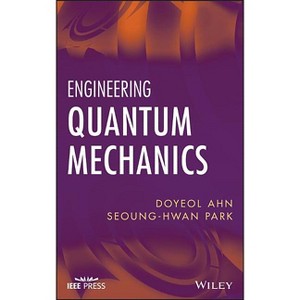
Engineering Quantum Mechanics - IEEE Press by Doyeol Ahn & Seoung-Hwan Park Hardcover
In Stock
Sponsored
About this item
Highlights
- There has been growing interest in the model of semiconductor lasers with non-Markovian relaxation.
- About the Author: DOYEOL AHN, PHD, is WB Distinguished Professor of Quantum Electronics in the Department of Electrical and Computer Engineering at the University of Seoul (Korea).
- 314 Pages
- Science, Physics
- Series Name: IEEE Press
Description
Book Synopsis
There has been growing interest in the model of semiconductor lasers with non-Markovian relaxation. Introducing senior and graduate students and research scientists to quantum mechanics concepts, which are becoming an essential tool in modern engineering, Engineering Quantum Mechanics develops a non-Markovian model for the optical gain of semiconductor, taking into account the rigorous electronic band-structure and the non-Markovian relaxation using the quantum statistical reduced-density operator formalism. Example programs based on Fortran 77 are provided for band-structures of zinc-blende and wurtzite quantum wells.
From the Back Cover
A CLEAR INTRODUCTION TO QUANTUM MECHANICS CONCEPTS
Quantum mechanics has become an essential tool for modern engineering, particularly due to the recent developments in quantum computing as well as the rapid progress in optoelectronic devices. Engineering Quantum Mechanics explains the fundamentals of this exciting field, providing broad coverage of both traditional areas such as semiconductor and laser physics as well as relatively new yet fast-growing areas such as quantum computation and quantum information technology.
The book begins with basic quantum mechanics, reviewing measurements and probability, Dirac formulation, the uncertainty principle, harmonic oscillator, angular momentum eigenstates, and perturbation theory. Then, quantum statistical mechanics is explored, from second quantization and density operators to coherent and squeezed states, coherent interactions between atoms and fields, and the Jaynes-Cummings model. From there, the book moves into elementary and modern applications, discussing such topics as Bloch theorem and effective mass theory, crystal orientation effects for zinc-blend and wurtzite Hamiltonian, and quantum entanglements and teleportation.
There has been growing interest in the model of semiconductor lasers with non-Markovian relaxation. This book develops a non-Markovian model for the optical gain in semiconductor materials, taking into account the rigorous electronic band-structure and the non-Markovian relaxation using the quantum statistical reduced-density operator formalism. Many-body effects are taken into account within the time-dependent Hartree-Fock equations, and example programs based on Fortran 77 are provided for band-structures of zinc-blend quantum wells.
Engineering Quantum Mechanics is intended for advanced undergraduate and graduate students in electrical engineering, physics, and materials science. It also provides the necessary theoretical background for researchers in optoelectronics or semiconductor devices.
Review Quotes
"The present book is intended for advanced undergraduate and graduate students in electrical engineering, physics, and material science. It also provides the necessary theoretical back-ground for researchers in optoelectronics or semiconductor devices." (Zentralblatt MATH, 2012)
"Ahn (quantum electronics, U. of Seoul) and Park (electronic engineering, Catholic U. of Daegu, Korea) present a textbook for graduate and advanced undergraduate students in electrical engineering, physics, and materials science and engineering on quantum mechanics as it is increasingly being used in these fields. It also provides the necessary theoretical background for researchers in optoelectronics or semiconductor devices." (Book News, 1 October 2011)
About the Author
DOYEOL AHN, PHD, is WB Distinguished Professor of Quantum Electronics in the Department of Electrical and Computer Engineering at the University of Seoul (Korea). A Fellow of the American Physical Society and an IEEE Fellow, he has coauthored more than 190 refereed journal papers and three book chapters, and holds seven U.S. patents to date.
SEOUNG-HWAN PARK, PHD, is Professor in the Department of Electronics Engineering at the Catholic University of Daegu (Korea). He has written two book chapters and coauthored more than 160 refereed journal and conference papers.
Shipping details
Return details
Trending Non-Fiction