Sponsored
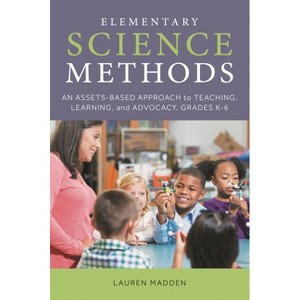
Elementary Science Methods - by Lauren Madden (Paperback)
In Stock
Sponsored
About this item
Highlights
- As teachers and parents, we often hear that children are the best scientists.
- About the Author: Lauren Madden is a professor of Elementary and Early Childhood Education at The College of New Jersey, where she teaches undergraduate and graduate science teaching methods courses and degree capstone courses.
- 216 Pages
- Education, Elementary
Description
About the Book
This book is designed to meet the needs of future elementary teachers preparing to teach science using an assets-based approach to science teaching and tools for advocating for scientific teaching and learning with respect to the NGSS.
Book Synopsis
As teachers and parents, we often hear that children are the best scientists. Great science teachers tune in to children's interests and observations to create engaging and effective lessons. This focus on the innate curiosity of children, or humans overall is celebrated and used to justify and support efforts around STEM teaching and learning. Yet, when we discuss elementary school teachers, we often hear many inside and outside the classroom report that these teachers dislike, fear, and feel uncomfortable with science. This is exactly the opposite approach from what is universally recommended by science education scholars.
This practical textbook meets the immediate, contextual needs of future and current elementary teachers by using an assets-based approach to science teaching, showing how to create inquiry-based lessons, differentiate instruction and lesson design based on children's developmental ages and needs, and providing easy-to-use tools to advocate for scientific teaching and learning guided by the Next Generation Science Standards (NGSS).
Review Quotes
"To face some of the world's greatest challenges, the importance of science and science education cannot be overstated. Lauren Madden embraces this perspective by cooking up truly inventive ways for teachers to weave scientific inquiry into day-to-day activities so that students easily move beyond meeting state standards to digesting and applying material. Equally important is her commitment to equity-offering up practical suggestions for ensuring that everyone gains equal access to the spaces opened through science. For science educators eager to forge the hearts and minds our world so desperately needs, this book will show you the way." --Randa Elbih, Assistant Professor, Department of Education/Special Education, University of St. Joseph
"In this text, Madden presents a current and comprehensive portrayal of science education in the elementary setting in a smooth, engaging narrative. She anchors the work in an NGSS world impacted by climate change and a global pandemic. She promotes the critical importance of knowing your students and integrating their experiences as central assets to learning in classrooms embracing equity, diversity, and inclusion." --Bill Lindquist, professor emeritus, Hamline University
"I was greatly impressed by the thoughtfulness that went into the design of Lauren Madden's Elementary Science Methods: An Assess-Based Approach to Teaching, Learning and Advocacy, Grades K-6. This textbook embraces some of the most essential concepts in education today, such as multidisciplinary connections and equity, diversity, and inclusion. Lauren Madden realizes the elements that current, practicing teachers need to effectively engage students in science and ensure they are masters of the content area and prepared for the competitive global economy of the future." --Jessica Bogunovich, Assistant Professor of Education, UMass Global
"Elementary Science Methods: An Assets-Based Approach to Teaching, Learning and Advocacy, Grades K-6 is an excellent resource for science teachers and educators to use to enable their students to construct their knowledge and understanding of science concepts. Lauren Madden not only applies the Next Generation Science Standards (NGSS) using the 3-D approach of "Disciplinary Core Ideas: Science Content, Science and Engineering Practices, and Crosscutting Concepts", she also provides straightforward explanations with logical strategies for creating meaningful learning experiences. In addition, she provides challenging opportunities for teachers to think critically about their teaching and its effectiveness. I highly recommend this textbook for science teachers and science teacher educators, alike." --Marianne C. Phillips, Texas A and M University
About the Author
Lauren Madden is a professor of Elementary and Early Childhood Education at The College of New Jersey, where she teaches undergraduate and graduate science teaching methods courses and degree capstone courses. She has published science education articles in many peer-reviewed journals, including Journal of Science Teacher Education, Science and Children (NSTA), Journal of Early Childhood Teacher Education, Research in Science Education, Environmental Education Research, CITE Journal (Society for Information Technology and Teacher Education), and International Journal of Science Education. Her research interests include scientist-educator collaboration, intersections of Next Generation Science Standards and Common Core Curriculum Standards, preservice teacher perspectives and attitudes on STEM education, and the uses of interactive science notebooks.