Sponsored
In Stock
Sponsored
About this item
Highlights
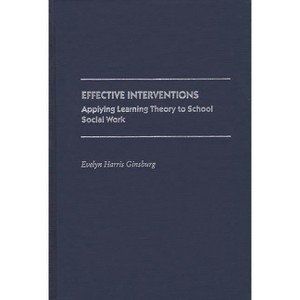
- This groundbreaking volume is written for therapists, school social workers, educational practitioners, and others who wish to provide psychological treatment to children from within the school environment.
- About the Author: EVELYN HARRIS GINSBURG is a School Social Worker in the Chicago Public Schools and a Field Instructor for the University of Chicago, School of Social Service Administration, the University of Illinois at Chicago, Jane Addams School of Social Work, and the Loyola University School of Social Work.
- 232 Pages
- Education, Counseling
- Series Name: Contributions to the Study of Education
Description
About the Book
This groundbreaking volume is written for therapists, school social workers, educational practitioners, and others who wish to provide psychological treatment to children from within the school environment. Evelyn Harris Ginsburg details the day-to-day functions and concerns of the school social worker, offering appropriate interventions that school social workers, no matter what their level of experience with applied behavior analysis, student social workers, and other school personnel can use to assist pupils. This study provides reports of empirically validated procedures--interventions that work--and the study serves as a needed working tool for those involved with the lives of children, to help them overcome a range of difficulties and to enhance their academic achievement. And, most of the procedures can be used not only by school personnel but also by the children themselves, family members, or friends working under the guidance of school social workers. The text, written in the language of learning theory, underlines the importance of environment in determining adjustment and advocates teamwork in schools and cooperation among those who deal with children in other settings.
Divided into three major sections, the volume begins with an introduction that provides a compelling rationale for behavior analysis in school social work. It also presents a history of behavioral analysis in schools and in social work and analyzes the current relation of the two. The central section is devoted to an explication of when to use behavior analysis that focuses on behavior problems related to school, home behavior problems related to school, and problems in the local community that effect school behavior. The final section addresses the components of the method, detailing useful interventions, parent training, and school related settings that favor behavior analysis. The valuable appendix offers a summary of the daily concerns of the behavioral school social worker, while an exhaustive bibliography as well as subject and author indexes complete the volume. Effective Interventions embodies a challenge to use the environment to improve the functioning of children and offers sound, practice-based strategies for doing so. Highly recommended as a how-to book for school social workers, behavior therapists, and school personnel, the study is also useful as a guide to further research needed in the field and as a text in college-level psychology, education, and social work courses.
Book Synopsis
This groundbreaking volume is written for therapists, school social workers, educational practitioners, and others who wish to provide psychological treatment to children from within the school environment. Evelyn Harris Ginsburg details the day-to-day functions and concerns of the school social worker, offering appropriate interventions that school social workers, no matter what their level of experience with applied behavior analysis, student social workers, and other school personnel can use to assist pupils. This study provides reports of empirically validated procedures--interventions that work--and the study serves as a needed working tool for those involved with the lives of children, to help them overcome a range of difficulties and to enhance their academic achievement. And, most of the procedures can be used not only by school personnel but also by the children themselves, family members, or friends working under the guidance of school social workers. The text, written in the language of learning theory, underlines the importance of environment in determining adjustment and advocates teamwork in schools and cooperation among those who deal with children in other settings.
Divided into three major sections, the volume begins with an introduction that provides a compelling rationale for behavior analysis in school social work. It also presents a history of behavioral analysis in schools and in social work and analyzes the current relation of the two. The central section is devoted to an explication of when to use behavior analysis that focuses on behavior problems related to school, home behavior problems related to school, and problems in the local community that effect school behavior. The final section addresses the components of the method, detailing useful interventions, parent training, and school related settings that favor behavior analysis. The valuable appendix offers a summary of the daily concerns of the behavioral school social worker, while an exhaustive bibliography as well as subject and author indexes complete the volume. Effective Interventions embodies a challenge to use the environment to improve the functioning of children and offers sound, practice-based strategies for doing so. Highly recommended as a how-to book for school social workers, behavior therapists, and school personnel, the study is also useful as a guide to further research needed in the field and as a text in college-level psychology, education, and social work courses.
Review Quotes
?Ginsburg examines the role of the school social worker and the collaborative relationships with other school personnel. She emphasizes the use of behavioral principles and behavior analysis in the educational and, to some degree, the home environment of the student. The history of behavior analysis is presented and the rationale for its use by school social workers is investigated. Utilizing school resources to change the environment in beneficial ways for the students is a major goal of school social workers and Ginsburg provides methodology to accomplish this. Although her focus is on studies and literature review, attention is also given to pragmatic specifics and applications to particular problems defined by the author. Examples of school programs that have adopted behavior analysis are highlighted. The book includes appendixes, and an extensive bibliography. Useful as a text or reference for school social workers. Recommended for upper-division undergraduate and graduate collections.?-Choice
"Ginsburg examines the role of the school social worker and the collaborative relationships with other school personnel. She emphasizes the use of behavioral principles and behavior analysis in the educational and, to some degree, the home environment of the student. The history of behavior analysis is presented and the rationale for its use by school social workers is investigated. Utilizing school resources to change the environment in beneficial ways for the students is a major goal of school social workers and Ginsburg provides methodology to accomplish this. Although her focus is on studies and literature review, attention is also given to pragmatic specifics and applications to particular problems defined by the author. Examples of school programs that have adopted behavior analysis are highlighted. The book includes appendixes, and an extensive bibliography. Useful as a text or reference for school social workers. Recommended for upper-division undergraduate and graduate collections."-Choice
About the Author
EVELYN HARRIS GINSBURG is a School Social Worker in the Chicago Public Schools and a Field Instructor for the University of Chicago, School of Social Service Administration, the University of Illinois at Chicago, Jane Addams School of Social Work, and the Loyola University School of Social Work. She is the author of School Social Work, A Practitioner's Guidebook: A Community Integrated Approach to Practice.
Shipping details
Return details
Trending Non-Fiction