Sponsored
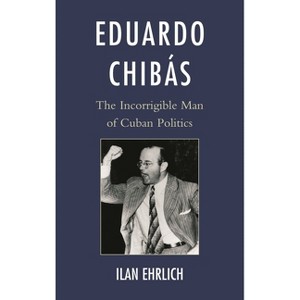
Eduardo Chibás - by Ilan Ehrlich Paperback
In Stock
Sponsored
About this item
Highlights
- This comprehensive biography of Eduardo René Chibás (1907-1951) traces the life and times of Cuba's most popular and charismatic politician during the late 1940s and early 1950s.
- About the Author: Ilan Ehrlich is assistant professor of history at Bergen Community College.
- 336 Pages
- Biography + Autobiography, Political
Description
About the Book
While Cuba's 1940 constitution was among the most progressive in the western hemisphere, few knew its details until political leader Chibás, whose suicide in 1951 precipitated the Cuban Revolution, read it on his radio program. This work explores Chibás's life in order to explain the nature of Cuban politics from the mid-twentieth century to today.
Book Synopsis
This comprehensive biography of Eduardo René Chibás (1907-1951) traces the life and times of Cuba's most popular and charismatic politician during the late 1940s and early 1950s. Chibás, whose admirers included young Fidel Castro, emphasized honesty in Cuban public life and promised to sweep away corrupt politicians during his popular Sunday broadcasts. His ties with supporters, many of whom knew him simply as "Eddy," were closer and more informal than any previous Cuban politician. During his 1948 presidential campaign, Chibás often hurled himself into the arms of adoring supporters after speeches. Such gestures were met with wonder and disgust by politicians more accustomed to buying votes than winning hearts. His suicide in 1951 dashed the dreams of his followers--who hoped he would deliver an honest government that provided services for the island's poor and respected Cuba's progressive 1940 constitution. His death, which was followed seven months hence by a military coup and eight years later by Castro's revolution, represents one of the great what ifs of Cuban politics. This seminal work explores Chibás's life in order to explain the nature of Cuban politics from the mid-twentieth century to today.
Review Quotes
"Ehrlich's extensive recounting of this dynamic era provides a lucid argument for affirming Chibás' importance in the Cuban pantheon. . . .Ehrlich's meticulous description of this period and his retelling of the ascent of Chibás as the main opposition candidate in the election cycle to follow leaves no stone unturned. . . .This publication excels at illustrating the impact on the island's zeitgeist during a pivotal point by one of the most dynamic political leaders in Cuba's history." --International Journal Of Cuban Studies
"A much-welcome and long-overdue English-language biography of the public life of Eddy Chibás. But more than a biography, Ehrlich's account serves to provide deeper insight into the Cuban political landscape of the 1940s, and hence a deeper insight into the complexities of the 1950s. An important gap in our knowledge has been filled." --Louis A. Pérez Jr., University of North Carolina at Chapel Hill
"A well-written and indispensable account of the late political life of Eduardo Chibás, a major figure in the first half of the twentieth century in Cuba and a forerunner of the revolution that overthrew the Batista dictatorship in 1959." --Samuel Farber, author of Cuba Since the Revolution of 1959: A Critical Assessment
"An important addition to this new scholarship on republican Cuba (1902-59). . . . The book provides much needed insight on one of the most important, yet neglected, figures of modern Cuban history, Eduardo Chibás. . . . [Ehrlich offers] much needed historical detail, nuance, and analysis about a period and a man whose life (and death) decisively changed Cuban history. The book is organized in ten well-written chapters which chronicle the decisive moments of Chibás's struggle against corruption and gangsterism. Each one is rich with detail about his activities, . . . such detailed accounts of both the man and his times provide us with a nuanced, multidimensional picture of Cuban political culture at a particular time in the country's history. . . . By telling these stories--by focusing on the choices particular people made at particular times--Ehrlich shows us that nothing was inevitable in Cuban politics, least of all the revolution of 1959." --Robert Whitney, New West Indian Guide
About the Author
Ilan Ehrlich is assistant professor of history at Bergen Community College.
Shipping details
Return details
Trending Non-Fiction






Discover more options