Sponsored
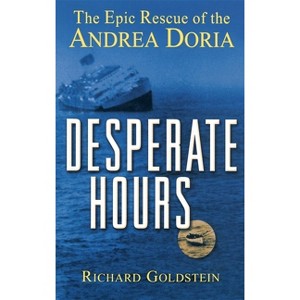
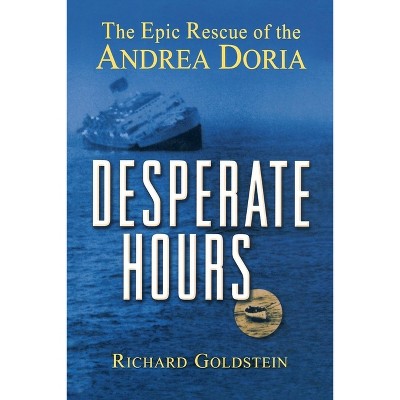
Desperate Hours - by Richard Goldstein Hardcover
In Stock
Sponsored
About this item
Highlights
- "A stupendous feat of reportage.
- About the Author: RICHARD GOLDSTEIN is an editor and writer for the New York Times, where he has worked since 1980.
- 304 Pages
- Transportation, Ships & Shipbuilding
Description
About the Book
In the tradition of Walter Lord's classic "A Night to Remember, " a dramatic moment-by-moment account of the greatest peacetime sea rescue in history. Goldstein presents the definitive history of a fateful day, a legendary ocean liner, and a deadly shipwreck now considered the Mount Everest of scuba diving. Photos.
Book Synopsis
"A stupendous feat of reportage."
-Ron Powers, cowriter of Flags of Our Fathers
Praise for Desperate Hours
"Goldstein's book is packed with detail. . . . This description of the Doria's sinking is especially moving."
--The New York Times
"A stupendous feat of reportage. Goldstein has virtually put us into lifeboats and sent us hurtling into the North Atlantic on the night of July 25, 1956."
--Ron Powers, cowriter, Flags of Our Fathers, and author of Dangerous Water and Tom and Huck Don't Live Here Anymore
On an extraordinary summer's night in 1956, in a fog off Nantucket, the world-renowned ocean liner Andrea Doria collided with the Swedish liner Stockholm and, eleven hours later, tragically sank. But in that brief time the Doria became, after the Titanic, the most storied vessel of the century, as nearly 1,700 people were saved in an unforgettable rescue punctuated by countless acts of heroism amid confusion, terror, and even cowardice.
In the tradition of Walter Lord's A Night To Remember, Desperate Hours re-creates the ill-fated voyage, from the passengers' parting waves at Genoa, to their last evening highball in the Doria's lavish lounge, to the unbelievable realization that catastrophe was imminent. Richard Goldstein draws from dozens of interviews, court documents, memoirs, and reports that relate never-before-told stories. He also presents technical findings that shed light on the blame for the disaster. The result is a definitive history of a fateful day, a legendary liner, and a deadly shipwreck now considered by scuba divers to be the Mount Everest of the deep.
From the Back Cover
In the tradition of Walter Lord's A Night to Remember, a dramatic moment-by-moment account of the greatest peacetime sea rescue in history
Advance Praise for Desperate Hours
"A stupendous feat of reportage. Goldstein has virtually put us into lifeboats and sent us hurtling into the North Atlantic on the night of July 25, 1956." ?Ron Powers, cowriter, Flags of Our Fathers, and author of Dangerous Water and Tom and Huck Don't Live Here Anymore
"Riveting. A vivid reconstruction of the chain of small events leading to a disaster and its impact on a rich cast of characters from a vanished era." ?Neil Hanson, author of The Custom of the Sea
Review Quotes
Praise for Desperate Hours
"Goldstein's book is packed with detail. . . . This description of the Doria's sinking is especially moving." -The New York Times
"A stupendous feat of reportage. Goldstein has virtually put us into lifeboats and sent us hurtling into the North Atlantic on the night of July 25, 1956." --Ron Powers, cowriter, Flags of Our Fathers, and author of Dangerous Water and Tom and Huck Don't Live Here Anymore
"On July 25th, 1956, the modern Swedish liner Stockholm collided with the equally modern Italian luxury liner Andrea Doria. The sea was foggy but calm, and both vessels had radar and experienced bridge crews. Eleven hours later, the Doria was lying on the bottom of the Atlantic, having lost 46 of its 1700 passengers; five lives were lost on the Stockholm. An editor and writer for The New York Times and author of Mine Eyes Have Seen, Goldstein focuses on the stories of the people, with just enough attention to the technical issues and the various legal battles to round out the account. Following the story from ship to ship, deck to deck, he clearly dissects the rescue of the passengers and crew. As often in large disasters, some committed acts of heroism, some cowardice; others just muddled through. The causes of the accident have never been fully adjudicated. The collision may have been the result of a concatenation of minor mistakes in judgment, but, as Goldstein demonstrates, the rescue was the result of a number of organizations, ships, and people who cooperated smoothly under extreme pressure. Recommended for most public libraries." --Library Journal, October 15, 2001
"The leading disaster story of 1956 was the collision during a foggy Long Island summer night of the Italian liner Andrea Doria with the Swedish liner Stockholm. Here, journalist Goldstein (Mine Eyes Have Seen, 1997) offers the definitive history of the Doria's sinking and the rescue of 1,700 people. Despite the modest death toll (46), the Doria's story bears striking resemblance to the Titanic's. Both were luxury liners built to the most advanced technology, sailing too fast in a dangerous area with poor visibility. In both, it was clear soon after the collision that the ship would sink. Both evacuations, however, were chaotic. Despite many heroic exceptions, too many crewmembers panicked, crowding into the first lifeboats. Unlike the Titanic, the Doria carried enough boats, but half were unavailable. At any angle above 15 degrees, boats on the high side couldn't be launched, and the Doria's list quickly reached 18 degrees. Because boats on the low side had to be dropped into the sea before loading, passengers were forced to climb down rope ladders or jump into the water. If the Doria had sunk in the Titanic's two-and-a-half hours instead of eleven, the death toll would have been catastrophic. After the rescue came the usual recriminations, investigations, and lawsuits. Each side gave conflicting versions of the collision, so no blame could be assigned. Even today the Andrea Doria continues to exact a toll. Resting at 250 feet, the limit for a skilled diver, it receives a steady stream of visitors. They explore, extract souvenirs, and sometimes die, at the rate of nearly one per year.
Goldstein has interviewed a mass of participants and experts. The result: a detailed and authoritative history ranging from the background of the liners and the technical details of ship construction and transatlantic navigation to a gripp
About the Author
RICHARD GOLDSTEIN is an editor and writer for the New York Times, where he has worked since 1980. He is the author of America at D-Day and Mine Eyes Have Seen: A First-Person History of the Events That Shaped America, which was an alternate selection of the Literary Guild. He lives in White Plains, New York.
Shipping details
Return details
Trending Non-Fiction






Discover more options