Sponsored
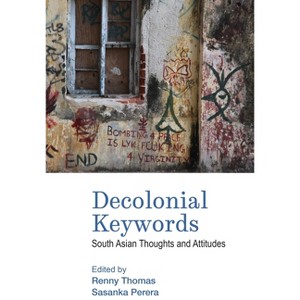
Decolonial Keywords - by Renny Thomas & Sasanka Perera (Hardcover)
Pre-order
Sponsored
About this item
Highlights
- This volume presents a set of keywords and concepts embedded in the languages of South Asia and its vast cultural landscape.
- About the Author: Renny Thomas is Assistant Professor of Sociology and Social Anthropology at the Department of Humanities and Social Sciences, Indian Institute of Science Education and Research (IISER) Bhopal, India, and was the Taki Visiting Global Professor at the Gallatin School of Individualized Study, New York University, New York, USA (2024-25).
- 324 Pages
- History, Social History
Description
About the Book
Presents a set of keywords, concepts thar represent the importance in moving away from the intellectual shackles of colonial and neo-colonial experiences.
Book Synopsis
This volume presents a set of keywords and concepts embedded in the languages of South Asia and its vast cultural landscape. It reiterates specific attitudes, ways of seeing and methods of doing, which are embedded in the historical and contemporary experiences in the region. The words, concepts, ideas and attitudes in the volume explore the contexts of their production and how their meanings might have changed at different historical moments. The volume also attempts to work out if these words and concepts can infuse a certain intellectual rigor to reinvent social sciences and humanities in the region and beyond. Individual essays, which are creative, imaginative, ethnographic and historical, explore the possibility of South Asian intellectual worlds and words to create a broader crossregional and global social science and humanities. The volume argues that it is important to move away from the intellectual shackles inherited from colonial and neo-colonial experiences while also not succumbing to the traps of local reductionist nativisms and cultural nationalisms.
Review Quotes
Decolonial Keywords: South Asian Thoughts and Attitudes is an original and inspiring collection of studies of thirty words, concepts, ideas and attitudes rooted in South Asia, from Nepal to Sri Lanka. It takes the reader on a detailed, deep, sometimes serious at others joyful and unfamiliar exploration of a range of keywords in multiple languages. The volume is clearly written and structured. It is an important contribution to the slew of recent works speaking from the global South aimed at theorizing from the historical and political trajectories of the South to offer an alternative to the dominant Euro-American epistemologies in the humanities and social sciences. Husserl's assumption that words and concepts from South Asia belong to the domain of the 'particular' rather than the universal is still widely accepted. This collection shows, on the contrary, that some concepts and ideas could travel well and have universal applicability. Words such as rasa convey the complexity of sensual and affective knowledge in a way a European language cannot strive to; or the Sinhala word aragalaya captures the idea of a righteous struggle of the collective that is distinct from a revolution or revolt. Both these terms and many others in this book are useful additions to a world lexicon. Some terms are more embedded in South Asian reality as they aim not only to decolonize the language and public sphere but also to de-brahmanize social theories in the social sciences and humanities. But the book does caution the reader that the search for a local sense of knowing can be weaponized and appropriated by nativist nationalisms. Decolonial Keywords is a recommended read for anyone interested in interdisciplinary forms of knowledge and in alternative ways of thinking about the world.--Nira Wickramasinghe, Professor of Modern South Asian Studies, Leiden University, The Netherlands
The highly original and insightful contributions to this collection demonstrate that decolonization remains an intellectual necessity as much as a political imperative. The knowledge systems at work in postcolonial milieus often remain subject still to Western categories and strictures, obscuring the radical potential of other forms of thought and practice that may be inherited and recuperated for critical work. This volume shows how robust and challenging theories and concepts can be developed in relation to the thinking that animates social and cultural life in South Asia, both historical and contemporary. Drawing on the methods of many fields in the humanities and social sciences, as well as circumstances of life in diverse settings throughout the region, the contributors to this volume gift readers with a new archive of decolonial concepts: many quite fresh and unknown in academic circles, some more familiar yet imagined profoundly anew through the careful exegesis of these writers. The result is a volume that renews our sense of surprise and possibility in the philosophical texture of postcolonial modernity.--Anand Pandian, Professor of Anthropology, Johns Hopkins University, Baltimore
This is an exciting volume marking a significant contribution to the emerging field of scholarship identifying concepts from the global South. . . The ambition of the volume is to create the kinds of conversations that can regenerate humanities and social sciences in South Asia.--Nivedita Menon, Professor of Political Theory, Centre for Comparative Politics and Political Theory, Jawaharlal Nehru University, New Delhi
Using a range of keywords to re-orient directions in the study of South Asian history and society, this volume is a valuable contribution to the subject. Keywords ranging from classical terms in music, art and philosophy to colloquial ones that are commonly used in everyday conversation and political ones that became well known in the recent past are juxtaposed to create a rich tapestry of textures, tones and colours. In their attempt to provide a non-essentialist and decolonized interpretation of South Asian history and culture, the editors have included English words such as 'lab' and 'violence' that are very much part of the fabric of ordinary, day-to-day life. Apart from commonly used words, the inclusion of terms from Western classical music that are an important part of the musical heritage of North-Eastern India is refreshing. It not only points to the cultural diversity of South Asia but also to its hybridity. While national cultures in the countries that make up the subcontinent may be different from each other with differing histories of colonization and independence, they have all at different moments in their histories embraced other cultures and integrated them into their own. At a time when most countries across the world are seeing a resurgence in nationalist ideologies, a volume that celebrates cultural diversity is a welcome contribution to the field of social science.--Roma Chatterji, Former Professor of Sociology, University of Delhi and Visiting Professor, Shiv Nadar University, Delhi NCR
About the Author
Renny Thomas is Assistant Professor of Sociology and Social Anthropology at the Department of Humanities and Social Sciences, Indian Institute of Science Education and Research (IISER) Bhopal, India, and was the Taki Visiting Global Professor at the Gallatin School of Individualized Study, New York University, New York, USA (2024-25). Before joining IISER, he taught Sociology at the University of Delhi (2015-21). He has been a Charles Wallace Fellow in Social Anthropology at Queen's University Belfast, Northern Ireland, UK (2017-18) and a Visiting Fellow at the Department of Cultural Anthropology and Cultural History at the Friedrich Schiller University, Jena, Germany (2022-23). He is the author of Science and Religion in India: Beyond Disenchantment (2021) and co-editor of Mapping Scientific Method: Disciplinary Narrations (2022).
Sasanka Perera is Chairman of the Colombo Institute for Human Sciences, and was Professor of Sociology at University of Colombo, Sri Lanka and South Asian University (SAU), New Delhi. He is the author of several books including Violence and the Burden of Memory: Remembrance and Erasure in Sinhala Consciousness (2015), Warzone Tourism in Sri Lanka: Tales from Darker Places in Paradise (2016) and The Fear of the Visual? Photography, Anthropology and Anxieties of Seeing (2020). He has edited and co-edited various volumes including Sociology and Social Anthropology in South Asia: Histories and Practices (2018), Intersections of Contemporary Art, Anthropology and Art History in South Asia: Decoding Visual Worlds (2019), Against the Nation: Thinking Like South Asians (2019) and Humour and the Performance of Power in South Asia: Anxiety, Laughter and Politics in Unstable Times (2022).
Shipping details
Return details
Frequently bought together






Trending Non-Fiction





Discover more options