Sponsored
In Stock
Sponsored
About this item
Highlights
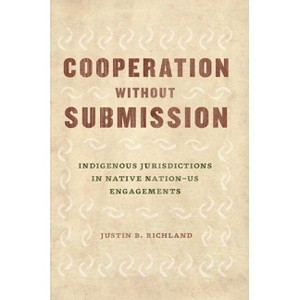
- A meticulous and thought-provoking look at how Tribes use language to engage in "cooperation without submission.
- About the Author: Justin B. Richland is associate justice of the Hopi Appellate Court as well as associate professor of anthropology at the University of California, Irvine, and faculty fellow of the American Bar Foundation.
- 232 Pages
- Freedom + Security / Law Enforcement, Indigenous Peoples
- Series Name: Chicago Law and Society
Description
About the Book
"Justin B. Richland continues his study of the relationship between American law and government and Native American law and tribal governance in his new manuscript Cooperation without Submission: Indigenous Jurisdictions in Native Nation-US Engagements. Richland looks at the way Native Americans and government officials talk about their relationship and seek to resolve conflicts over the extent of Native American authority in tribal lands when it conflicts with federal law and policy. The American federal government is supposed to engage in meaningful consultations with the tribes about issues that affect the tribes under long standing Federal law which accorded the federal government the responsibility of a trustee to the tribes. It requires the government to act in the best interest of the tribes and to interpret agreements with tribes in a way that respects their rights and interests. At least partly based on a patronizing view of Native Americans, the law has also sought to protect the interests of the tribes from those who might take advantage of them. In Cooperation without Submission, Richland looks closely at the language employed by both sides in consultations between tribes and government agencies focusing on the Hopi tribe but also discussing other cases. Richland shows how tribes conduct these meetings using language that demonstrates their commitment to nation-to -nation interdependency, while federal agents appear to approach these consultations with the assumption that federal l aw is supreme and ultimately authoritative"--
Book Synopsis
A meticulous and thought-provoking look at how Tribes use language to engage in "cooperation without submission."
It is well-known that there is a complicated relationship between Native American Tribes and the US government. Relations between Tribes and the federal government are dominated by the principle that the government is supposed to engage in meaningful consultations with the tribes about issues that affect them.
In Cooperation without Submission, Justin B. Richland, an associate justice of the Hopi Appellate Court and ethnographer, closely examines the language employed by both Tribes and government agencies in over eighty hours of meetings between the two. Richland shows how Tribes conduct these meetings using language that demonstrates their commitment to nation-to-nation interdependency, while federal agents appear to approach these consultations with the assumption that federal law is supreme and ultimately authoritative. In other words, Native American Tribes see themselves as nations with some degree of independence, entitled to recognition of their sovereignty over Tribal lands, while the federal government acts to limit that authority. In this vital book, Richland sheds light on the ways the Tribes use their language to engage in "cooperation without submission."
Review Quotes
"A significant contribution to an important and ongoing conversation. Thoughtful, erudite, and insightful, Richland's scholarship deserves an appreciative audience among practitioners and scholars of Native law and policy, and all who are interested in advancing the cause of Indigenous self-determination."-- "New Mexico Historical Review"
"The true marvel of this book is its assertion of Indigenous sovereignty in the legal landscape, which Richland suggests is a key component in taking steps toward decolonization and as a way forward in Native Nation-US engagements predicated upon amore equitable relationship of reciprocity, respect, and understanding."-- "Great Plains Quarterly"
"Justin B. Richland's new book, Cooperation without Submission, provides a valuable decoder ring for non-Native government officials, scholars, and researchers who seek to consult meaningfully with Native leaders, Native nation governments, and their advocates. Rather than characterize and base recommendations on generalized Indigenous values or philosophies, the author draws conclusions from scrutinizing the details of specific Native-US engagements, and observing and analyzing the language used in meeting transcripts and legal texts. Richland does so with a thorough consideration of the current sociolegal scholarship on Indigenous law ways, settler colonialism, and US federal Indian law."-- "American Indian Culture and Research Journal"
About the Author
Justin B. Richland is associate justice of the Hopi Appellate Court as well as associate professor of anthropology at the University of California, Irvine, and faculty fellow of the American Bar Foundation. He is the author of several works on the contemporary legal systems and practices of Native American Nations, including Introduction to Tribal Legal Studies and Arguing with Tradition: The Language of Law in Hopi Tribal Court, the latter also published by the University of Chicago Press.
Shipping details
Return details
Frequently bought together





Trending Non-Fiction





Discover more options