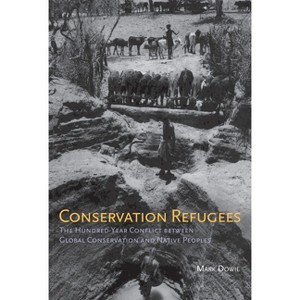
How native people--from the Miwoks of Yosemite to the Maasai of eastern Africa--have been displaced from their lands in the name of conservation.Since 1900, more than 108,000 officially protected conservation areas have been established worldwide, largely at the urging of five international conservation organizations.
About the Author: Award-winning journalist Mark Dowie is the author of Losing Ground: American Environmentalism at the Close of the Twentieth Century, American Foundations: An Investigative History (both published by the MIT Press), and four other books.
376 Pages
Nature, Environmental Conservation & Protection
Description
About the Book
How native people--from the Miwoks of Yosemite to the Maasai of eastern Africa--have been displaced from their lands in the name of conservation.
Book Synopsis
How native people--from the Miwoks of Yosemite to the Maasai of eastern Africa--have been displaced from their lands in the name of conservation.
Since 1900, more than 108,000 officially protected conservation areas have been established worldwide, largely at the urging of five international conservation organizations. About half of these areas were occupied or regularly used by indigenous peoples. Millions who had been living sustainably on their land for generations were displaced in the interests of conservation. In Conservation Refugees, Mark Dowie tells this story. This is a "good guy vs. good guy" story, Dowie writes; the indigenous peoples' movement and conservation organizations have a vital common goal--to protect biological diversity--and could work effectively and powerfully together to protect the planet and preserve biological diversity. Yet for more than a hundred years, these two forces have been at odds. The result: thousands of unmanageable protected areas and native peoples reduced to poaching and trespassing on their ancestral lands or "assimilated" but permanently indentured on the lowest rungs of the money economy. Dowie begins with the story of Yosemite National Park, which by the turn of the twentieth century established a template for bitter encounters between native peoples and conservation. He then describes the experiences of other groups, ranging from the Ogiek and Maasai of eastern Africa and the Pygmies of Central Africa to the Karen of Thailand and the Adevasis of India. He also discusses such issues as differing definitions of "nature" and "wilderness," the influence of the "BINGOs" (Big International NGOs, including the Worldwide Fund for Nature, Conservation International, and The Nature Conservancy), the need for Western scientists to respect and honor traditional lifeways, and the need for native peoples to blend their traditional knowledge with the knowledge of modern ecology. When conservationists and native peoples acknowledge the interdependence of biodiversity conservation and cultural survival, Dowie writes, they can together create a new and much more effective paradigm for conservation.
Review Quotes
A beautiful balance of critique and sympathy.-- Publishers Weekly--
Far from being a hysterical diatribe...this exceptionally researched and documented study provides authoritative guidance toward a diverse and sustainable future.
--Richard W. Grefrath, Magill Book Reviews--
About the Author
Award-winning journalist Mark Dowie is the author of Losing Ground: American Environmentalism at the Close of the Twentieth Century, American Foundations: An Investigative History (both published by the MIT Press), and four other books.
Dimensions (Overall): 8.94 Inches (H) x 6.05 Inches (W) x .94 Inches (D)
If the item details aren’t accurate or complete, we want to know about it.
Shipping details
Estimated ship dimensions: 0.94 inches length x 6.05 inches width x 8.94 inches height
Estimated ship weight: 1.12 pounds
We regret that this item cannot be shipped to PO Boxes.
This item cannot be shipped to the following locations: American Samoa (see also separate entry under AS), Guam (see also separate entry under GU), Northern Mariana Islands, Puerto Rico (see also separate entry under PR), United States Minor Outlying Islands, Virgin Islands, U.S., APO/FPO, Alaska, Hawaii
Return details
This item can be returned to any Target store or Target.com.
This item must be returned within 90 days of the date it was purchased in store, delivered to the guest, delivered by a Shipt shopper, or picked up by the guest.
Q: What is the author's perspective on collaboration for conservation?
submitted by AI Shopping Assistant - 2 months ago
A: Dowie argues that recognizing the interdependence of cultural survival and biodiversity conservation can foster effective collaborative efforts.
submitted byAI Shopping Assistant - 2 months ago
Ai generated
Q: How does the book address the relationship between conservation and indigenous peoples?
submitted by AI Shopping Assistant - 2 months ago
A: It discusses the tension between conservation initiatives and indigenous populations, suggesting collaboration for effective biodiversity protection.
submitted byAI Shopping Assistant - 2 months ago
Ai generated
Q: What examples of indigenous groups are mentioned?
submitted by AI Shopping Assistant - 2 months ago
A: The book includes examples like the Miwoks of Yosemite, Maasai of Africa, Ogiek, Pygmies, Karen of Thailand, and Adevasis of India.
submitted byAI Shopping Assistant - 2 months ago
Ai generated
Q: What historical perspective does the author provide?
submitted by AI Shopping Assistant - 2 months ago
A: Dowie offers a historical perspective on over a century of displacements caused by conservation policies and their impacts on indigenous communities.
submitted byAI Shopping Assistant - 2 months ago
Ai generated
Q: What is the main focus of the book?
submitted by AI Shopping Assistant - 2 months ago
A: The book explores how indigenous people have been displaced for conservation efforts, highlighting conflicts between conservation practices and native rights.