Sponsored
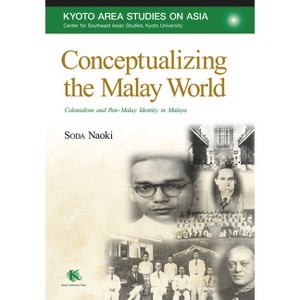
Conceptualizing the Malay World - by Naoki Soda (Paperback)
In Stock
Sponsored
About this item
Highlights
- Conceptualizing the Malay World explores the interrelations between the indigenization of "colonial knowledge" and the quest for pan-Malay identity in Malaya.
- About the Author: Soda Naoki is Professor at the Institute of Global Studies, Tokyo University of Foreign Studies.
- 226 Pages
- History, Asia
Description
Book Synopsis
Conceptualizing the Malay World explores the interrelations between the indigenization of "colonial knowledge" and the quest for pan-Malay identity in Malaya. In what way, to what extent, and for what purpose did the colonized accept, modify, and adapt the colonizer's worldview? To answer these questions, this study examines textbooks produced by British and Malay authors for teaching Malay history and geography to the local populace in teacher training colleges, then conducts a case study of one of these students who would go on to become a prominent nationalist activist. It shows that while the colonizers brought new concepts of Malayness to Malaya, the indigenization of colonial knowledge entailed significant reinterpretation, transformation, and appropriation.
Review Quotes
"Having a chance to review a book on my alma mater is truly a wonderful opportunity. Entitled Conceptualizing the Malay World: Colonialism and Pan-Malay Identity, the book was originally a doctoral thesis. First published in 2020, it is an eye-opener to the role of Malay educational institutions, particularly SITC, in triggering the spirit of Malay nationalism throughout Malaya. Although the discussion is limited to certain aspects and criteria, it undoubtedly provides an engaging and compelling analysis on the impact of colonial education towards the formation of Pan-Malay identity in British Malaya. The analysis is indeed thorough and meticulous while the structure of the ideas is well organised. The painstaking research to collect the primary and secondary data such as the interviews should be given unreserved praise [...] The strength of this book lies in its meticulous comparative textual analyses of four textbooks as well as the various writings by Ibrahim Haji Yaacob. Every significant key concept from the textbooks was rigorously analysed, thereby qualifying this book as a must-read for every ardent researcher and reader, especially to those specialising in Malay nationalism." --Norizan Kadir, Kyoto University Press
"In essence, this book is a story of Malay identity: how the colonialists sought to impose their definitions of ethnicity on the populace, and how the locals redefined those understandings as active agents and not passive passers-by. The book deals with the "transmission, localization, transformation, reproduction and reconstruction" of Knowledge; it must never be assumed that just because there is a power of imbalance, anything the colonialists tried to impart would be wholly accepted by the native populations. [...] The book most definitely achieved its objective in demonstrating the various contestations that took place with colonial impositions, through the adroit usage of the case of Ibrahim. Its relevance to current-day politics in Malaysia was made explicit, and shows how the study is not merely looking back at history for the sake of it, but to make sense of the Malay world as we know it today. [...] The book is a welcome and positive contribution in examining the contestations toward colonial rule which existed in the realm of ideas, in the British were almost able to redefine ethnicity in Southeast Asia as they pleased. Monograph like this serve to show that the situation was far more nuanced and complicated than many had hitherto imagined." --Walid Jumblatt Bin Abdullah, Journal of the Malaysian Branch of the Royal Asiatic Society
About the Author
Soda Naoki is Professor at the Institute of Global Studies, Tokyo University of Foreign Studies. He specializes in modern Southeast Asian history and Malaysian political and social history. He received his PhD in Area Studies from Kyoto University in 2008, and served at the National Museum of Ethnology as Researcher, and at the Tokyo University of Foreign Studies as Lecturer in 2002 and as Assistant Professor in 2006, before taking up his current position in 2019.
Shipping details
Return details
Frequently bought together




Trending Non-Fiction





Discover more options