Target New ArrivalsGift Ideas for DadClothing, Shoes & AccessoriesHome & DecorKitchen & DiningOutdoor Living & GardenGroceryHousehold EssentialsBabyBeautyPersonal CareSports & OutdoorsHealthWellnessLuggageSchool & Office SuppliesToysElectronicsVideo GamesMovies, Music & BooksParty SuppliesGift IdeasGift CardsPetsUlta Beauty at TargetShop by CommunityTarget OpticalDealsClearanceNew ArrivalsGift Ideas for DadBack to SchoolCollegeTop DealsTarget Circle DealsWeekly AdShop Order PickupShop Same Day DeliveryRegistryRedCardTarget CircleFind Stores
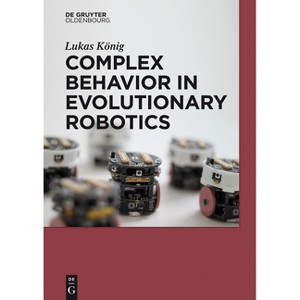
Complex Behavior in Evolutionary Robotics - by  Lukas König (Paperback) - 1 of 1

Complex Behavior in Evolutionary Robotics - by Lukas König (Paperback)

$105.00

In Stock

Free & easy returns

Free & easy returns

Return this item by mail or in store within 90 days for a full refund.
Eligible for registries and wish lists

About this item

Highlights

  • Today, autonomous robots are used in a rather limited range of applications such as exploration of inaccessible locations, cleaning floors, mowing lawns etc.
  • About the Author: Lukas König, KIT Karslruhe, Germany.
  • 262 Pages
  • Technology, Robotics

Description


About the Book


This book examines four new approaches for problem solving in evolutionary robotics and agent simulation. Of particular interest is a new method that imitates natural evolution, allowing mutation and recombination operations to be adapted during the


Book Synopsis


Today, autonomous robots are used in a rather limited range of applications such as exploration of inaccessible locations, cleaning floors, mowing lawns etc. However, ongoing hardware improvements (and human fantasy) steadily reveal new robotic applications of significantly higher sophistication. For such applications, the crucial bottleneck in the engineering process tends to shift from physical boundaries to controller generation. As an attempt to automatize this process, Evolutionary Robotics has successfully been used to generate robotic controllers of various types. However, a major challenge of the field remains the evolution of truly complex behavior. Furthermore, automatically created controllers often lack analyzability which makes them useless for safety-critical applications. In this book, a simple controller model based on Finite State Machines is proposed which allows a straightforward analysis of evolved behaviors. To increase the model's evolvability, a procedure is introduced which, by adapting the genotype-phenotype mapping at runtime, efficiently traverses both the behavioral search space as well as (recursively) the search space of genotype-phenotype mappings. Furthermore, a data-driven mathematical framework is proposed which can be used to calculate the expected success of evolution in complex environments.


About the Author


Lukas König, KIT Karslruhe, Germany.

Dimensions (Overall): 9.4 Inches (H) x 6.7 Inches (W) x .6 Inches (D)
Weight: 1.05 Pounds
Suggested Age: 22 Years and Up
Number of Pages: 262
Genre: Technology
Sub-Genre: Robotics
Publisher: De Gruyter Oldenbourg
Format: Paperback
Author: Lukas König
Language: English
Street Date: March 13, 2015
TCIN: 1010776122
UPC: 9783110408546
Item Number (DPCI): 247-31-2130
Origin: Made in the USA or Imported
If the item details aren’t accurate or complete, we want to know about it.

Shipping details

Estimated ship dimensions: 0.6 inches length x 6.7 inches width x 9.4 inches height
Estimated ship weight: 1.05 pounds
We regret that this item cannot be shipped to PO Boxes.
This item cannot be shipped to the following locations: American Samoa (see also separate entry under AS), Guam (see also separate entry under GU), Northern Mariana Islands, Puerto Rico (see also separate entry under PR), United States Minor Outlying Islands, Virgin Islands, U.S., APO/FPO, Alaska, Hawaii

Return details

This item can be returned to any Target store or Target.com.
This item must be returned within 90 days of the date it was purchased in store, delivered to the guest, delivered by a Shipt shopper, or picked up by the guest.
See the return policy for complete information.

Q: What framework is proposed for evaluating evolutionary success?

submitted by AI Shopping Assistant - 1 month ago
  • A: A data-driven mathematical framework is introduced to calculate expected evolutionary success in complex environments.

    submitted byAI Shopping Assistant - 1 month ago
    Ai generated

Q: What is the main focus of the book?

submitted by AI Shopping Assistant - 1 month ago
  • A: It primarily focuses on evolving complex behaviors and improving controller generation for autonomous robots.

    submitted byAI Shopping Assistant - 1 month ago
    Ai generated

Q: What are the new approaches discussed in the book?

submitted by AI Shopping Assistant - 1 month ago
  • A: The book examines four innovative approaches for problem solving in evolutionary robotics and agent simulation.

    submitted byAI Shopping Assistant - 1 month ago
    Ai generated

Q: What improvements does the book suggest for robotic applications?

submitted by AI Shopping Assistant - 1 month ago
  • A: It discusses evolving sophisticated robotic applications by overcoming current limitations in hardware and controller generation.

    submitted byAI Shopping Assistant - 1 month ago
    Ai generated

Q: How does the book propose to analyze evolved behaviors?

submitted by AI Shopping Assistant - 1 month ago
  • A: It introduces a Finite State Machines model that allows straightforward behavior analysis for evolved robotic controllers.

    submitted byAI Shopping Assistant - 1 month ago
    Ai generated

Additional product information and recommendations

Discover more options

Get top deals, latest trends, and more.

Privacy policy