Sponsored
Pre-order
Sponsored
About this item
Highlights
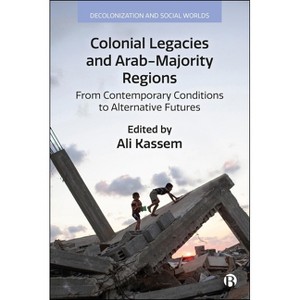
- How do colonial legacies shape contemporary realities in the Arab-majority region?
- About the Author: Ali Kassem is Lecturer in Sociology at the National University of Singapore.
- 300 Pages
- Political Science, Colonialism & Post-Colonialism
- Series Name: Decolonization and Social Worlds
Description
About the Book
How do colonial legacies shape the Arab-majority region today? This groundbreaking book unpacks power, resistance and decolonial futures-from refugee aid to climate crises.
Book Synopsis
How do colonial legacies shape contemporary realities in the Arab-majority region? What possibilities exist for decolonial futures?
This groundbreaking volume brings together interdisciplinary explorations of the enduring colonial condition in the Arab-majority region, moving beyond reductive analyses and engaging deeply with a variety of histories, lived experiences, and theoretical tools. Across its chapters, the collection exposes how various structures and institutions operating at diverse sites and scales constitute a contemporary entangled coloniality, and offers pathways and resources towards moving beyond this from, for, and contra the region.
In the shadow of ongoing colonial violence, this collection is both an urgent critique and a hopeful call for new ways of knowing and reimagining the future of the Arab-majority region.
Review Quotes
'In this excellent volume Ali Kassem brings together a new generation of scholarship, from and on the region, working out what a decolonial approach means for the study of the Arab-majority world. Ranging across disciplines, and spanning from Morocco to Qatar, the chapters wrestle reflexively with theory and method as they take on a spectrum of topics including the state, race, aid, development, and urban planning and conservation. The book, with its incisive introduction and concluding chapters, is a must-read for those interested in decolonial knowledge production and praxis in the region in the 21st century.' Jonathan Wyrtzen, Yale University
'A vital, multivocal exploration of South-South dialogues. Ali Kassem curates a groundbreaking volume, forging new paths beyond centers of power/knowledge. This is essential reading for scholars of transnational imperial legacies and decolonial resistances.' Santiago Slabodsky, Hofstra University
'This volume is sure to open up transdisciplinary and transregional conversations about the crucial meaning of the decolonial and its liberatory potential. Theoretically sophisticated and in touch with critical international thought, it is distinctive not just for its grounding in empirically rich analyses of the current colonial condition in what Kassem calls the Arab-majority region, but also for its hopeful offer to think both about and for the region.' Lila Abu-Lughod, Columbia University
'This fascinating collection of essays examines a range of political and social issues through a decolonial lens in Arab-majority countries. Covering subjects as diverse as the scarcity of green spaces in Beirut, the double burden faced by Arab scholars at home and in the diaspora, the role of race and extractive colonialism, and many more subjects besides, the authors in this volume ask us to rethink received political and heuristic categories and think with the people of the region.' Laleh Khalili, University of Exeter
'In this excellent volume Ali Kassem brings together a new generation of scholarship, from and on the region, working out what a decolonial approach means for the study of the Arab-majority world. Ranging across disciplines, and spanning from Morocco to Qatar, the chapters wrestle reflexively with theory and method as they take on a spectrum of topics including the state, race, aid, development, and urban planning and conservation. The book, with its incisive introduction and concluding chapters, is a must-read for those interested in decolonial knowledge production and praxis in the region in the 21st century.' Jonathan Wyrtzen, Yale University
'A vital, multivocal exploration of South-South dialogues. Ali Kassem curates a groundbreaking volume, forging new paths beyond centers of power/knowledge. This is essential reading for scholars of transnational imperial legacies and decolonial resistances.' Santiago Slabodsky, Hofstra University
'This fascinating collection of essays examines a range of political and social issues through a decolonial lens in Arab-majority countries. Covering subjects as diverse as the scarcity of green spaces in Beirut, the double burden faced by Arab scholars at home and in the diaspora, the role of race and extractive colonialism, and many more subjects besides, the authors in this volume ask us to rethink received political and heuristic categories and think with the people of the region.' Laleh Khalili, University of Exeter
'This volume is sure to open up transdisciplinary and transregional conversations about the crucial meaning of the decolonial and its liberatory potential. Theoretically sophisticated and in touch with critical international thought, it is distinctive not just for its grounding in empirically rich analyses of the current colonial condition in what Kassem calls the Arab-majority region, but also for its hopeful offer to think both about and for the region.' Lila Abu-Lughod, Columbia University
"The strength of this book lies in its central focus on how places - along with their institutions, associations, academic debates, and public opinion mobilization - contribute to transforming work organization within the platform economy." Social Policy Administration
About the Author
Ali Kassem is Lecturer in Sociology at the National University of Singapore.
Shipping details
Return details
Frequently bought together

Trending Non-Fiction