Sponsored
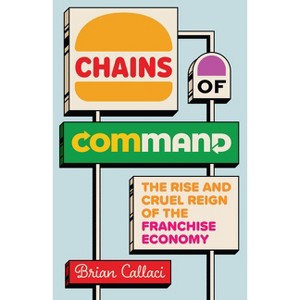
Chains of Command - by Brian Callaci (Hardcover)
Pre-order
Sponsored
About this item
Highlights
- A surprising look at the big business of owning small businesses and what America's franchise economy means for its workers.
- About the Author: Brian Callaci is chief economist at the Open Markets Institute and a former staffer and research consultant for labor unions.
- 264 Pages
- Art, Russian + Former Soviet Union
Description
About the Book
"Franchising is everywhere in the United States. From ride-sharing apps to fast food to poultry farming, millions of small businesses are controlled by systems of oversight-franchisors--designed to maximize the efficiencies and profits of their franchisees. Their controls include not only branding and operations, but wages and worker advancement. What else are they doing? In this revelatory work, economist Brian Callaci shows how franchising-ostensibly an economic system for aligning interests between franchisor and franchisee--has advanced all manner of legal and economic sins on the US economy and labor force. As a business model, franchises produce structural protections for owners from workers, especially in matters related to wages and worker organizing. The results have been unfettered growth of some of America's most recognizable businesses, at the aggregate expense of America's workers. Telling for the first time the history of this business movement--initially struck down by US courts, then revived over decades by some of America's most recognizable entrepreneurs--Callaci's story is remarkable in its scale, synthesis, and importance. Chains of Command is an urgent and erudite history of how the US labor market was tamed"-- Provided by publisher.
Book Synopsis
A surprising look at the big business of owning small businesses and what America's franchise economy means for its workers.
Walk into a McDonald's anywhere in the United States, and it will be identical to every other McDonald's in the country. Yet, that particular store is almost certainly owned and operated by an "independent" franchisee. While McDonald's presents an image of centralized uniformity to the consumer, it shows a different face to the small business owners operating its stores under its control and the workers preparing its product to its standards. How then does McDonald's--and its big business peers--manage to be two things at once?
In this revelatory work, economist Brian Callaci shows how franchisors have altered the legal treatment of corporations in their favor through a decades-long crusade of lobbying and litigation. Their efforts subsequently unleashed a slew of legal and economic sins upon the US economy and labor force, allowing multinational corporations to control continent-spanning empires while outsourcing employment and scapegoating legal responsibilities onto small businesses. The result: the unfettered growth of some of America's most recognizable businesses, at the aggregate expense of America's workers.
Remarkable in both its scale and synthesis, Callaci's story is the first chronicle of this business movement--initially resisted by US courts before experiencing a dramatic reversal of fortune after decades of campaigning by some of America's most established entrepreneurs. An urgent and erudite history, Chains of Command reveals how the US labor market was tamed one small business at a time.
Review Quotes
"Chains of Command masterfully tells the story of how franchising as a business model has become so ubiquitous since the 1960s, and how that model has eroded protections for workers and disempowered many franchisees. Callaci brings this story to life, providing an easily accessible and massively important account of how franchising business contracts have empowered franchisor-owners at the expense of franchisees and workers at a dramatic--and devastating--scale."
--Laura Phillips-Sawyer author of "American Fair Trade: Proprietary Capitalism, Corporatism, and the 'New Competition, ' 1890-1940""Callaci provides a riveting account of the rise of modern franchising. By comprehensively charting the International Franchising Association's political rise and its role in shaping the legal framework of franchising, he explains the ability of franchisors to control most aspects of franchisee operations while avoiding responsibility for their negative effects on workers. His account deftly explains the consequent challenges facing both franchisees and their workers."
--David Weil author of "The Fissured Workplace: Why Work Became So Bad for So Many and What Can Be Done to Improve It""Callaci's superb analysis of how diabolically clever franchisors created a fast-food dystopia will make you think twice the next time you order a Big Mac or nibble on a cruller. He gets inside the corporate mindset to show how these giant companies used the media, courts, legislatures, and government regulatory agencies to win control of their workers without taking legal, financial, or moral responsibility for the resultant exploitation."
--Nelson Lichtenstein author of "Why Labor Unions Matter"About the Author
Brian Callaci is chief economist at the Open Markets Institute and a former staffer and research consultant for labor unions. He has published widely in TheHarvard Business Review, The New Republic, Boston Review, and Democracy Journal, among others.
Shipping details
Return details
Frequently bought together






Trending Non-Fiction





Discover more options