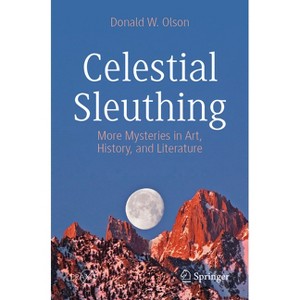
Many mysteries in art, history, and literature can be solved using "celestial sleuthing," including calculating phases of the Moon, determining the positions of the planets and stars, and identifying celestial objects in paintings.
About the Author: Donald W. Olson is a Regents' Professor and Distinguished Professor Emeritus of Physics at Texas State University.
368 Pages
Science, Astronomy
Description
Book Synopsis
Many mysteries in art, history, and literature can be solved using "celestial sleuthing," including calculating phases of the Moon, determining the positions of the planets and stars, and identifying celestial objects in paintings. In addition to helping to crack difficult cases, such studies spark our imagination and provide a better understanding of the skies. This book shows how weather archives, vintage maps, historical letters and diaries, military records, and site visits aid the work.
For each artwork, historical event, or literary passage influenced by astronomy, there is a different kind of mystery to be solved. For example, how can the position of the Sun and Moon determine the date and time of famous paintings by Vincent van Gogh and Caspar David Friedrich? How can astronomy determine a precise date for a work by Wassily Kandinsky, a painter best-known for abstract works with geometrical shapes and dramatic colors? What important battle of ancient history caused a design change with a crescent Moon added to the silver tetradrachms of Athens? In what season did Sappho write her iconic work, "The Midnight Poem"? Did observers actually report five Moons simultaneously in the sky during the time of King John, as recorded in lines from Shakespeare's play?
Follow these exciting investigations with Donald Olson, a master "Celestial Sleuth," as he tracks down the truth and helps unravel mysteries as far back as ancient history and as recent as World War II.
From the Back Cover
Many mysteries in art, history, and literature can be solved using "celestial sleuthing," including calculating phases of the Moon, determining the positions of the planets and stars, and identifying celestial objects in paintings. In addition to helping to crack difficult cases, such studies spark our imagination and provide a better understanding of the skies. This book shows how weather archives, vintage maps, historical letters and diaries, military records, and site visits aid the work.
For each artwork, historical event, or literary passage influenced by astronomy, there is a different kind of mystery to be solved. For example, how can the position of the Sun and Moon determine the date and time of famous paintings by Vincent van Gogh and Caspar David Friedrich? How can astronomy determine a precise date for a work by Wassily Kandinsky, a painter best-known for abstract works with geometrical shapes and dramatic colors? What important battle of ancient history caused a design change with a crescent Moon added to the silver tetradrachms of Athens? In what season did Sappho write her iconic work, "The Midnight Poem"? Did observers actually report five Moons simultaneously in the sky during the time of King John, as recorded in lines from Shakespeare's play?
Follow these exciting investigations with Donald Olson, a master "Celestial Sleuth," as he tracks down the truth and helps unravel mysteries as far back as ancient history and as recent as World War II.
About the Author
Donald W. Olson is a Regents' Professor and Distinguished Professor Emeritus of Physics at Texas State University. He received his B.S. (Physics) from Michigan State University and a Ph.D. (Physics) from the University of California at Berkeley, then went on to conduct post-doctoral research at Cornell University and the University of Texas at Austin.
At Texas State University, Olson taught an Honors College course linking science and the humanities, and the Texas State group has published more than 60 articles using astronomy to solve mysteries in art, history, and literature. In 2014 the American Association of Physics Teachers honored Olson with the Paul Klopsteg Award, which recognizes outstanding communication of the excitement of contemporary physics and astronomy to the general public. In 2015 Olson was named a Regents' Professor, the highest honor of the Texas State University system. His three previous Springer/Praxis books are Celestial Sleuth (2014), Further Adventures of the Celestial Sleuth (2018), and Investigating Art, History, and Literature with Astronomy (2022).
Dimensions (Overall): 9.3 Inches (H) x 6.15 Inches (W) x .69 Inches (D)
Weight: 1.49 Pounds
Suggested Age: 22 Years and Up
Number of Pages: 368
Genre: Science
Sub-Genre: Astronomy
Publisher: Springer
Format: Paperback
Author: Donald W Olson
Language: English
Street Date: January 3, 2026
TCIN: 1009800042
UPC: 9783032099884
Item Number (DPCI): 247-24-8307
Origin: Made in the USA or Imported
If the item details aren’t accurate or complete, we want to know about it.
Shipping details
Estimated ship dimensions: 0.69 inches length x 6.15 inches width x 9.3 inches height
Estimated ship weight: 1.49 pounds
We regret that this item cannot be shipped to PO Boxes.
This item cannot be shipped to the following locations: American Samoa (see also separate entry under AS), Guam (see also separate entry under GU), Northern Mariana Islands, Puerto Rico (see also separate entry under PR), United States Minor Outlying Islands, Virgin Islands, U.S., APO/FPO, Alaska, Hawaii
Return details
This item can be returned to any Target store or Target.com.
This item must be returned within 90 days of the date it was purchased in store, delivered to the guest, delivered by a Shipt shopper, or picked up by the guest.