Sponsored
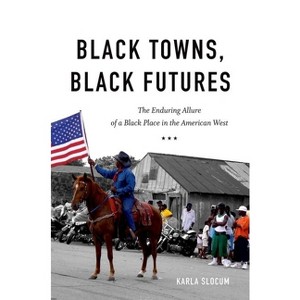
Black Towns, Black Futures - by Karla Slocum Paperback
In Stock
Sponsored
About this item
Highlights
- Some know Oklahoma's Black towns as historic communities that thrived during the Jim Crow era--this is only part of the story.
- About the Author: Karla Slocum is the Thomas Willis Lambeth Distinguished Chair in Public Policy and professor of anthropology at the University of North Carolina at Chapel Hill.
- 192 Pages
- History, African American
Description
About the Book
"Beginning at the end of the Civil War and continuing for nearly fifty years, Oklahoma saw the settlement of over fifty unique towns with a common thread; in each of these towns, nearly every citizen was African American. Black town founders and residents, who were anxious to escape the racially hostile Deep South, built schools, banks, and churches, creating their own places of success and security. In this ethnographic study, Karla Slocum reveals the lasting importance of these all-black towns to Black Americans. Once considered icons of Black American economic and social achievement, these towns have been studied by historians, but here Slocum examines the present-day fascination they produce. Many of these towns still exist, though their populations have dwindled, and continue to hold an appeal for Black Americans seeking a safe and affirming residential space"--
Book Synopsis
Some know Oklahoma's Black towns as historic communities that thrived during the Jim Crow era--this is only part of the story. In this book, Karla Slocum shows that the appeal of these towns is more than their past. Drawing on interviews and observations of town life spanning several years, Slocum reveals that people from diverse backgrounds are still attracted to the communities because of the towns' remarkable history as well as their racial identity and rurality. But that attraction cuts both ways. Tourists visit to see living examples of Black success in America, while informal predatory lenders flock to exploit the rural Black economies. In Black towns, there are developers, return migrants, rodeo spectators, and gentrifiers, too. Giving us a complex window into Black town and rural life, Slocum ultimately makes the case that these communities are places for affirming, building, and dreaming of Black community success even as they contend with the sometimes marginality of Black and rural America.
Review Quotes
"A compelling and fascinating exploration of how space, place, and race converge in rural America."--Journal of Southern History
"An impressive effort to theorize what Slocum calls the 'appeal' of Black towns in the United States, not historically, but in contemporary social life. . . . Black Towns, Black Futures is necessary now, for the glimpse it provides into the vision and attraction of Black spaces and Black places, at a time when safety and survival seem increasingly precarious."--Anthropological Quarterly
"In a succinctly written text, Karla Slocum explores the Black towns that thrived in Oklahoma during the Jim Crow years. Her analysis however, does not stop there. Utilizing interviews and observations, Slocum explores the enduring attraction to these communities both in memory and in person. In doing so, she underscores the history of these towns as examples of African American self-determination, autonomy, and freedom in rural Oklahoma."--Western Historical Quarterly
"Incorporating interviews, reflections on participation in local events, personal narratives, and archival research across multiple towns, the work demonstrates that Black towns remain a source of pride in success, innovation, and community. . . . Recommended."--CHOICE
"Slocum builds on a fascinating multidisciplinary literature . . . This book should resonate well with students and scholars of multiple disciplines. Its ability to effectively link history to contemporary concerns is reminiscent of the superb anthropological works on southern life in the 1930s."--Journal of African American History
"Though neither a history of Black towns nor an architectural study of Black town buildings and spaces, Black Towns, Black Futures makes a critical contribution for scholars of the built environment of the southern United States and the Americas at large by showing that the complex reality of twenty-first century Black towns is constructed upon centuries of sedimented racial violence, displacement, and resistance."--Arris
About the Author
Karla Slocum is the Thomas Willis Lambeth Distinguished Chair in Public Policy and professor of anthropology at the University of North Carolina at Chapel Hill. She is also director of the Institute of African American Research.
Shipping details
Return details
Trending Non-Fiction





Discover more options