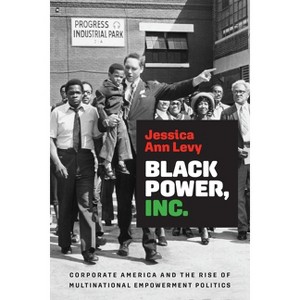
Traces the rise of Black empowerment politics in the United States and Africa On a cold January day in 1964, civil rights minister turned entrepreneur Rev. Leon Howard Sullivan declared to a group of supporters gathered to witness the launch of Sullivan's latest venture, Opportunities Industrialization Centers, Inc., "The day has come when we must do more than protest--we must now also PREPARE and PRODUCE!
About the Author: Jessica Levy is Assistant Professor of History at Purchase College, State University of New York.
360 Pages
History, African American
Series Name: Politics and Culture in Modern America
Description
Book Synopsis
Traces the rise of Black empowerment politics in the United States and Africa
On a cold January day in 1964, civil rights minister turned entrepreneur Rev. Leon Howard Sullivan declared to a group of supporters gathered to witness the launch of Sullivan's latest venture, Opportunities Industrialization Centers, Inc., "The day has come when we must do more than protest--we must now also PREPARE and PRODUCE!" Occasionally linked with the movement for Black Power, Sullivan and others, including Coca-Cola vice president Carl Ware and Atlanta mayor Andrew Young, were in fact architects of Black empowerment--an intellectual and political movement that championed private enterprise as the key to Black people's prosperity.
Jessica Ann Levy traces Black empowerment's rise in American politics--from early twentieth-century influences including Booker T. Washington and Marcus Garvey to the cities of postwar America into corporate boardrooms and government offices--and across the Atlantic Ocean to Africa. Civil rights leaders, Black entrepreneurs, white corporate executives, and government officials all championed Black empowerment as a means to address multiple crises in US cities and to blunt some of the more radical aspects of the Black Power movement. Black empowerment politics likewise found application overseas in various Cold War efforts to promote American-style free enterprise in Africa. This was especially the case in South Africa, where US corporate executives and government officials wielded Black empowerment politics to oppose apartheid and divestment.
By the early twenty-first century, the idea that private enterprise, including small-scale entrepreneurs and large multinational corporations, should play a leading role in combating racial inequality and empowering Black and other marginalized people featured prominently in various policies and programs at the local, national, and international level. By tracing Black empowerment politics' evolution, Black Power, Inc. explains its popularity, championed by leaders from Bill Clinton to Nelson Mandela, while also revealing its role in expanding US corporate power, locally and globally.
Review Quotes
"Black Power Inc. tells, for the first time, the history of corporate America's efforts to co-opt, contain, and change the trajectory of Black radical politics--and the Black activists, entrepreneurs, and opportunists who helped them along the way. Levy brilliantly tracks the turn in black politics from 'Black power' to 'Black empowerment' and shows how it both exemplified and influenced the broader neoliberal turn in American politics since the 1960s. An essential book for understanding the politics of race and persistence of racial inequality in our time."-- "Andrew Kahrl, author of The Black Tax: 150 Years of Theft, Exploitation, and Dispossession in America"
"Jessica Levy's outstanding Black Power, Inc. richly explores transnational campaigns by African American and Black South African entrepreneurs to challenge Jim Crow and apartheid racisms through capitalist means. Levy powerfully demonstrates how Black businessmen allied with US corporations and policymakers to advance Black 'empowerment' agendas for a transition away from apartheid while maintaining market dominance. Bridging Philadelphia and Johannesburg, Coca-Cola and the African National Congress, this book is exemplary transnational scholarship, with revelations and insights about the United States, South Africa, and the asymmetric ties that bind them."-- "Paul Kramer, author of The Blood of Government: Race, Empire, the United States, and the Philippines"
"Shattering our facile notions of Black Power as only a left-wing movement, Levy reveals that it had two ideological poles, the anti-imperialist politics of people like Stokely Carmichael and Angela Davis, and the pro-capitalist 'Black empowerment politics' of organizers like Rev. Leon Sullivan and the South African businessman Samuel Motsuenyane. Faced with this broad and ideologically diverse movement, U.S. state and corporate actors repressed the former and cultivated the latter. Using an impressive diversity of activist and corporate records, Black Power, Inc., shows us how this process took place in the United States and sub-Saharan Africa."-- "George Derek Musgrove, co-author of Chocolate City: A History of Race and Democracy in the Nation's Capital"
About the Author
Jessica Levy is Assistant Professor of History at Purchase College, State University of New York.
Dimensions (Overall): 9.0 Inches (H) x 6.0 Inches (W) x .94 Inches (D)
Weight: 1.4 Pounds
Suggested Age: 22 Years and Up
Number of Pages: 360
Genre: History
Sub-Genre: African American
Series Title: Politics and Culture in Modern America
Publisher: University of Pennsylvania Press
Format: Hardcover
Author: Jessica Ann Levy
Language: English
Street Date: January 13, 2026
TCIN: 1001833166
UPC: 9781512828573
Item Number (DPCI): 247-00-4835
Origin: Made in the USA or Imported
If the item details aren’t accurate or complete, we want to know about it.
Shipping details
Estimated ship dimensions: 0.94 inches length x 6 inches width x 9 inches height
Estimated ship weight: 1.4 pounds
We regret that this item cannot be shipped to PO Boxes.
This item cannot be shipped to the following locations: American Samoa (see also separate entry under AS), Guam (see also separate entry under GU), Northern Mariana Islands, Puerto Rico (see also separate entry under PR), United States Minor Outlying Islands, Virgin Islands, U.S., APO/FPO
Return details
This item can be returned to any Target store or Target.com.
This item must be returned within 90 days of the date it was purchased in store, shipped, delivered by a Shipt shopper, or made ready for pickup.