Sponsored
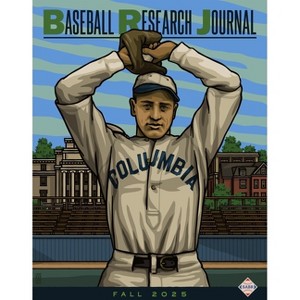
Baseball Research Journal (Brj), Volume 54 #2 - (Paperback)
Out of Stock
Sponsored
About this item
Highlights
- With this issue of the Baseball Research Journal, SABR welcomes new editor Elizabeth Roscher.
- 128 Pages
- Sports + Recreation, Baseball
Description
Book Synopsis
With this issue of the Baseball Research Journal, SABR welcomes new editor Elizabeth Roscher. The cover features an illustration of Lou Gehrig in his Columbia University baseball uniform by artist Gary Cieradkowski. Among this issue's featured articles:
Lou Gehrig's Three "Lost" Columbia Home Runs
Robert Muldoon
It only took a few months at Columbia for Lou Gehrig, 19-year-old hitting prodigy, to be compared to the greatest slugger in the game. One publication said Gehrig "lived up to his reputation as the Babe Ruth of Columbia." But his college baseball career didn't have such an auspicious start. In his first official college game on April 3, Gehrig was ejected. "NYU Wins Weird Encounter" read the Columbia Spectator headline as Columbia, using five pitchers, was trounced 12-4. Relieving in the eighth, Gehrig was tossed for protesting a pitch. Batting third, he had one hit in three tries.
The Disappearance of the Nippon Cup: Early Japanese Participation in Australian Baseball
Ray Nickson
After 1941, the Nippon Cup disappeared from the records. It is not mentioned in subsequent baseball reports by state associations, internet searches provide no details on its existence, and enquiries with the last club to win the Nippon Cup have gone unanswered. The Nippon Cup vanishes.The absence of the Nippon Cup in Australian baseball after 1941 reflects the limited recognition of the role Japanese players and the Japanese expatriate community played in Australian baseball in the first two decades of the twentieth century, history that was actively erased during and immediately after World War II. The major but forgotten element of that history is the Nippon Baseball Club, who played in Sydney from 1917 to 1919. Their players gave the NSW Baseball Association and its members the Nippon Cup as a gesture of the positive relations that existed between the Japanese residents and the wider baseball community.
The 1915 Army Baseball Team at West Point: Five Future Generals and an 18-3 Record
Stephen V. Rice
The United States Military Academy was established at West Point, New York, in 1802, and it has fielded a baseball team every year since 1890. The 1915 team, with an 18-3 record, was arguably the greatest in the school's history. This team is also remarkable because five of the nine starters went on to serve as Army generals during World War II. The most prominent of these was Omar Bradley, a left fielder with a rifle arm, who commanded US ground forces invading Germany and rose to the rank of five-star general.
Swifts, Slows, and Batteries: A Chronology of the 1868 Championship Season
David Rader
It may be helpful to think of the championship like it was an unsanctioned boxing title. The championship could change hands multiple times during a season, as it did in 1868. Any club was allowed to challenge the champion club, who then chose which challenges they accepted. Only the social norms of the era served as oversight. Championship matches were determined in a best-of-three series colloquially known as "home-
and-home" series, so named because each club hosted one of the first two matches (and took the gate receipts). A third match, if necessary, was to be held at a neutral ballfield. The championship could change clubs at any point during a season, with some home-and-home series even beginning late in one season and ending early in the next.
The End of the Spitball: Sloppy, Dirty, Disgusting...and Almost Impossible to Get Rid Of
Mike Lackey
Like the spitball itself, its last legal purveyors were long-running throwbacks to deadball days. Frank Shellenback was typical; he won nine games for the Chicago White Sox as a 19-year-old rookie in 1918. But when two of the Sox top pitchers returned from World War I service--Red Faber from the Navy and Lefty Williams from war-related work in a shipyard--Shellenback figured less prominently in the team's plans. Then, just as baseball was moving to ban the spitball, the White Sox decided they didn't need him. However, there might have been an element of spite in the decision. The pitcher recalled years later that as the deadline approached for finalizing the list of established spitballers who would be permitted to continue using the pitch in the major leagues, he was involved in "a little contract wrangle" with the White Sox. Demoted to the minor leagues, Shellenback was ineligible to be grandfathered.
Shipping details
Return details
Trending Non-Fiction



Discover more options