Sponsored
In Stock
Sponsored
About this item
Highlights
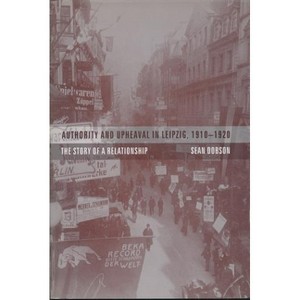
- In the fall of 1918, after it had become clear that the Great War was lost, revolution broke out in Germany.
- About the Author: Sean Dobson worked as a historian for the U.S. Holocaust Memorial Museum and taught at Portland State University before serving as adviser for communication and strategy in President Clinton's National Economic Council.
- 352 Pages
- History, Europe
Description
Book Synopsis
In the fall of 1918, after it had become clear that the Great War was lost, revolution broke out in Germany. In the area around Leipzig, workers supported the revolution with unusual determination, in many cases seeking to socialize their companies on their own authority.
In the first book to devote serious scholarly attention to Leipzig's turbulent transition from authoritarian monarchy to democratic republic, Sean Dobson offers a cogent history of political change in what was one of Germany's most industrialized and politically radical districts. During most of the post-WWII period, only Leninist historians--following the strict ideological guidelines dictated by the Socialist Unity Party of the German Democratic Republic--were permitted access to the relevant archives. With the fall of the Berlin Wall, Dobson gained unprecedented access to those archives. His study tells the real story of what happened in one of the revolution's storm centers and enriches the larger theoretical discussion of class and identity formation.
Because the turmoil in and around Leipzig is incomprehensible without an understanding of the region before 1914, Dobson details the antecedents of the revolution. In the process, he challenges common historiographical assumptions about prewar and wartime Germany.
Review Quotes
Authority and Upheaval in Leipzig is the most vivid account in English of German working-class radicalism in war and revolution and will be indispensable to scholars of the period. Because it synthesizes with remarkable clarity the historiography on Germany more generally, it is also highly suitable for undergraduate courses.--Andrew Donson "German History"
Dobon provides here a thorough account of the relations between workers and nonworkers in a major center of industrial activity... a fine first book.--Andrew Lees "Central European History"
Exploring the longer-term causes of the revolution, Professor Dobson challenges common historiographical assumptions about the desire for reform among the Wilhelmine elites and the extent of integration of the working class in the established sociopolitical order.-- "International Review of Social History"
Scholars interested in the history of workers...will want to read this book, and it would enliven many undergraduate courses as well--Elizabeth H. Tobin "Journal of Modern History"
About the Author
Sean Dobson worked as a historian for the U.S. Holocaust Memorial Museum and taught at Portland State University before serving as adviser for communication and strategy in President Clinton's National Economic Council. He is now helping to found Progressive Maryland, a nonprofit organization advancing a pro-working family agenda through grassroots action.
Shipping details
Return details
Frequently bought together





Trending Non-Fiction






Discover more options