Target New ArrivalsGift Ideas for MomClothing, Shoes & AccessoriesHome & DecorKitchen & DiningOutdoor Living & GardenGroceryHousehold EssentialsBabyBeautyPersonal CareHealthWellnessLuggageSports & OutdoorsToysElectronicsVideo GamesMovies, Music & BooksSchool & Office SuppliesParty SuppliesGift IdeasGift CardsPetsUlta Beauty at TargetShop by CommunityTarget OpticalDealsClearanceTarget New ArrivalsSpring OutfitsGift Ideas for MomWomen’s Festival OutfitsTop DealsTarget Circle DealsWeekly AdShop Order PickupShop Same Day DeliveryRegistryRedCardTarget CircleFind Stores
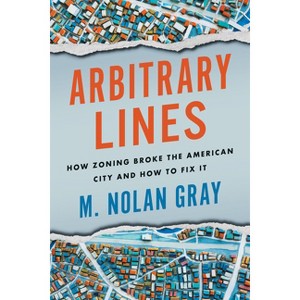
Arbitrary Lines - by  M Nolan Gray (Paperback) - 1 of 1

Arbitrary Lines - by M Nolan Gray (Paperback)

$25.99Save $4.01 (13% off)

In Stock

Free & easy returns

Free & easy returns

Return this item by mail or in store within 90 days for a full refund.
Eligible for registries and wish lists

About this item

Highlights

  • What if scrapping one flawed policy could bring US cities closer to addressing debilitating housing shortages, stunted growth and innovation, persistent racial and economic segregation, and car-dependent development?
  • About the Author: M. Nolan Gray is a professional city planner and an expert in urban land-use regulation.
  • 256 Pages
  • Architecture, Urban & Land Use Planning

Description


About the Book


It's time for America to move beyond zoning, argues city planner M. Nolan Gray in Arbitrary Lines: How Zoning Broke the American City and How to Fix It. With lively explanations, Gray shows why zoning abolition is a necessary--if not sufficient--condition for building more affordable, vibrant, equitable, and sustainable cities.

Gray lays the groundwork for this ambitious cause by clearing up common misconceptions about how American cities regulate growth and examining four contemporary critiques of zoning (its role in increasing housing costs, restricting growth in our most productive cities, institutionalizing racial and economic segregation, and mandating sprawl). He sets out some of the efforts currently underway to reform zoning and charts how land-use regulation might work in the post-zoning American city.

Arbitrary Lines is an invitation to rethink the rules that will continue to shape American life--where we may live or work, who we may encounter, how we may travel. If the task seems daunting, the good news is that we have nowhere to go but up.


Book Synopsis


What if scrapping one flawed policy could bring US cities closer to addressing debilitating housing shortages, stunted growth and innovation, persistent racial and economic segregation, and car-dependent development?

It's time for America to move beyond zoning, argues city planner M. Nolan Gray in Arbitrary Lines: How Zoning Broke the American City and How to Fix It. With lively explanations and stories, Gray shows why zoning abolition is a necessary--if not sufficient--condition for building more affordable, vibrant, equitable, and sustainable cities.

The arbitrary lines of zoning maps across the country have come to dictate where Americans may live and work, forcing cities into a pattern of growth that is segregated and sprawling.

The good news is that it doesn't have to be this way. Reform is in the air, with cities and states across the country critically reevaluating zoning. In cities as diverse as Minneapolis, Fayetteville, and Hartford, the key pillars of zoning are under fire, with apartment bans being scrapped, minimum lot sizes dropping, and off-street parking requirements disappearing altogether. Some American cities--including Houston, America's fourth-largest city--already make land-use planning work without zoning.

In Arbitrary Lines, Gray lays the groundwork for this ambitious cause by clearing up common confusions and myths about how American cities regulate growth and examining the major contemporary critiques of zoning. Gray sets out some of the efforts currently underway to reform zoning and charts how land-use regulation might work in the post-zoning American city.

Despite mounting interest, no single book has pulled these threads together for a popular audience. In Arbitrary Lines, Gray fills this gap by showing how zoning has failed to address even our most basic concerns about urban growth over the past century, and how we can think about a new way of planning a more affordable, prosperous, equitable, and sustainable American city.


Review Quotes


"Arbitrary Lines is a valuable contribution to the zoning literature and expands on ongoing debates and dialogues on zoning reform..... Gray's vibrant discussion of local examples, disputes, and misinterpretations about zoning makes it a wonderful read and leaves the reader with lingering thoughts on potential solutions."-- "Pennslyvania Geographer"

""Overall, Gray's book is an excellent addition to the literature on housing and land-use regulations.""---Adam Millsap, Forbes

"If you are interested in affordable housing, housing equity, environmental justice, reduction of carbon emissions, adequate public transit, or streets that are safe for walking and cycling, Arbitrary Lines is an excellent resource in understanding how American cities got the way they are and how they might be changed for the better."-- "Resilience"

"If I could get all members of my own city council to read one thing, it would be the chapters of Arbitrary Lines that convey vital messages about zoning's failures and the potential for its reform."-- "Journal of Urban Affairs"

"In Arbitrary Lines, Nolan Gray wrote a compelling argument for urgently reforming the 'stodgy rulebook' that distorts the shape and decreases the welfare of American cities. In addition to his devastating critique of the status quo, Nolan suggests a practical path that would allow urban communities to get out of their current zoning straightjacket. This book is a must-read for all of us who are interested in more innovative and affordable cities."---Alain Bertaud, senior fellow at the Marron Institute of Urban Management and former principal urban planner at the World Bank

"Nolan Gray's Arbitrary Lines could not have arrived at a better time, quenching the thirst of the American public's desire to know more about zoning. It is an accessible introductory text for anyone who wants to understand zoning enough to have informed conversations about its adverse impacts on racial equity, the environment, housing affordability, and economic growth. Undoubtedly, the book has further mainstreamed zoning not just in policy debates but also in casual conversations."-- "Housing and Society"

"The major purpose of Nolan Gray's new book, Arbitrary Lines, is to show that by limiting housing construction, zoning increases rents by limiting housing supply, accelerates suburban sprawl by reducing density and pricing Americans out of walkable areas, and slows economic growth by making it expensive for Americans to move to prosperous areas. On each count, Gray makes a persuasive (to me) case."-- "Planetizen"

"Excellent new book."---Matt Yglesias, Slow Boring

"In Arbitrary Lines, Gray provides a compelling case against the parochial zoning rules that have shaped Americans' lives, from our homes to our budgets to the work opportunities available to us. While the costs of zoning become clearer each year, few have questioned the paradigm of local policymakers determining the quantity and type of building that will be permitted on the private land in their jurisdictions. Gray steps in with a new way of thinking about urban land use and a road map for a future unconstrained by zoning."---Emily Hamilton, Senior Research Fellow and Director of the Urbanity Project at the Mercatus Center at George Mason University

"Nolan Gray has the insights of Jane Jacobs and the prose style of Mark Twain. In his aptly-titled new book, Arbitrary Lines, Gray argues that zoning in America is a disease masquerading as a cure. He also proposes a post-zoning style of planning for fair, sustainable, and livable cities."---Donald Shoup, Distinguished Research Professor, Department of Urban Planning, University of California, Los Angeles; author of "The High Cost of Free Parking"

"Arbitrary Lines is a comprehensive, well-grounded, and logically organized critique of the rigid and indeed arbitrary way in which Euclidean zoning structures our communities and shapes our lives. Elegantly written, concise, and witty, Gray's book is a useful introduction to zoning's history and current state...If you live outside the world of professional architects, landscape architects, urban designers, and planners and yet you wonder why our cities are built the way they are and if, further, you have time to read one book on the subject, Arbitrary Lines, with its engaging writing style, may well top your list."-- "Journal of the American Planning Association"

"Arbitrary Lines is at once a primer and a manifesto, a highly readable introduction to zoning's history and harms as well as a bracing call for a post-zoning city."-- "American Conservative"

"A provocation and a prescriptive treatise."-- "Common Edge"

"Powerfully argued book."-- "Orange County Register"

"A welcome manifesto for rethought urban spaces and their outliers, bringing social justice into the discussion."-- "Kirkus Reviews"


About the Author


M. Nolan Gray is a professional city planner and an expert in urban land-use regulation. He is currently completing a Ph.D. in urban planning at the University of California, Los Angeles. Gray previously worked on the front lines of zoning as a planner in New York City. He now serves as an Affiliated Scholar with the Mercatus Center at George Mason University, where he advises state and local policymakers on land-use policy. Gray is a contributor to Market Urbanism and a widely published author, with work appearing in outlets such as The Atlantic, Bloomberg Citylab, and The Guardian. He lives in Los Angeles, California and is originally from Lexington, Kentucky.

Dimensions (Overall): 8.99 Inches (H) x 6.06 Inches (W) x .62 Inches (D)
Weight: .73 Pounds
Suggested Age: 22 Years and Up
Number of Pages: 256
Genre: Architecture
Sub-Genre: Urban & Land Use Planning
Publisher: Island Press
Format: Paperback
Author: M Nolan Gray
Language: English
Street Date: June 21, 2022
TCIN: 1011121082
UPC: 9781642832549
Item Number (DPCI): 247-43-7385
Origin: Made in the USA or Imported
If the item details aren’t accurate or complete, we want to know about it.

Shipping details

Estimated ship dimensions: 0.62 inches length x 6.06 inches width x 8.99 inches height
Estimated ship weight: 0.73 pounds
We regret that this item cannot be shipped to PO Boxes.
This item cannot be shipped to the following locations: American Samoa (see also separate entry under AS), Guam (see also separate entry under GU), Northern Mariana Islands, Puerto Rico (see also separate entry under PR), United States Minor Outlying Islands, Virgin Islands, U.S., APO/FPO, Alaska, Hawaii

Return details

This item can be returned to any Target store or Target.com.
This item must be returned within 90 days of the date it was purchased in store, delivered to the guest, delivered by a Shipt shopper, or picked up by the guest.
See the return policy for complete information.

Q: What topics does this book explore?

submitted by AI Shopping Assistant - 3 days ago
  • A: The book explores zoning's impact on housing costs, urban growth, racial segregation, and presents alternative land-use ideas.

    submitted byAI Shopping Assistant - 3 days ago
    Ai generated

Q: Is there a focus on contemporary zoning reform efforts?

submitted by AI Shopping Assistant - 3 days ago
  • A: Yes, the book examines current movements to reform zoning in various American cities, highlighting significant changes underway.

    submitted byAI Shopping Assistant - 3 days ago
    Ai generated

Q: What type of writing style does the author use?

submitted by AI Shopping Assistant - 3 days ago
  • A: M. Nolan Gray employs a lively and engaging writing style that makes complex urban planning concepts more accessible to readers.

    submitted byAI Shopping Assistant - 3 days ago
    Ai generated

Q: Who is the author of this book?

submitted by AI Shopping Assistant - 3 days ago
  • A: The author is M. Nolan Gray, a professional city planner and expert in urban land-use regulation.

    submitted byAI Shopping Assistant - 3 days ago
    Ai generated

Q: What is the main argument of Arbitrary Lines?

submitted by AI Shopping Assistant - 3 days ago
  • A: The main argument is that abolishing zoning could lead to more affordable, equitable, and sustainable cities across the United States.

    submitted byAI Shopping Assistant - 3 days ago
    Ai generated

Additional product information and recommendations

Discover more options

Trending Art, Photography & Design Books

Get top deals, latest trends, and more.

Privacy policy