Sponsored
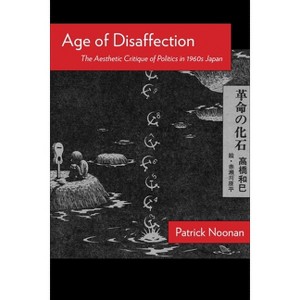
Age of Disaffection - by Patrick Noonan
In Stock
Sponsored
About this item
Highlights
- The 1960s in Japan have long been understood as a period of radical political engagement.
- About the Author: Patrick Noonan is assistant professor of Japanese literature and culture at Northwestern University.
- 288 Pages
- Social Science, Anthropology
Description
About the Book
Examining aesthetic criticism, popular literature, avant-garde art, cinema, and political theory, Patrick Noonan argues that cultural producers in 1960s Japan cultivated what he calls an "ethos of disaffection" toward revolutionary politics and postwar society.
Book Synopsis
The 1960s in Japan have long been understood as a period of radical political engagement. But as political movements from Old Left Communism to New Left revolts appeared to fail in their efforts to revolutionize Japanese society, artists and intellectuals came to reject the ideals of postwar politics. Instead, they advocated withdrawing from political participation and making self-transformation the grounds for social change.
This provocative book uncovers a paradox at the heart of the 1960s: how political disillusionment became the basis for a new form of politics--a politics of the self. Examining aesthetic criticism, popular literature, avant-garde art, cinema, and political theory, Patrick Noonan argues that cultural producers in 1960s Japan cultivated what he calls an "ethos of disaffection" toward revolutionary politics and postwar society. Departing from approaches that define politics as contestation, Age of Disaffection foregrounds cultivation, or the production of ways of feeling and relating to the world in efforts to redefine the political. It presents an unorthodox account of the 1960s: withdrawal from political activity developed not as the decade ended but as it was unfolding. Noonan reveals how Japanese artists and intellectuals in this period confronted a crucial question that continues to vex efforts at radical change today: transform institutions or alter how people relate to themselves and others?
Review Quotes
Building on a robust discourse on 1960s culture in Japan, Age of Disaffection offers a new way to understand the so-called 'nonpolitical' faction of Japanese youth culture. Noonan presents an argument for the social meaningfulness of political disengagement in the cultivation of autonomy--a clever balancing act and one very relevant to our current situation, with doomsday scenarios driving politics across the spectrum.--Steve Ridgely, University of Wisconsin-Madison
Age of Disaffection is a profound exploration of the politics and aesthetics of emotion. In this startlingly original book, Patrick Noonan analyzes the turn to subjectivity in the 1960s, drawing a line from political disenchantment to new strategies of self-stylization. This book offers new insights into the shared critical terrain of Terayama Shūji, Kuroi Senji, Yoshida Kijū, and Yoshimoto Takaaki. A dazzling work of scholarship with a remarkable ethical vision.--Diane Wei Lewis, author of Powers of the Real: Cinema, Gender, and Emotion in Interwar Japan
About the Author
Patrick Noonan is assistant professor of Japanese literature and culture at Northwestern University.
Shipping details
Return details
Frequently bought together



Trending Non-Fiction





Discover more options