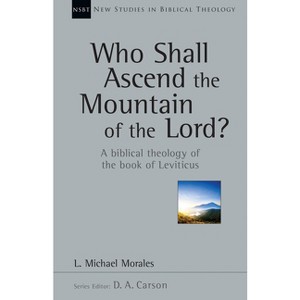
Reformation 21's End of Year Review of Books Preaching's Survey of Bibles and Bible Reference "Who shall ascend the mountain of the LORD?
About the Author: L. Michael Morales is Professor of Biblical Studies, Greenville Presbyterian Theological Seminary, Taylors, South Carolina.
349 Pages
Religion + Beliefs, Biblical Studies
Series Name: New Studies in Biblical Theology
Description
About the Book
How can creatures made from dust become members of God's household "forever"? In this New Studies in Biblical Theology volume, Michael Morales explores the narrative context, literary structure and theology of Leviticus, following its dramatic movement from the tabernacle to the temple--and from the earthly to the heavenly Mount Zion in the New Testament.
Book Synopsis
Reformation 21's End of Year Review of Books
Preaching's Survey of Bibles and Bible Reference
"Who shall ascend the mountain of the LORD?" - Psalm 24:3
In many ways, this is the fundamental question of Old Testament Israel's cult-and, indeed, of life itself. How can creatures made from dust become members of God's household "forever"?
The question of ascending God's mountain to his house was likely recited by pilgrims approaching the temple on Mount Zion during the annual festivals. This entrance liturgy runs as an undercurrent throughout the Pentateuch and is at the heart of its central book, Leviticus. Its dominating concern, as well as that of the rest of the Bible, is the way in which humanity may come to dwell with God. Israel's deepest hope was not merely a liturgical question, but a historical quest.
Under the Mosaic covenant, the way opened up by God was through the Levitical cult of the tabernacle and later temple, its priesthood and rituals. The advent of Christ would open up a new and living way into the house of God-indeed, that was the goal of his taking our humanity upon himself, his suffering, his resurrection and ascension.
In this stimulating volume in the New Studies in Biblical Theology, Michael Morales explores the narrative context, literary structure and theology of Leviticus through:
examining the tabernacle cult and the Day of Atonement,
tracking the development from Sinai's tabernacle to Zion's temple as well as from the earthly to the heavenly Mount Zion in the New Testament, and
showing how life with God in the house of God was the original goal of the creation of the cosmos, and became the goal of redemption and the new creation.
About the Series
Addressing key issues in biblical theology, the works comprising New Studies in Biblical Theology are creative attempts to help Christians better understand their Bibles. The NSBT series is edited by D. A. Carson and Benjamin L. Gladd, aiming to simultaneously instruct and to edify, to interact with current scholarship, and to point the way ahead.
Review Quotes
"A persuasive and perceptive exploration of Leviticus in its canonical setting which, in the final analysis, has potential to propagate engagement with this oft-neglected book. . . . Who Shall Ascend offers preachers a broad conceptual understanding of the book that will nicely complement standard commentaries."
"Leviticus is an oft-ignored book, shunted to the side in popular devotional reading and preaching largely because it appears to the book of arcane, pointless laws connected to the now-defunct sacrificial system. This is tragic because Leviticus is the heart of the first five books of the Bible and, in many ways, the heart of the story-line of the Bible. Morales aims to open up the dense, confusing text by placing it in the broader story of the Scripture. Drawing on many of the advances in our study of the Ancient Near East as well as our understanding of the narrative structure of Genesis, Exodus, and so forth, the sacrificial system of Leviticus stands as the answer to the question, 'Who shall ascend to the Mountain of the Lord?' . . . It's really a fantastic bit of biblical theology that's illuminating, not only for the way you read Leviticus, but Genesis, Exodus, and the whole story-line of Scripture."
"Michael Morales has written an excellent book, Who Shall Ascend the Mountain of the Lord? A Biblical Theology of Leviticus (IVP), that I hope will help people to better understand the purpose of Leviticus, and in particular the nature of true biblical worship. Highly recommended."
"Morales convincingly reads Leviticus as solving these problems through the Levitical approach to the house of God (Leviticus 1-10), cleansing of the house of God (11-16), and meeting with God (17-27). Levitical worship is obsolete today, but Morales demonstrates its significance to those entering God's presence through a better way."
"Morales's work models impeccable biblical scholarship while at the same time demonstrates the practical and ongoing relevance of the theology of the Pentateuch (and Leviticus in particular) for Christ-centered, biblically-grounded gospel preaching."
"Not only does Morales do an incredible job of broadly overviewing Leviticus and connecting the dots between the Testaments, but Morales' book helps me to want to read the Bible even more. And if a book can help fuel that desire, then it's worth reading. . . . There are a number of good volumes in the NSBT series, and this is one of the best."
"Some books give insight at multiple levels. This is one of them. Entirely in line with the goals of NSBT, Dr Laniak develops a biblical theology of 'shepherd' imagery throughout the Bible."
"There are a number of titles in this series that I have found extremely helpful. This is definitely one of those titles. . . . Why do I recommend it? Many Christians who try to read through the Bible stumble when they get to Leviticus because they don't understand what is going on. They then skip the book that is at the structural and theological heart of the Torah. . . . If you enjoy books that help you grasp the meaning of Scripture and provide numerous 'Aha!' moments, put this book on your reading list."
"There are many excellent books on Leviticus, which has been something of a cottage industry of late. Few studies, though, place Leviticus in so rich a biblical context, and few point so clearly to Christian uses of the book. Aspiring students of Leviticus would do well to begin here."
"Today it is not uncommon to discover that Christians consider OT books like Leviticus boring or worse, irrelevant. But this new book by Michael Morales demonstrates that Leviticus brings us face to face with the central question of our existence: How can creatures of dust become members of God's household forever? Join Morales as he walks you through the theology of Leviticus in order to answer this critical question."
About the Author
L. Michael Morales is Professor of Biblical Studies, Greenville Presbyterian Theological Seminary, Taylors, South Carolina. Previously he was Provost and Professor of Old Testament at Reformation Bible College, Sanford, Florida. He is the author of The Tabernacle Pre-Figured: Cosmic Mountain Ideology in Genesis and Exodus (Peeters).
Dimensions (Overall): 8.4 Inches (H) x 5.4 Inches (W) x 1.1 Inches (D)
Weight: 1.0 Pounds
Suggested Age: 22 Years and Up
Number of Pages: 349
Genre: Religion + Beliefs
Sub-Genre: Biblical Studies
Series Title: New Studies in Biblical Theology
Publisher: IVP Academic
Theme: Old Testament, General
Format: Paperback
Author: L Michael Morales
Language: English
Street Date: November 10, 2015
TCIN: 77796701
UPC: 9780830826384
Item Number (DPCI): 247-11-3315
Origin: Made in the USA or Imported
If the item details aren’t accurate or complete, we want to know about it.
Shipping details
Estimated ship dimensions: 1.1 inches length x 5.4 inches width x 8.4 inches height
Estimated ship weight: 1 pounds
We regret that this item cannot be shipped to PO Boxes.
This item cannot be shipped to the following locations: American Samoa (see also separate entry under AS), Guam (see also separate entry under GU), Northern Mariana Islands, Puerto Rico (see also separate entry under PR), United States Minor Outlying Islands, Virgin Islands, U.S., APO/FPO
Return details
This item can be returned to any Target store or Target.com.
This item must be returned within 90 days of the date it was purchased in store, shipped, delivered by a Shipt shopper, or made ready for pickup.