Sponsored
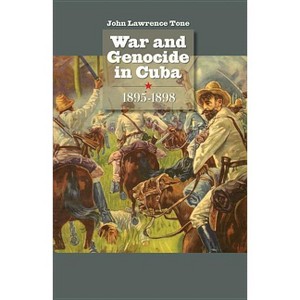
War and Genocide in Cuba, 1895-1898 - (Envisioning Cuba) by John Lawrence Tone (Paperback)
In Stock
Sponsored
About this item
Highlights
- From 1895 to 1898, Cuban insurgents fought to free their homeland from Spanish rule.
- Author(s): John Lawrence Tone
- 352 Pages
- History, Military
- Series Name: Envisioning Cuba
Description
About the Book
The Spanish-Cuban-American war proved pivotal in the histories of all three countries involved. Employing newly released evidence, including hospital records, intercepted Cuban letters, battle diaries from both sides, and Spanish administrative records, Tone offers new answers to old questions concerning the war. His analysis will provoke new discussions and debates among historians and human rights scholars as they reexamine the war in which the concentration camp was invented, Cuba was born, Spain lost its empire, and America gained an overseas empire.
Book Synopsis
From 1895 to 1898, Cuban insurgents fought to free their homeland from Spanish rule. Though often overshadowed by the "Splendid Little War" of the Americans in 1898, according to John Tone, the longer Spanish-Cuban conflict was in fact more remarkable, foreshadowing the wars of decolonization in the twentieth century.
Employing newly released evidence -- including hospital records, intercepted Cuban letters, battle diaries from both sides, and Spanish administrative records -- Tone offers new answers to old questions concerning the war. He examines the origin of Spain's genocidal policy of "reconcentration"; the causes of Spain's military difficulties; the condition, effectiveness, and popularity of the Cuban insurgency; the necessity of American intervention; and Spain's supposed foreknowledge of defeat.
The Spanish-Cuban-American war proved pivotal in the histories of all three countries involved. Tone's fresh analysis will provoke new discussions and debates among historians and human rights scholars as they reexamine the war in which the concentration camp was invented, Cuba was born, Spain lost its empire, and America gained an overseas empire.
Review Quotes
"A highly accessible, explicitly revisionist narrative. . . . Told with verve and pathos. . . . Engagingly written, humane and judicious in its appraisals of a complex and contested history. It deserves to be widely read and its implications debated." -- Cuban Review
"A nuanced perspective. . . . Tone writes well and his work will be accessible to experts and undergraduates alike. . . . A valuable addition to both Cuban and Spanish history and its publication is yet another indication of the high quality of scholarship that has emerged in recent years." -- American Historical Review
"Adds enormously to our understanding of the political, social and military dimensions of this war and is essential reading for anyone interested in the island's history, the early story of U.S. imperialism in the Caribbean, or Latin American military history." -- Caribbean Studies
"An engagingly written book that offers new insights into the war. . . .This thought provoking book should be on many bookshelves." -- The Past in Review
"An outstanding work. . . . Extremely well researched. . . . A fine study that will stimulate considerable scholarly debate." -- History
"Makes interesting reading and will stir academic debate and inspire further research." -- Register of the Kentucky Historical Society
"Masterful account . . . fascinating and captivating. . . . A must read . . . for anyone who is concerned with current global conflicts and the human rights of noncombatants. . . . Tone does an excellent job of presenting the viewpoint of both the Cubans and the Spanish fairly." -- H-Net
"Skillful research leads to revisions of past interpretations. . . . [A] comprehensive inquiry. . . . Deserves considerable attention." -- The Journal of Military History
"This pathbreaking military history sheds new light on Spanish America's last colonial war and the multitudes that died on its 'ever faithful isle.' . . . Entwines vivid retellings of military engagements with nuanced analyses of the varying motives and strategies of the war's leaders. . . . An engaging study with broad appeal for Cuban, Spanish, and U.S. historians." -- HAHR
"Tone's cogent and elegantly written book does not turn patriotic history on its head, but it does dismember the subject. . . . John Tone portrays Cuba as Spain's Vietnam, and his skill at narrating the frightening realities of these 'unconventional' guerilla wars makes it hard to avoid reflecting on tragic events in the world today." -- Times Literary Supplement
Shipping details
Return details
Frequently bought together


Guests also viewed
Discover more options