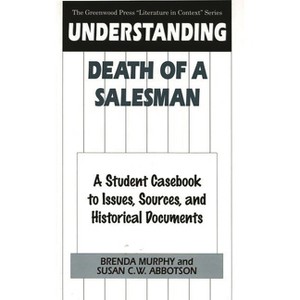
This collection of social, cultural, and historical documents and popular materials, with linking explanations and commentary, will help the reader to study the play in the context of its time and cultural background.
About the Author: BRENDA MURPHY has taught at Brown University, St. Lawrence University, and the University of Connecticut, where she is currently Professor of English.
248 Pages
Study Guides, Book Notes
Series Name: Greenwood Press Literature in Context
Description
About the Book
This collection of social, cultural, and historical documents and popular materials, with linking explanations and commentary, will help the reader to study the play in the context of its time and cultural background. The collected materials are designed to work with the play to highlight inherent conflicts within American society which lie at the heart of Death of a Salesman, and to explore how the play affects and is affected by social mores and beliefs. Salesmanship and the changing face of business, along with perceptions of sports, gender, and families, are explored through selections drawn from a rich variety of sources that help provide forceful evidence of the play's influence. Documents include essays, articles, and fiction, which have created or explored the social expectations of a typical American family in the late 1940s; unusual selections such as a self-analysis chart, an obituary, and a diary, which help to trace the history of salesmanship from the nineteenth century to the present day; and advertisements, song lyrics, speeches, how-to books, and other readings that promote an interdisciplinary study of the play.
More than 70 short primary documents illustrate the cultural, social and historical milieu of the time in which the play takes place. Topics explored under Cultural Myths and Values include the Protestant work ethic vs. myths of success, the myth of the golden West vs. urban myth, and the culture of youth vs. the culture of age. A chapter on economic forces provides materials on business vs. morality, humanity vs. technology, the haves and the have-nots, American business culture, the Depression, and how to be an effective salesman. A chapter on family and gender expectations includes documents on the roles of fathers and mothers, providers vs. cowboys or playboys, and homemakers vs. call girls. A chapter on sports and leisure features documents on amateur football and sports and American values. A final chapter examines the impact of Death of a Salesman on American culture. Each chapter is followed by study questions, topics for writing and discussion, and a list of suggested reading. This work is an ideal companion for interdisciplinary study of the play.
Book Synopsis
This collection of social, cultural, and historical documents and popular materials, with linking explanations and commentary, will help the reader to study the play in the context of its time and cultural background. The collected materials are designed to work with the play to highlight inherent conflicts within American society which lie at the heart of Death of a Salesman, and to explore how the play affects and is affected by social mores and beliefs. Salesmanship and the changing face of business, along with perceptions of sports, gender, and families, are explored through selections drawn from a rich variety of sources that help provide forceful evidence of the play's influence. Documents include essays, articles, and fiction, which have created or explored the social expectations of a typical American family in the late 1940s; unusual selections such as a self-analysis chart, an obituary, and a diary, which help to trace the history of salesmanship from the nineteenth century to the present day; and advertisements, song lyrics, speeches, how-to books, and other readings that promote an interdisciplinary study of the play.
More than 70 short primary documents illustrate the cultural, social and historical milieu of the time in which the play takes place. Topics explored under Cultural Myths and Values include the Protestant work ethic vs. myths of success, the myth of the golden West vs. urban myth, and the culture of youth vs. the culture of age. A chapter on economic forces provides materials on business vs. morality, humanity vs. technology, the haves and the have-nots, American business culture, the Depression, and how to be an effective salesman. A chapter on family and gender expectations includes documents on the roles of fathers and mothers, providers vs. cowboys or playboys, and homemakers vs. call girls. A chapter on sports and leisure features documents on amateur football and sports and American values. A final chapter examines the impact of Death of a Salesman on American culture. Each chapter is followed by study questions, topics for writing and discussion, and a list of suggested reading. This work is an ideal companion for interdisciplinary study of the play.
Review Quotes
.,."invaluable resources for new students of theatre, some of whom might well, in years to come, contribute to yet another reassessment of Miller and his work."-Modern Drama
"Murphy and Abbotson have pulled together an assortment of materials that would otherwise be hard to find and put them in an easy-to-use format. [T]his book will come in quite handy at report time."-School Library Journal
?...invaluable resources for new students of theatre, some of whom might well, in years to come, contribute to yet another reassessment of Miller and his work.?-Modern Drama
?Murphy and Abbotson have pulled together an assortment of materials that would otherwise be hard to find and put them in an easy-to-use format. [T]his book will come in quite handy at report time.?-School Library Journal
..."invaluable resources for new students of theatre, some of whom might well, in years to come, contribute to yet another reassessment of Miller and his work."-Modern Drama
About the Author
BRENDA MURPHY has taught at Brown University, St. Lawrence University, and the University of Connecticut, where she is currently Professor of English. She is the author of Miller: Death of a Salesman (1995), as well as a number of articles on Arthur Miller. She is also author of Tennessee Williams and Elia Kazan: A Collaboration in the Theatre (1992), A Realist in the American Theatre: Selected Drama Criticism of William Dean Howells (1992), American Realism and American Drama, 1880-1940 (1987), the Cambridge Companion to American Women Playwrights (forthcoming), and Congressional Theatre: Dramatizing McCarthyism on Stage, Film, and Television (forthcoming).
SUSAN C. W. ABBOTSON has taught English for fourteen years, first at the high school level, and more recently at the Rhode Island University. A recent Ph.D., she wrote her dissertation on Arthur Miller and August Wilson. She is also author of the drama section for Resources for Teaching: Literature and Its Writers (1997), The Student Companion to Arthur Miller (forthcoming), and a number of entries for the forthcoming Cambridge Guide for Children's Books.
Dimensions (Overall): 9.48 Inches (H) x 6.4 Inches (W) x .88 Inches (D)
Weight: 1.23 Pounds
Suggested Age: 22 Years and Up
Number of Pages: 248
Genre: Study Guides
Sub-Genre: Book Notes
Series Title: Greenwood Press Literature in Context
Publisher: Greenwood
Format: Hardcover
Author: Brenda Murphy & Susan C W Abbotson
Language: English
Street Date: February 28, 1999
TCIN: 1003033530
UPC: 9780313304026
Item Number (DPCI): 247-07-5220
Origin: Made in the USA or Imported
If the item details aren’t accurate or complete, we want to know about it.
Shipping details
Estimated ship dimensions: 0.88 inches length x 6.4 inches width x 9.48 inches height
Estimated ship weight: 1.23 pounds
We regret that this item cannot be shipped to PO Boxes.
This item cannot be shipped to the following locations: American Samoa (see also separate entry under AS), Guam (see also separate entry under GU), Northern Mariana Islands, Puerto Rico (see also separate entry under PR), United States Minor Outlying Islands, Virgin Islands, U.S., APO/FPO
Return details
This item can be returned to any Target store or Target.com.
This item must be returned within 90 days of the date it was purchased in store, shipped, delivered by a Shipt shopper, or made ready for pickup.