Sponsored
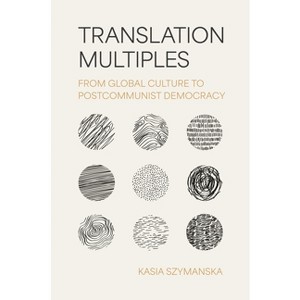
Translation Multiples - (Translation/Transnation) by Kasia Szymanska
In Stock
Sponsored
About this item
Highlights
- A new genre of writing demonstrating that translation is neither a transparent medium nor a secondary form of literature In Translation Multiples, Kasia Szymanska examines what happens when translators, poets, and artists expose the act of translation by placing parallel translation variants next to one another in a standalone work of art, presenting each as a legitimate version of the original.
- About the Author: Kasia Szymanska is lecturer in the Centre for Translation and Intercultural Studies at the University of Manchester.
- 248 Pages
- Literary Criticism, Comparative Literature
- Series Name: Translation/Transnation
Description
About the Book
"A new genre of writing that demonstrates that translation is neither a transparent medium nor a secondary form of literatureIn Translation Multiples, Kasia Szymanska examines what happens when translators, poets, and artists expose the act of translation by placing parallel translation variants next to one another in a standalone work of art, presenting each as a legitimate version of the original. Analyzing such "translation multiples" as a new genre of writing, Szymanska explores how an original text can diverge into variants, how such multiplicity can be displayed and embraced, and how the resulting work can still be read as a coherent text. To do so, she focuses on contemporary projects in two different contexts-Anglophone experimental practices and post-1989 Poland's emergence into democracy-while viewing them against the backdrop of twentieth-century cultural and political developments.Szymanska first takes a broad look at Anglophone global culture, debunking the myth of translation as a transparent medium and an unoriginal, secondary form of writing. She then turns to post-communist Poland, where projects introducing multiple translation variants with different ideological readings offered an essential platform for pluralist political discussion. She examines in particular an elaborate metatranslation of "La Marseillaise"; a triple rendering of Anthony Burgess's novel A Clockwork Orange; and a quadruple book of Bertolt Brecht's poetry with distinct readings by four translators. She argues that the creators of such multiples want to tell their own stories-personal, critical, visual, or political. Showing why multiple translations matter, Szymanska calls for a redefined practice of reading translations that follow the ethics of the multiple"--
Book Synopsis
A new genre of writing demonstrating that translation is neither a transparent medium nor a secondary form of literature
In Translation Multiples, Kasia Szymanska examines what happens when translators, poets, and artists expose the act of translation by placing parallel translation variants next to one another in a standalone work of art, presenting each as a legitimate version of the original. Analyzing such "translation multiples" as a new genre of writing, Szymanska explores how an original text can diverge into variants, how such multiplicity can be displayed and embraced, and how the resulting work can still be read as a coherent text. To do so, she focuses on contemporary projects in two different contexts--Anglophone experimental practices and post-1989 Poland's emergence into democracy--while viewing them against the backdrop of twentieth-century cultural and political developments.
Szymanska first takes a broad look at Anglophone global culture, debunking the myth of translation as a transparent medium and an unoriginal, secondary form of writing. She then turns to postcommunist Poland, where projects introducing multiple translation variants with different ideological readings offered an essential platform for pluralist political discussion. She examines in particular an elaborate metatranslation of "La Marseillaise"; a triple rendering of Anthony Burgess's novel A Clockwork Orange; and a quadruple book of Bertolt Brecht's poetry with distinct readings by four translators. She argues that the creators of such multiples want to tell their own stories--personal, critical, visual, or political. Showing why multiple translations matter, Szymanska calls for a redefined practice of reading translations that follows the ethics of the multiple.
Review Quotes
"A refreshing, contemporary approach to translation. . . . This book can be read as a scholarly study but also as an introduction to a particular line of avant-garde literary practice and, as such, it may be inspiring for both literary scholars and creative practitioners. In the field of translation studies, it will become required reading."---Magdalena Kay, Canadian Slavonic Papers
"A welcome reminder of the vitality of literature and literary studies in non-major languages."---Ina Schabert, Translation and Literature
"[A] celebratory, pluralist approach to translation."---Jess Jensen Mitchell, Hopscotch Translation
About the Author
Kasia Szymanska is lecturer in the Centre for Translation and Intercultural Studies at the University of Manchester.
Shipping details
Return details
Frequently bought together




Trending Paperback Books





Discover more options