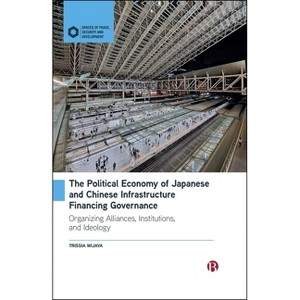
This book explores the political economy of Chinese and Japanese infrastructure financing in Indonesia, examining how Chinese and Japanese actors utilize diverse modes including Official Development Assistant, commercial loans, export credits, business-to-business investments, and public-private partnerships to ensure profitability and manage risks.
About the Author: Trissia Wijaya is a McKenzie Research Fellow, Asia Institute, University of Melbourne.
262 Pages
Political Science, World
Series Name: Spaces of Peace, Security and Development
Description
About the Book
This book explores the political economy of Chinese and Japanese infrastructure financing in Indonesia, examining how Chinese and Japanese actors utilize diverse modes to ensure profitability and manage risks.
Book Synopsis
This book explores the political economy of Chinese and Japanese infrastructure financing in Indonesia, examining how Chinese and Japanese actors utilize diverse modes including Official Development Assistant, commercial loans, export credits, business-to-business investments, and public-private partnerships to ensure profitability and manage risks.
Moving beyond traditional views of these financing modes as geoeconomic statecraft, the book exposes readers to a new perspective by situating infrastructure financing in the context of capitalist development. It reveals how contestation, conflicts, and compromise between socio-political forces including different segments of Japanese and Chinese capital, state actors, and civil society actors in Indonesia give shape to distinct modes of financing. Through detailed case studies and interviews across Japan, China and Indonesia, it uncovers the interplay between these forces and how their relations are sustained through regulatory complexes underpinning large-scale projects.
Review Quotes
'An ambitious, original, and insightful gem. Writing with theoretical rigor, historical complexity and analytical clarity, Wijaya explains the differences in regulatory politics involving Japanese and Chinese financing infrastructural projects in Indonesia. Her focus on the variations in transnational capitalist class interests, their conflicts and alliances with the host country's power elite effectively debunks facile assumptions about the national characters of foreign capital or the unitary interest of the nation states. A brilliant study of one of the most dynamic regions of the global south.' Ching Kwan Lee, University of California, Los Angeles and author of The Specter of Global China and Forever Hong Kong
'This book reveals how geostrategic ambitions collide with domestic politics, as large-scale infrastructure projects are planned, financed, and constructed - a must read that shows how geopolitical rivalry is reshaping our world.' Seth Schindler, University of Manchester
'This book makes a major contribution to our understanding of states and development. Articulating and successfully deploying the concept of "regulatory complexes," Trissia Wijaya takes us well beyond the important but routinized analyses of regulatory capture, providing a rich theoretical framework for analyzing the complex interactions between various actors involved in infrastructure financing. The book extends critical political economy perspectives, providing not only a compelling and detailed empirical analysis of the practices of Japanese and Chinese investors in Indonesia but a framework for thinking about states, transnational fractions of capital, finance, and development issues more generally. It will serve as an important reference for scholars working on these crucial issues.' Jim Glassman, University of British Columbia
'Scholars have recognized the significance of Asian donors in the 2000s, when many emerged as new players in international development. Today, we must shed new light on the role of Asian donors, such as China and Japan, as potential forces to supplement the United States' retreat from global affairs. This book serves as a valuable reference for navigating the increasingly uncertain landscape of infrastructure financing.' Jin Sato, University of Tokyo
'Innovative and thought-provoking, this book points to a new direction in studying the political economy of a changing Asia and its global implications.' Hong Liu, Nanyang Technological University
About the Author
Trissia Wijaya is a McKenzie Research Fellow, Asia Institute, University of Melbourne.
Dimensions (Overall): 9.21 Inches (H) x 6.14 Inches (W) x .63 Inches (D)
Weight: 1.2 Pounds
Suggested Age: 22 Years and Up
Number of Pages: 262
Genre: Political Science
Sub-Genre: World
Series Title: Spaces of Peace, Security and Development
Publisher: Bristol University Press
Theme: Asian
Format: Hardcover
Author: Trissia Wijaya
Language: English
Street Date: December 16, 2025
TCIN: 1002535872
UPC: 9781529250220
Item Number (DPCI): 247-49-8945
Origin: Made in the USA or Imported
If the item details aren’t accurate or complete, we want to know about it.
Shipping details
Estimated ship dimensions: 0.63 inches length x 6.14 inches width x 9.21 inches height
Estimated ship weight: 1.2 pounds
We regret that this item cannot be shipped to PO Boxes.
This item cannot be shipped to the following locations: American Samoa (see also separate entry under AS), Guam (see also separate entry under GU), Northern Mariana Islands, Puerto Rico (see also separate entry under PR), United States Minor Outlying Islands, Virgin Islands, U.S., APO/FPO
Return details
This item can be returned to any Target store or Target.com.
This item must be returned within 90 days of the date it was purchased in store, shipped, delivered by a Shipt shopper, or made ready for pickup.