Sponsored
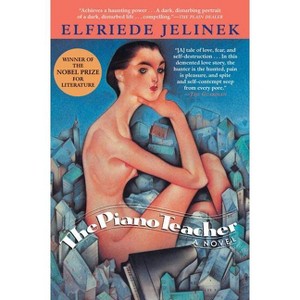
The Piano Teacher - by Elfriede Jelinek (Paperback)
In Stock
Sponsored
About this item
Highlights
- From the Nobel Prize-winning Austrian author: a "brilliant, uncompromising" novel that "gets behind the cream-puff prettiness of Vienna" (Publishers Weekly).
- About the Author: Elfriede Jelinek was born in Mürzzuschlag, Austria, in 1946, and grew up in Vienna, where she attended the Vienna Conservatory of Music.
- 288 Pages
- Fiction + Literature Genres, Literary
Description
About the Book
"Originally published in German as Die Klavierspielerin by Rowholt Verlag, Reinbek, [1983]"--T.p. verso.
Book Synopsis
From the Nobel Prize-winning Austrian author: a "brilliant, uncompromising" novel that "gets behind the cream-puff prettiness of Vienna" (Publishers Weekly).
In The Piano Teacher, Elfride Jelinek creates a shocking portrait of a talented, capable woman fashioned by society into a ticking bomb. Set in 1980s Vienna, it describes a culture rotting under the weight of its oppressive, outmoded ideals--a place mirrored by the heroine's own repressed dreams.
Erika Kohut, piano teacher at the prestigious Vienna Conservatory, is a quiet woman devoted to Bach, Beethoven, and her domineering mother. Her life consists of desperate boredom, neurotic possessiveness, and hopeless dreams of a concert career whose hour has long passed. Enter Walter Klemmer--a handsome, arrogant man out to conquer Erika's affections. Suddenly the dangerous passions roiling under her subdued exterior explode in a release of sexual perversity and long-buried violence.
Awarded the Nobel and the Heinrich Boll Prize for her outstanding contribution to German letters, Elfriede Jelinek is one of the most original and controversial writers in Austria today.
The Piano Teacher was made into an acclaimed film by Michael Haneke in 2001.
Review Quotes
"The Piano Teacher is compelling fiction, ensnaring the reader with the intensity of the author's vision and the bitter irony she uses to present her view of the city. The prose is disarmingly colloquial, the work of a gifted translator who has carefully preserved the stylistic nuances of the original German and the black humor inherent in Erika's bizarre encounters. Passionately political." --Elaine Kendall, Los Angeles Times Book Review
"The language is simple yet full of imaginative, often darkly funny metaphors; the view of the world original." --Charlotte Innes, The New York Times
"Extraordinary linguistic zeal . . . [Jelinek's] musical flow of voices and countervoices in novels and plays . . . reveal the absurdity of society's clichés and their subjugating power." --Royal Swedish Academy of Sciences, Nobel Prize address, 2004
"With her facility for metaphor and stylish narrative, Austrian Jelinek bears comparison to Schmidt and Böll at their best. Hers is a powerful debut in English." --Paul E. Hutchinson, Library Journal
"While this story almost becomes a postfeminist, postmodern tempestuous romance, Jelinek skillfully uses both psychological description and social observations to portray her character and the world in which she lives." --Booklist
"Brilliant, uncompromising . . . Jelinek gets behind the cream-puff prettiness of Vienna; this novel is not for the weak of heart." --Publishers Weekly
"The Piano Teacher is a brilliant, bitter, wonderful portrait of mother and daughter, artist and lover. Jelinek's particular European imagination should be valued and enjoyed by American readers." --John Hawkes
"In my opinion, Elfriede Jelinek is one of the most stimulating, daring, and imaginative writers in present-day Austria. The Piano Teacher confronts the reader with a relentlessly vivid sexual struggle in which dependency and abject self-abasement are strategies to obtain a personal freedom. It's a dazzling performance that will make the blood run cold." --Walter Abish
"A brilliant, deadly book." --Elizabeth Young
"In this superbly intelligent, psychoanalytic tale Jelinek skillfully plays on the dualisms of repression and domination, repulsion and compulsion, through the exquisitely dark central relationship." --Leeds Guide
"Jelinek's fragmented style blurs reality and imagination, creating a harsh, expressionistic picture of sexuality." --Scotland on Sunday
"Her work tends to see power and aggression as the driving forces of relationships, in which men and parents subjugate women. But as an admirer of Bertold Brecht, she sometimes brings to her dramas a touch of vaudeville." --The Guardian
"Moves impressively across that psychic terrain which is born out of maternal fear, fear of the outside world and of the body and fear of the loss of control." --The Independent
About the Author
Elfriede Jelinek was born in Mürzzuschlag, Austria, in 1946, and grew up in Vienna, where she attended the Vienna Conservatory of Music. She is the author of five other novels, a collection of poetry, a number of pieces for radio and theater, and is the German translator of Thomas Pynchon, as well as a composer and organist. Ms. Jelinek lives in Vienna and Munich. In 1986 she was awarded the prestigious Heinrich Böll Prize. Most recently she has published Der Tod und das Mädchen I-V (2003), her "princess dramas." Elfriede Jelinek won the 2004 Nobel Prize in Literature.
Shipping details
Return details
Frequently bought together





Guests also viewed





Discover more options