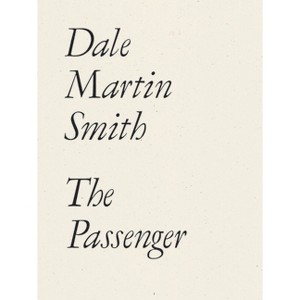
The Passenger - by Dale Martin Smith (Paperback)
Pre-order

Free & easy returns
About this item
Highlights
- In his latest collection, Toronto-based poet Dale Martin Smith invites us into a vivid lyric landscape, a looping personal voyage of reckoning and return.
- About the Author: Dale Martin Smith was born in Garland, Texas, in 1967, graduated from the University of Texas at Austin in 1990, and lived in the Republic of Yemen as a Peace Corps volunteer before moving to San Francisco to study poetry at the New College of California (MA, 1996).
- 112 Pages
- Poetry, American
Description
Book Synopsis
In his latest collection, Toronto-based poet Dale Martin Smith invites us into a vivid lyric landscape, a looping personal voyage of reckoning and return.
In a series of spare evocative poems, framed by two lyric essays, Smith presents a search for meaning in terms of memory, the self, and national narrative. The Passenger inhabits multiple iterations of selfhood across time, spanning over 30 years and starting with site-specific images of the author's experience as a Peace Corps volunteer in the Republic of Yemen in the early 1990s. The violence of US imperialism, the sacrifice of lives in the ongoing wars on terror, and the author's own lived encounters between cultures trace an echo of mnemonic layering. Smith subtly guides the experience of embodied but unsettled subjectivity, questioning the dominance of Western idealism and what it means to contend with national identity through recollection.
Review Quotes
"With a kind of clipped historical shorthand, the use of the fragment in The Size of Paradise becomes a supercharged lyrical force that is also sprung with time. The momentum of this capacious book-length sequence keeps turning outward as it investigates an inward subjectivity.... Smith has written a high-stakes recounting of time and experience expanding the world we live within and that lives within us."--Peter Gizzi"What is lyric's relation to history, to a public today? In this poetry--the impossible heart beating intensities through every human murmur and whisper that manages to lift itself up into song into solace. In this poetry, the deep neon glow of America visible from across fake nations' lines, pulsating broken geographies, rent histories, torn earth. Deep gratitude to Dale Smith for willing more beauty and more tenderness into the world."--Stephen Collis"[Smith's] poems are auto-biographical; personal, yet universal. They are permeated with history and geography; socially aware and impassioned. At the same time, they can be quiet, even tender. Dale weaves textures of culture and memory that explore and question the experience of being alive in a volatile world."--Kim Dorman"Not since Haniel Long's retelling of Cabeza de Vaca's poignant journal of his wanderings has an American writer so vividly and particularly located the mind and heart of those historic particulars. Here is initial America sans the hype, the heart-breaking first story."--Robert Creeley
About the Author
Dale Martin Smith was born in Garland, Texas, in 1967, graduated from the University of Texas at Austin in 1990, and lived in the Republic of Yemen as a Peace Corps volunteer before moving to San Francisco to study poetry at the New College of California (MA, 1996). Smith published Mike & Dale's Younger Poets in San Francisco and, with Hoa Nguyen, edited the little magazine and book imprint Skanky Possum from their home in Austin. To support the press, Smith worked a series of day jobs, wrote regularly for newspapers, and began teaching for a local community college before completing a doctorate in English at UT Austin in 2011. Smith maintained close ties with an intergenerational group of poets, published poetry, reviews, and essays in small press publications throughout North America, and with Nguyen facilitated a community of poets and artists, hosting readings and events for luminaries like Alice Notley, Anne Waldman, and Eileen Myles. He is the author of the poetry collections The Size of Paradise (knifeforkbook, 2024), longlisted for the 2025 Griffin Poetry Prize; Flying Red Horse (Talonbooks, 2021); Slow Poetry in America (Cuneiform Press, 2014); Susquehanna (Punch Press, 2008), Black Stone (effing press, 2007); and American Rambler (Thorp Springs, 2000). In 2011, he moved to Canada to teach at Toronto Metropolitan University. In addition to his poetry, Smith has drawn attention to twentieth and twenty-first century poets through critical and editorial contributions in Poets Beyond the Barricade: Rhetoric, Citizenship, and Dissent after 1960 (University of Alabama Press, 2012) and three edited editions: That Tongue Be Time: Norma Cole and a Continuous Making (University of New Mexico Press, 2025), An Open Map: The Correspondence of Robert Duncan and Charles Olson (University of New Mexico Press, 2017), and Imagining Persons: Robert Duncan's Lectures on Charles Olson (University of New Mexico Press, 2017). His essays and poetry have appeared in Poetry, The Walrus, Los Angeles Review of Books, Boston Review, and Jacket Magazine. He lives in Toronto, Ontario.
Shipping details
Return details
Q: What themes are explored in Dale Martin Smith's poetry?
A: The poetry explores themes of memory, selfhood, national identity, and the impacts of cultural experiences.
submitted byAI Shopping Assistant - 4 days agoAi generated
Q: What backgrounds does the author draw upon in his work?
A: The author draws upon his experiences as a Peace Corps volunteer and his reflections on US imperialism.
submitted byAI Shopping Assistant - 4 days agoAi generated
Q: How does the poetry relate to individual and collective experiences?
A: The poetry intertwines personal narratives with broader historical events, highlighting both individual subjectivity and national narratives.
submitted byAI Shopping Assistant - 4 days agoAi generated
Q: What literary styles are used in this collection?
A: The collection employs a combination of evocative lyricism, historical fragments, and introspective reflections.
submitted byAI Shopping Assistant - 4 days agoAi generated
Q: What is unique about the structure of the poems?
A: The poems are framed by two lyric essays, creating a narrative of personal reflection and historical context.
submitted byAI Shopping Assistant - 4 days agoAi generated
Additional product information and recommendations
Discover more options
Trending Poetry